


UVB Lighting for Pet Reptiles: Bulbs, Heat and Light Schedules


Good reptile lighting does more than brighten an enclosure: UVB helps reptiles produce vitamin D3, which supports calcium absorption. Getting UVB lighting for pet reptiles right means matching the bulb and fixture to the animal and habitat, then keeping the light on a steady schedule. A general schedule for reptiles and amphibians is 12 hours on and 12 hours off.
Choosing a bulb can feel complicated when heat, visible light, and UVB each play a different role. Plan them together, and make sure UVB reaches the habitat directly: glass and plastic filter UV wavelengths.
This guide explains why lighting matters, how UVB supports reptile health, and what to consider when selecting bulbs and fixtures. You’ll also learn why UVB output changes over time, when fluorescent bulbs need replacing, and how to coordinate daytime lighting with darkness at night. Whether you’re setting up your first terrarium or reviewing an established habitat, these basics can help you make thoughtful choices for reptiles and amphibians.
Key Takeaways
- Track fluorescent UVB bulb age: output diminishes over time, so plan replacement around 3,500 hours or 12 months.
- Choose a desert 10.0 bulb for a habitat only when its UVB needs suit the reptile; the strength label alone doesn’t determine the right setup.
- Plan heat and lighting as related but distinct parts of the enclosure, and choose fixtures that fit the habitat and bulb.
- Use a consistent daytime and nighttime routine to give reptiles and amphibians a predictable light cycle.
- Explore reptiles, amphibians, and reptile terrariums at Garden State Pet Center when you’re planning or updating a habitat.
UV bulb replacement
Fluorescent UVB output diminishes with use, even when a bulb still produces visible light. Track the installation date and operating hours to plan replacement.
Replacing UVB Bulbs
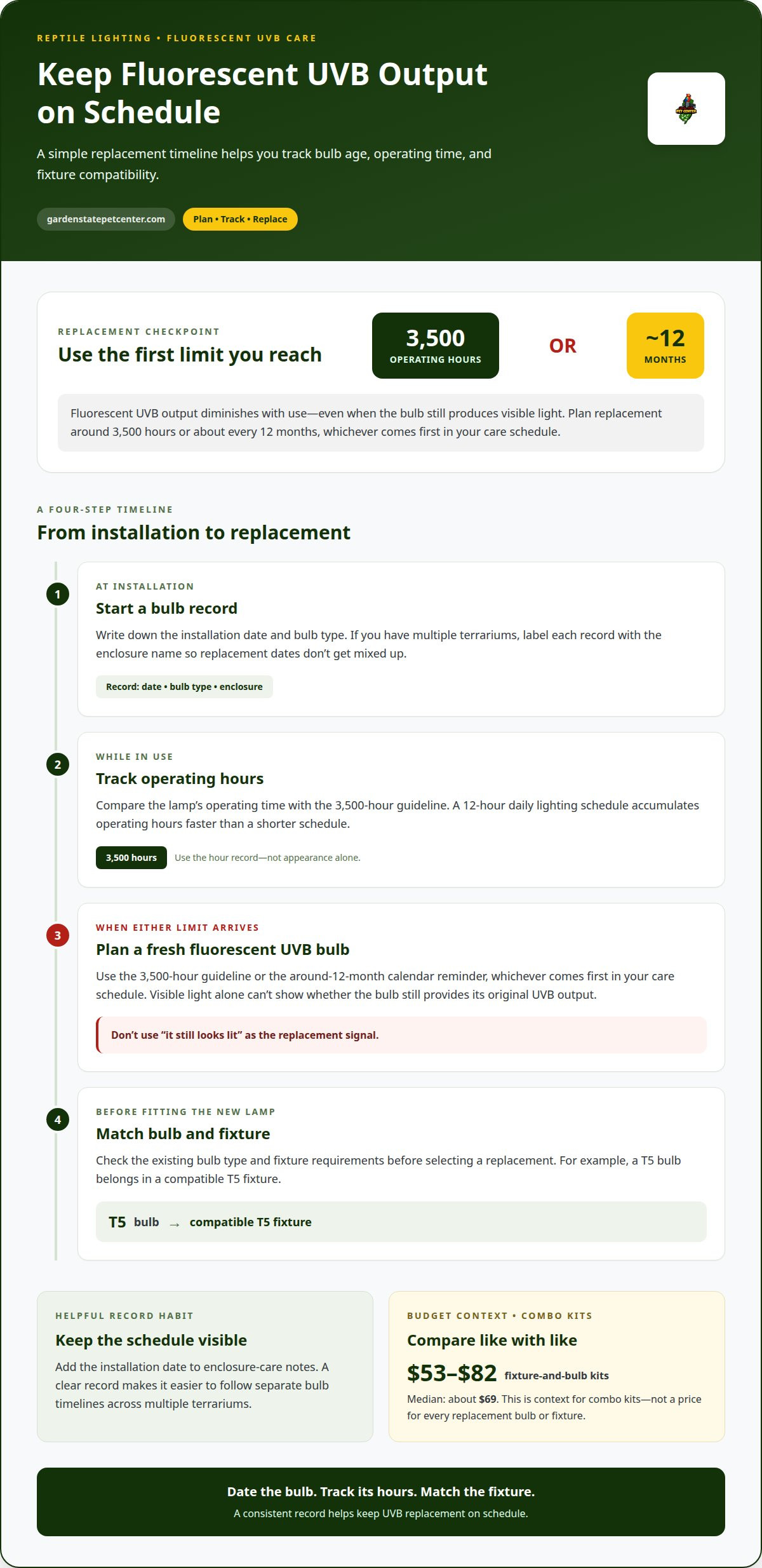
UVB bulb replacement means installing a fresh lamp when an older fluorescent bulb’s UV output has declined. It matters because visible light alone doesn’t show whether the bulb still provides its original UVB output. Use the 3,500-hour guideline or replace fluorescent UV bulbs around every 12 months, whichever comes first in your care schedule.
Start with a simple record when you fit a new bulb. Write down its installation date and track the hours it operates. A 12-hour daily lighting schedule, for example, accumulates operating hours faster than a shorter schedule. Using both records helps you avoid relying on appearance as a replacement signal.
Keep the new lamp compatible with the existing fixture. Before replacing it, note the bulb type and fixture requirements, then match those details when selecting a replacement. A T5 bulb, for example, belongs in a compatible T5 fixture. Replacing a lamp with a mismatched type can leave you with equipment that doesn’t fit together.
- Record the installation date for each fluorescent UVB bulb.
- Track operating hours against the 3,500-hour guideline.
- Use the around-12-month replacement point as a calendar reminder.
- Match the replacement bulb to its fixture.
Replacing a bulb doesn’t remove the need to keep a clear schedule. Record the installation date with your enclosure-care notes, especially if you have multiple terrariums with different bulbs. Label each record with the enclosure name to avoid mixing up replacement dates.
UVB Bulb Pricing
UVB bulb pricing varies with the product format, and a fixture-and-bulb kit is different from a replacement bulb alone. That distinction matters when estimating the cost of routine upkeep versus setting up new equipment. On the market, reptile UVB fixture-and-bulb combo kits typically range from $53 to $82, with a median of about $69.
Treat that range as context for combo kits, not as a price for every individual bulb or fixture. A replacement bulb and a complete kit contain different equipment, so compare like with like when budgeting. The kit range also doesn’t establish what a particular bulb should cost.
Include replacement bulbs in your enclosure budget rather than treating the initial purchase as your only lighting expense. A dated record helps you anticipate when you may need another lamp. Check the bulb’s compatibility details, too, so your next purchase suits both the timing and the fixture.
Daytime and nighttime lighting
A general lighting schedule for reptiles and amphibians keeps UVB on for 12 hours and off for 12 hours. A consistent cycle gives the enclosure a defined light period and a defined dark period. The exact start time can fit your household routine; the important step is keeping the daily pattern steady.
Choose a daytime schedule that’s easy to maintain, such as switching UVB on in the morning and off in the evening. A timer can repeat those times without relying on someone being home to operate a switch. Set it once and keep the enclosure’s daily rhythm predictable.
Think of the 12-hour schedule as a cycle, not simply a total number of hours. If the lamp turns on at 8 a.m., the corresponding 12-hour period ends at 8 p.m. That example shows how to plan a full interval; it isn’t a required clock time for every reptile. Align the lighting routine with the animal’s established care plan.
At night, switch off the UVB lamp for its full dark period. Leaving it on through the entire day and night would break the general 12-hours-on, 12-hours-off schedule. A brief written routine beside the enclosure can make the intended switch times clear to everyone caring for the animal.
- Choose a reliable daytime start and matching evening switch-off.
- Use a timer to repeat the same daily cycle.
- Keep the UVB off during the 12-hour nighttime period.
- Write down the schedule when more than one person cares for the reptile.
Keep UVB timing separate from nighttime heating. A light schedule sets when the UVB lamp operates, but doesn’t specify how to heat the enclosure. Turning off UVB at night creates darkness; heat planning remains a separate part of habitat setup.
That distinction is useful when an enclosure has several fixtures. Label each control by its purpose, such as “UVB,” so a caretaker doesn’t accidentally leave the wrong lamp running overnight. Then review the daily sequence: daytime UVB on, the planned 12-hour light period, and UVB off for the night. Consistency makes the routine easier to follow and helps prevent accidental changes during everyday care.
For a reptile or amphibian, start with the general 12-hour UVB cycle and make the switching times repeatable. Use a timer or a written schedule, keep the nighttime UVB period dark, and treat heat as a separate lighting decision. Those simple steps turn a broad schedule into a routine that’s clear for both the animal’s habitat and its caretakers.
Desert 10.0 UVB bulbs
No single bulb type is best for every reptile: T5 HO, T8, mercury vapor, and compact fluorescent options suit different setups. Choose by matching the reptile’s UVB needs to the habitat and a compatible fixture, rather than relying on “10.0” alone.
“Desert 10.0” is a product label, not a complete description of the UVB a reptile receives. The lamp type, fixture, placement, and the animal’s access to the illuminated area all affect the setup. A 10.0 label can help narrow a product category, but it doesn’t replace species-specific habitat planning.
Start with the reptile, not the number printed on the package. A desert-dwelling species and a forest-dwelling species may have different lighting needs, so a bulb label isn’t a universal recommendation. Consider the animal’s habits, the enclosure layout, and whether the lamp fits its fixture.
The main bulb types named here are T5 HO, T8, mercury vapor, and compact fluorescent. A T5 HO option is one format to consider when its fixture suits the enclosure. T8 and compact fluorescent bulbs are separate formats, while mercury vapor is another option. The available information doesn’t establish one type as best across all species or setups.
Check the bulb and fixture as a pair. For example, choosing a T5 HO bulb means selecting a fixture designed for that format. Don’t assume that a “10.0” label guarantees compatibility with every lamp holder or enclosure. Keep the reptile’s habitat needs central, then compare the actual bulb type and fixture requirements.
There are named products within these categories. The Arcadia Desert D3+ T5 HO is one example of a desert-labeled T5 HO bulb. Its name identifies the product and format, but the name alone doesn’t tell you whether it suits every desert reptile. Treat the animal’s needs and the enclosure design as separate decision points.
- Identify the reptile and its habitat needs.
- Compare T5 HO, T8, mercury vapor, and compact fluorescent formats.
- Match the selected bulb to a compatible fixture.
- Use “10.0” as a product label, not a complete setup recommendation.
For example, a desert 10.0 bulb isn’t automatically the right choice simply because an enclosure looks dry or brightly lit. The species and the enclosure’s arrangement matter more than appearance alone. Apply the same reasoning to a T5 HO, T8, mercury vapor, or compact fluorescent option. This keeps the decision grounded in the animal’s habitat rather than one label.
Use the bulb name, format, and fixture compatibility together when comparing choices. That gives you a more useful basis for selecting desert 10.0 UVB lighting than relying on the label by itself.
Lighting and heat fixtures
UVB, visible light, and heat fixtures serve related but distinct purposes in a reptile habitat. Match each fixture to its bulb, function, and position.
Lighting and Heat Fixture Roles
A lighting fixture holds and powers a lamp, while a heat fixture supplies warmth. An enclosure may need both. UVA light helps regulate behaviors such as feeding, diurnal movement, and mating. UVC isn’t required for reptiles, and high levels of exposure can harm most animals, so don’t treat ultraviolet wavelengths as interchangeable.
Start by identifying each lamp’s purpose, then match it to a compatible fixture. For uvb lighting for pet reptiles, choosing a fixture that fits the bulb format is part of planning the setup. A T5 fixture with a 10.0 bulb, for example, is listed as 22.7 inches long and rated at 14 watts. Those specifications describe that fixture, not every terrarium.
Fixture dimensions affect how equipment fits the enclosure. Arcadia Forest D3 T5 HO bulbs are available in 22-inch, 24-watt and 34-inch, 39-watt sizes. These examples show why enclosure length and lamp format need to be considered together. A fixture that doesn’t fit the habitat won’t provide the intended arrangement.
UVB Output and Basking Distance
UVB output describes the radiation a lamp emits; basking distance is the space between the lamp and the reptile. Both affect the exposure reaching the animal. A reptile closer to the UVB source receives different exposure from one farther away, so fixture placement matters as much as bulb selection.
Consider how the reptile reaches its basking area. A branch or platform that lets it move closer changes its distance from the lamp. With uvb lighting for pet reptiles, fixture position and habitat layout shape exposure, even when the bulb stays the same.
Don’t use wattage alone to judge UVB exposure. A fixture’s 14-watt rating describes electrical power, not a direct UVB reading at the basking spot. A bulb label also can’t show how distance and enclosure arrangement affect the light reaching the animal.
Assess the whole arrangement: bulb type, compatible fixture, basking location, and the reptile’s distance from the lamp. Moving a platform changes that distance without changing the bulb. Treat heat and UVB as separate fixture functions, and consider how each fits the habitat instead of assuming one lamp meets every need.
- Identify whether each fixture provides lighting or heat.
- Match the bulb format to its fixture.
- Consider basking distance and access when positioning UVB.
- Don’t confuse wattage with UVB output.
UVB lighting for reptiles and amphibians
UVB needs vary by animal and habitat, so no bulb label is a universal target. Aim to provide suitable exposure for the species, without assuming more UV is automatically better.
UVB Needs Across Reptile Species
Species-specific UVB needs reflect the exposure suited to an animal’s natural habits and habitat. A desert reptile and a forest-dwelling reptile shouldn’t automatically have identical setups. There’s no single amount that suits every common reptile species; assess the animal and its enclosure together.
For example, a basking reptile and a species that spends more time under cover use their habitats differently, affecting where they encounter light. Choose a setup around the animal’s behavior and access to illuminated areas, rather than relying only on a broad species category or package label.
UVB enables vitamin D3 synthesis, which helps reptiles absorb calcium. REPTI ZOO states that reptile UVB lighting supports vitamin D3 production for healthy skin and bones. That role explains why species-appropriate exposure matters, while still leaving room for different habitat designs and light access among reptiles and amphibians.
Risks of Too Little or Too Much UVB
Too little UVB can limit the process that supports vitamin D3 synthesis and calcium absorption. That makes inadequate exposure a concern for reptile health, not merely a lighting preference. The risk depends on whether the animal receives appropriate UVB through its habitat setup.
More exposure isn’t automatically safer or more beneficial. UVC isn’t required for reptiles, and high levels of UVC exposure can harm most animals. Keep the distinction clear: UVB has a role in vitamin D3 synthesis, while UVC is not a required reptile light.
Safe UVB Practices for Reptiles and People
Safe practice means providing suitable UVB while avoiding unnecessary UVC exposure. Glass and plastic filter UV wavelengths, and high UVC exposure can harm most animals. Position the UVB source so light reaches the habitat directly, without a glass or plastic barrier.
Keep the lamp’s purpose clear as you arrange the enclosure. A visible glow, for example, doesn’t prove UVB reaches the animal through a glass lid. Consider the habitat materials and the reptile’s access to the illuminated area together.
Use this short review when planning a habitat:
- Identify the reptile or amphibian and its habitat style.
- Choose UVB suited to that animal, not a label alone.
- Keep glass and plastic out of the UVB path.
- Exclude UVC, which reptiles don’t require.
For help planning a habitat around reptiles and amphibians, explore reptile habitat options with the animal’s species and enclosure in mind.
Garden State Pet Center: Reptiles and Amphibians
Garden State Pet Center offers reptiles and amphibians, along with reptile terrariums to help plan their habitats. When setting up an enclosure or reviewing its layout, consider the animal’s species, basking area, and lighting arrangement. Pet toys and accessories can help complete a habitat, while premium pet food supports everyday care.
Use these lighting principles to guide your choices, then consider how the terrarium and its contents work together. A suitable enclosure gives you a practical starting point for arranging a habitat around your reptile’s needs.
Contact Garden State Pet Center to discuss your reptile or amphibian habitat needs.
Build a Care Routine That Grows With Your Reptile
Make lighting part of a broader habitat-care routine. Keep a simple record of equipment changes and enclosure adjustments, so you can see what changed if you revisit the setup. As you learn more about your animal’s behavior, use your observations to guide habitat decisions rather than guessing.
A considered approach to UVB lighting for pet reptiles starts with the individual animal and its environment. Keep the habitat plan focused on the species, the enclosure, and how the reptile uses its space. If you’re planning a new setup or want another perspective on your reptile’s habitat needs, contact Garden State Pet Center to discuss your reptile.
Small, deliberate care decisions can make habitat planning more manageable. Keep learning about your animal, refine its environment thoughtfully, and take the next step when you’re ready.
Frequently Asked Questions
Why is Lighting Important for Your Reptile?
Lighting helps establish a day-and-night environment and supports behaviors tied to daylight. UVA light helps regulate feeding, diurnal movement, and mating, while UVB enables vitamin D3 synthesis that helps reptiles absorb calcium. These roles are distinct: a lamp’s visible brightness doesn’t show how much UVB reaches the animal. Plan lighting around the species and habitat, rather than treating every bulb as interchangeable.
Why do pet reptiles need UVB lighting?
UVB allows reptiles to synthesize vitamin D3, which helps them absorb calcium. That connection makes UVB a meaningful part of habitat planning, not simply a way to brighten the enclosure. For example, a brightly lit terrarium doesn’t necessarily provide suitable UVB. Consider the animal’s species, the bulb and fixture, and whether the enclosure materials block UV wavelengths before settling on a lighting arrangement.
How many hours per day should reptile UVB lights be on?
A general schedule for reptiles and amphibians is 12 hours of UVB light followed by 12 hours off. Keep the switch times consistent so the light cycle remains predictable. For example, if a caretaker needs to change the routine after a power interruption, resume the established schedule rather than leaving the lamp on overnight. This guidance applies to UVB lighting; heat sources have a separate role in the habitat.
How often should reptile UVB bulbs be replaced, and how can output be measured?
Fluorescent UV bulbs should be replaced every 3,500 hours or around 12 months because UV output diminishes over time. A UVB meter can assess output at the reptile’s accessible basking area; visible light alone doesn’t show UVB levels. Keep an installation date and operating-hours record, then use a measurement at the animal’s position to assess the setup rather than judging the bulb by appearance.
How should UVB lighting be set up with basking heat, shade, and a screen lid?
Plan UVB and basking heat as separate parts of the habitat, and consider where the reptile can bask or move into shade. Distance from the lamp affects exposure, so assess the animal’s position, not just the bulb. Glass and plastic filter UV wavelengths, so don’t place the UVB source behind either material. A screen lid is also part of the setup; assess UVB where the animal can access it.
How much do reptile UVB bulbs and fixtures cost in the United States?
On the U.S. market, reptile UVB fixture-and-bulb combo kits typically range from $53 to $82, with a median of about $69. This range describes combo kits, not a universal price for individual replacement bulbs or every fixture. Compare like with like when planning a purchase: a replacement lamp and a complete fixture-and-bulb setup are different equipment options.
Do reptiles need UVB lighting if they receive dietary vitamin D3 or live outdoors?
Dietary vitamin D3 or outdoor access doesn’t by itself establish that a reptile receives suitable UVB. UVB supports vitamin D3 synthesis, while the animal’s diet and habitat are separate considerations. Outdoor conditions and access to direct exposure vary, just as enclosure materials and basking positions do indoors. Base the lighting plan on the species’ needs and the UVB the animal actually receives, rather than assuming one factor replaces another.

Article by
Victor Santucci
Victor Santucci Jr. is the owner of Garden State Pet Center and a Certified Clinical Pet Nutritionist specializing in premium pet nutrition, raw and fresh feeding, holistic pet wellness, birds and exotic animals. Through years of hands-on retail and animal-care experience, Victor helps pet parents make informed decisions about nutrition, enrichment and species-appropriate care.
Share this post
- 0 comment
- Tags: amphibian care, lighting schedule, reptile bulbs, reptile care, reptile health, reptile heating, terrarium setup, UVB lighting, uvb lighting for pet reptiles