


How Does Mail-In Bird DNA Testing Work? A Guide for Bird Owners


A bird DNA test analyzes a submitted sample to determine whether a bird is male or female. Depending on the test provider, the sample may be a feather, blood spot, or another accepted type. The lab examines genetic markers, and sample condition can affect whether it can complete the analysis.
Test methods and sample requirements vary by provider, so check the instructions before collecting a sample. If a sample cannot be analyzed, the lab may report that it could not determine the bird’s sex. The outcome depends on the test and sample, so avoid assuming that every unsuccessful test produces the same result.
This guide explains how samples are collected and analyzed, how sample type can affect results, and what to consider when comparing test options, costs, and turnaround times. You’ll also learn what information to have ready when arranging professional testing for your bird.
Key Takeaways
- Choose a sample type the test accepts, and keep in mind that a fresh sample may be more useful than an older feather.
- Feathers, blood spots, eggshell membranes, and tissue can be used for bird DNA testing, but the right sample depends on the test.
- Bird sexing tests analyze genetic markers linked to sex chromosomes, rather than relying on a bird’s appearance.
- Compare test options by sample requirements, the type of result provided, cost, and turnaround time.
- Decide whether you need sex identification or disease screening, since they answer different questions.
Collecting feather, blood, or eggshell samples
Bird DNA samples may come from a feather, blood spot, or eggshell membrane. The appropriate collection method depends on the test and the bird’s circumstances.
Self-Collection and Professional Assistance
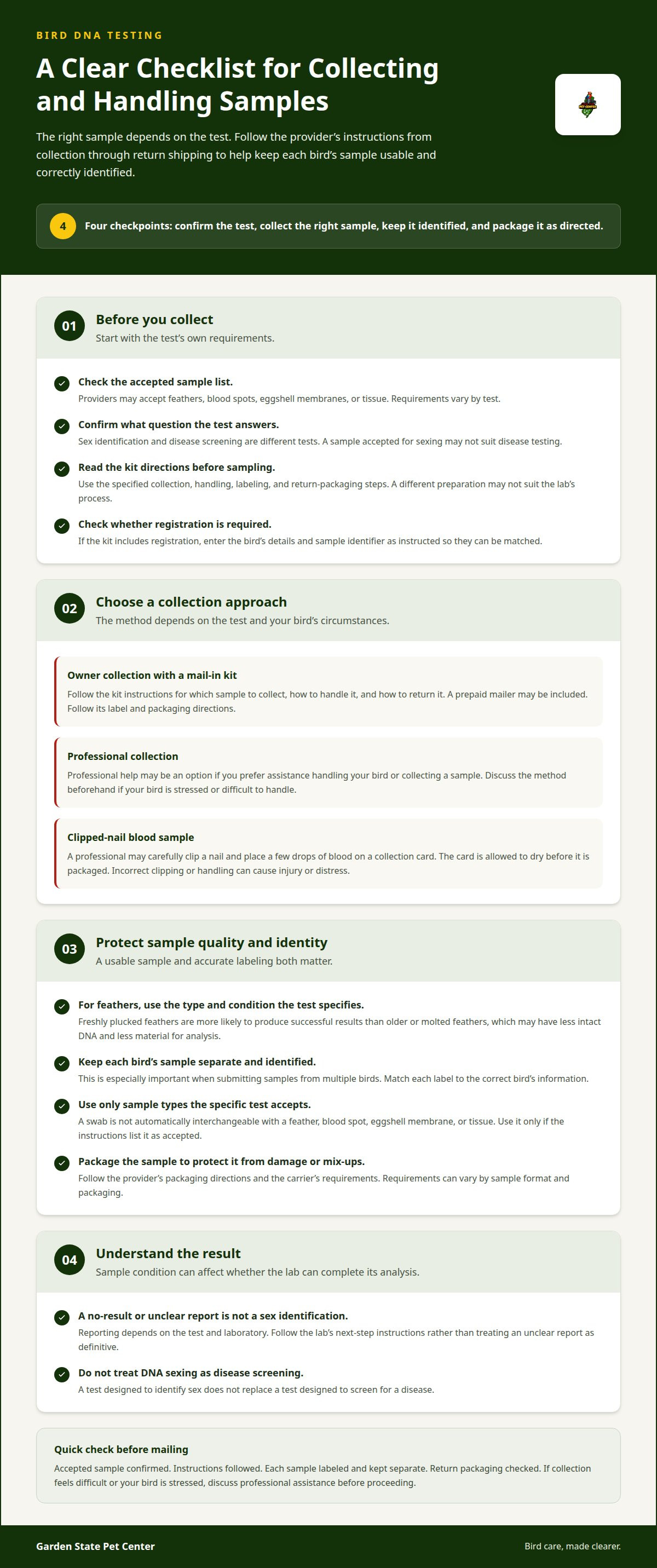
Some mail-in tests let owners collect a sample using a kit. Its instructions explain which sample to collect, how to handle it, and how to return it. A prepaid mailer may be included, but follow its label and packaging directions. Use the steps for that specific test, since a differently prepared sample may not suit its process.
Professional collection may be an option for owners who prefer help handling their bird or collecting a sample. On-site collection means a bird is brought to a location for sampling, rather than having the owner mail a sample from home. International service can involve different shipping arrangements, and a prepaid label may apply only to the route printed on it. For broader bird-care needs, explore bird supplies and care essentials.
Clipped-Nail Blood Sampling
A professional may collect blood by carefully clipping a bird’s nail and placing a few drops on a collection card. The card lets the sample dry before it is packaged for the lab. This requires careful handling: an owner unfamiliar with the process may struggle to collect a usable sample or keep the bird calm.
Professional assistance can help position the bird and collect the sample as intended. The collector also follows the test’s instructions for the blood card, labeling, and packaging. If the bird is stressed or difficult to handle, discuss the collection method before proceeding. The goal is to obtain a suitable sample without making collection rushed or unfamiliar.
Sample Packaging and Collection Risks
A provider safely collects and packages a sample by following the test’s collection instructions, keeping the sample identified, and protecting it from damage or mix-ups during return shipping. Keep each bird’s sample separate, especially when breeders are submitting samples from multiple birds.
Feather collection can go wrong if the wrong feathers are used or an older, molted feather is submitted. Older feathers may contain less intact DNA and less material for testing. Blood collection also requires care: clipping a nail incorrectly or handling a bird poorly can cause injury or distress. Professional assistance can help prevent handling mistakes and keep collection organized. For an eggshell membrane, follow the test’s specific collection and packaging instructions, since requirements vary.
Are results from feather and blood samples equally accurate?
Feathers, blood spots, eggshell membranes, and tissue can all provide DNA for bird sexing tests. Accuracy depends on whether the sample is accepted for the test and reaches the laboratory in usable condition.
For domestic U.S. mail, follow the test kit’s packaging and labeling instructions as well as the carrier’s requirements. Requirements can vary by sample format and packaging. Keep each bird’s sample identified and separate, and use the specified return packaging.
Some tests require registration before mailing. If the kit includes this step, enter the bird’s details and sample identifier as instructed. This links the arriving sample to the correct test request. Breeders submitting several samples should match each label to the right bird’s information to avoid processing mix-ups.
Samples for Sexing and Disease Testing
Accepted sample types for avian DNA sexing may include feathers, blood spots, eggshell membranes, and tissue. A swab is not automatically interchangeable with these options. Use one only if the specific test instructions identify it as an accepted sample. The laboratory’s requirements matter because tests can target different genetic markers or diseases.
Disease screening may require a different collection method from sex identification. Check the test’s specimen list before collecting a sample, including any species or sample-type requirements. A sample accepted for sexing is not necessarily suitable for disease testing. Registration details also help the laboratory match the sample to the requested test.
Sample Accuracy
Blood and feather samples can both support DNA sexing, but their condition affects the chance of a clear result. Freshly plucked feathers are more likely to produce successful results than older ones. Molted feathers may contain less intact DNA and less material for analysis, so freshness and proper collection matter.
For some DNA sexing tests, an unsuccessful analysis may be reported as no result or an unclear result rather than an incorrect sex determination. Reporting depends on the specific test and laboratory, so check the test provider’s guidance. An inconclusive report is not the same as a result identifying the bird’s sex.
Consider the bird’s species, the test’s accepted sample list, and how the sample was collected. If the report is unclear, follow the laboratory’s next-step instructions rather than treating it as definitive. For a disease concern, DNA sexing does not replace a test designed to screen for that disease.
How Does DNA Gender Determination Work in Birds?
For bird owners wondering how mail-in bird DNA testing works, the key step happens in the laboratory. The submitted sample is analyzed for genetic markers linked to the bird’s sex chromosomes. The result comes from DNA evidence, not visible traits such as color, size, or behavior.
Birds typically have a different sex chromosome system from mammals. Males are typically ZZ, while females are typically ZW. Differences between these chromosomes let a laboratory identify genetic sex, even when a bird’s appearance offers few clues.
Many bird DNA tests target variants of the CHD1 gene found on the Z and W chromosomes. The lab uses suitable primers to amplify those gene regions through PCR, or polymerase chain reaction. PCR makes selected DNA segments easier to detect, allowing the lab to examine whether the sample shows evidence of one chromosome type or both.
In a common workflow, amplified DNA is separated by gel electrophoresis. The gel sorts DNA fragments by size, creating visible bands for interpretation. A male bird typically produces one visible band, corresponding to the Z-linked marker. A female typically produces two, reflecting markers on both the Z and W chromosomes.
Controls help the laboratory interpret the test. A negative control can reveal contamination, while a positive control helps show that the procedure worked as intended. Suitable primers matter, too. If the sample does not produce a clear pattern, the lab may report no result or an unclear result instead of assigning a sex.
This process shows why a report reflects genetic evidence, not physical or behavioral traits. Color, size, calls, and nesting behavior vary across species and individual birds, so they cannot replace laboratory analysis of sex-linked DNA. The exact testing method can also depend on the species and sample submitted.
In practical terms, what happens after the sample arrives? A professional or laboratory prepares it for DNA analysis, uses PCR to examine relevant chromosome markers, and interprets the resulting pattern. The typical workflow includes sample collection, DNA extraction, amplification, gel electrophoresis, and interpretation of results.
DIY PCR workflows are listed as producing results within 3-5 hours, but that describes laboratory steps, not mailing or a complete mail-in service. External bird DNA sexing service results are listed as taking 3-7 days. The lab’s interpretation follows the sample’s arrival, so laboratory processing time is distinct from shipping time.
Comparing costs and turnaround times
Mail-in testing takes longer than the laboratory analysis alone because the sample must travel to the lab. External bird DNA sexing service results are listed as taking 3-7 days. Shipping adds time before processing begins and before results return.
Laboratory Turnaround and Results
The listed 3-7-day turnaround describes external service results, not necessarily the full mailing period. Ask what event starts the laboratory’s turnaround clock, such as sample receipt or registration. Then check how results are delivered, whether by email, online account, or another stated method.
Compare what each report includes. A sexing result answers a different question from disease screening, so match the test to your need. If a sample produces an unclear result, follow the lab’s next-step instructions. Do not treat laboratory processing time as a guaranteed delivery date.
Shipping Time for Mail-In Testing
For a mail-in test, account for the outbound trip, lab processing, and result delivery. A prepaid shipping label may simplify mailing, but it does not eliminate transit time. Shipping speed depends on the route, carrier service, dispatch timing, and whether the sample is accepted for processing when it arrives.
Follow the kit’s packaging instructions before sending feathers, blood, or an eggshell sample. If a package arrives without required registration details, the lab may need clarification before testing proceeds. For multiple samples, matching each identifier to the correct bird helps prevent processing delays.
Compare quoted turnaround periods carefully. One service may report lab processing time, while another describes the full process. Check whether the clock starts after registration, delivery, or sample acceptance. Different start points can make timelines look different even when tests use the same genetic method.
For a meaningful cost comparison, match the test details. Compare the same purpose, such as sex identification or disease screening, and the same number of birds. Check what the quoted amount covers, including the sample kit, return shipping, laboratory analysis, and report delivery. These details help distinguish comparable options without assuming every test includes the same items.
Sample method can affect how practical a test is. A feather test may suit an owner able to collect feathers as instructed, while another method may require a blood sample. An eggshell sample is an option only when the bird’s circumstances and test instructions allow it. Compare accepted samples before choosing, not after mailing.
Before arranging testing, note the service’s stated processing period, shipping method, registration steps, and result format. For example, a 3-7-day service-result estimate should not be read as the entire door-to-door timeline. Including outbound and return transit gives a more useful expectation for planning a breeder decision or household introduction.
Choosing a bird DNA sexing test
Choose a DNA test by matching its purpose, accepted sample, and bird species. A useful comparison also separates laboratory processing time from shipping time and explains how results are delivered.
Start with the decision the test needs to support. A sexing test identifies genetic sex; disease screening addresses a different question. Don’t choose a disease panel when you need sex identification, or treat a sexing report as a health assessment. For example, a breeder planning a pairing needs sex identification, while a bird owner concerned about a specific disease needs the corresponding screening test.
Check that the test covers your bird’s species and accepts the sample you plan to submit. A kit that accepts feathers may not accept a swab or eggshell membrane. The instructions should explain which sample to use and how to prepare it. If collection requires handling your bird, consider whether professional collection better suits the bird’s temperament and your comfort level.
Review the registration and labeling steps before arranging the test. Keep the sample identifier matched to the bird’s details throughout the process. If you submit samples for several birds, make sure each bird’s information stays with its own sample. This helps avoid confusion when results arrive, especially when birds look alike or share an enclosure.
Compare turnaround descriptions carefully. A period stated in business days may exclude weekends and shipping, while another estimate may cover a different stage. The external-service estimate discussed earlier refers to test results, not necessarily the full door-to-door period. Check whether the timeline begins at registration, sample receipt, or acceptance for processing.
Cost comparisons are useful only when the tests and included items match. Compare the same purpose, sample method, and number of birds. Check whether the listed amount includes collection materials, return shipping, laboratory analysis, and result delivery. A lower price may reflect a different package, so compare what each option covers rather than price alone.
Before choosing, use this checklist:
- Confirm the test covers your bird species and answers your question.
- Match the accepted sample type to your collection plan.
- Review registration, packaging, and result-delivery instructions.
- Compare the stated processing period with shipping and business days.
For guidance on bird care alongside your testing decision, explore bird-care resources and consider which questions you want answered before arranging a test.
Garden State Pet Center: Exotic Birds
Garden State Pet Center supports bird owners choosing an exotic bird and preparing for its everyday needs. Once a DNA test identifies a bird’s sex, owners may find the information useful when planning housing or considering a companion. The result is one part of care, alongside the bird’s individual needs and suitable environment.
Explore bird supplies and care essentials, including premium pet food, toys, and accessories. These categories can help you plan practical basics for a bird’s home and daily routine.
Contact Garden State Pet Center to discuss your bird-related needs.
Use the Result to Plan Your Bird’s Next Step
Before arranging a test, decide what you hope the result will help you plan. It may inform future breeding decisions or help you consider a bird’s place in your household. Understanding how mail-in bird DNA testing works can make the decision more deliberate, but the result is only one part of understanding an individual bird.
Consider how the information fits with your bird’s temperament, daily routine, and care needs. If you’re weighing a test or planning for an exotic bird, identify the questions that matter most to you. A focused conversation can help you choose a practical next step without treating a DNA result as the whole picture.
Talk with Garden State Pet Center about your bird-care questions and next steps. A thoughtful plan starts with what your bird needs.
Frequently Asked Questions
Does a DNA sexing result show whether a bird is ready to breed?
No. A sexing result identifies genetic sex, but it doesn’t assess reproductive maturity, condition, or suitability for breeding. Those are separate considerations. If you’re planning to breed birds, discuss their health and individual circumstances with an avian veterinarian. Use the DNA result as one piece of information, not as a complete breeding assessment.
Can a DNA test predict a bird’s personality?
No. A sexing test doesn’t describe an individual bird’s personality, preferences, or behavior. Birds of the same genetic sex can have different temperaments and responses to people. Observe your bird over time and consider its individual history when making care decisions. A DNA result answers a sex-identification question, but it cannot tell you what a particular bird will be like.
Should a sexing result change my bird’s daily care?
Not by itself. A DNA sex result doesn’t replace care decisions based on species, life stage, environment, and individual health. For example, don’t change a bird’s diet solely because a report identifies its sex. If you’re considering a change for a medical or reproductive reason, discuss it with an avian veterinarian who can assess your bird’s specific needs.
Does knowing two birds’ sexes mean they’ll be compatible?
No. Knowing the genetic sex of two birds doesn’t establish whether they’ll tolerate or bond with each other. Compatibility depends on each bird and how they respond during interactions. Plan introductions carefully, provide appropriate supervision, and observe their behavior rather than assuming a pairing will work based on sex alone.
Can a DNA sexing test assess reproductive health?
No. A sexing result doesn’t evaluate reproductive health or explain a medical concern. If you notice changes such as unusual behavior or other symptoms, contact an avian veterinarian for an assessment. Keep the result as background information, but don’t use it to diagnose a health problem or decide on treatment.
Should I keep the test report with my bird’s records?
Yes. Keep the report with the individual bird’s other records, such as its identification and care history. If you later discuss breeding plans or a health concern with an avian veterinarian, having relevant records together can make the conversation more organized. Don’t treat a report for one bird as documentation for another.
Can a sexing test tell me whether my bird is laying eggs because of a health problem?
No. A sexing test identifies genetic sex, but it doesn’t determine why a bird is laying eggs or assess its reproductive health. If egg laying raises a health concern, seek guidance from an avian veterinarian. The result may provide background about sex, but it cannot explain the cause or guide treatment on its own.
Should a DNA result be the only factor in a breeding decision?
No. Genetic sex is only one consideration, and it doesn’t establish whether a bird is healthy or suitable for breeding. Consider each bird’s condition and circumstances, and consult an avian veterinarian about health questions. A sexing result can inform a decision, but it shouldn’t replace a broader assessment of the birds.

Article by
Victor Santucci
Victor Santucci Jr. is the owner of Garden State Pet Center and a Certified Clinical Pet Nutritionist specializing in premium pet nutrition, raw and fresh feeding, holistic pet wellness, birds and exotic animals. Through years of hands-on retail and animal-care experience, Victor helps pet parents make informed decisions about nutrition, enrichment and species-appropriate care.
Share this post
- 0 comment
- Tags: avian care, bird care, bird DNA testing, bird health, bird sexing, feather samples, how does mail-in bird DNA testing work, pet birds