

The Essential Guide to Professional Bird Grooming: Health, Safety, and Expert Care


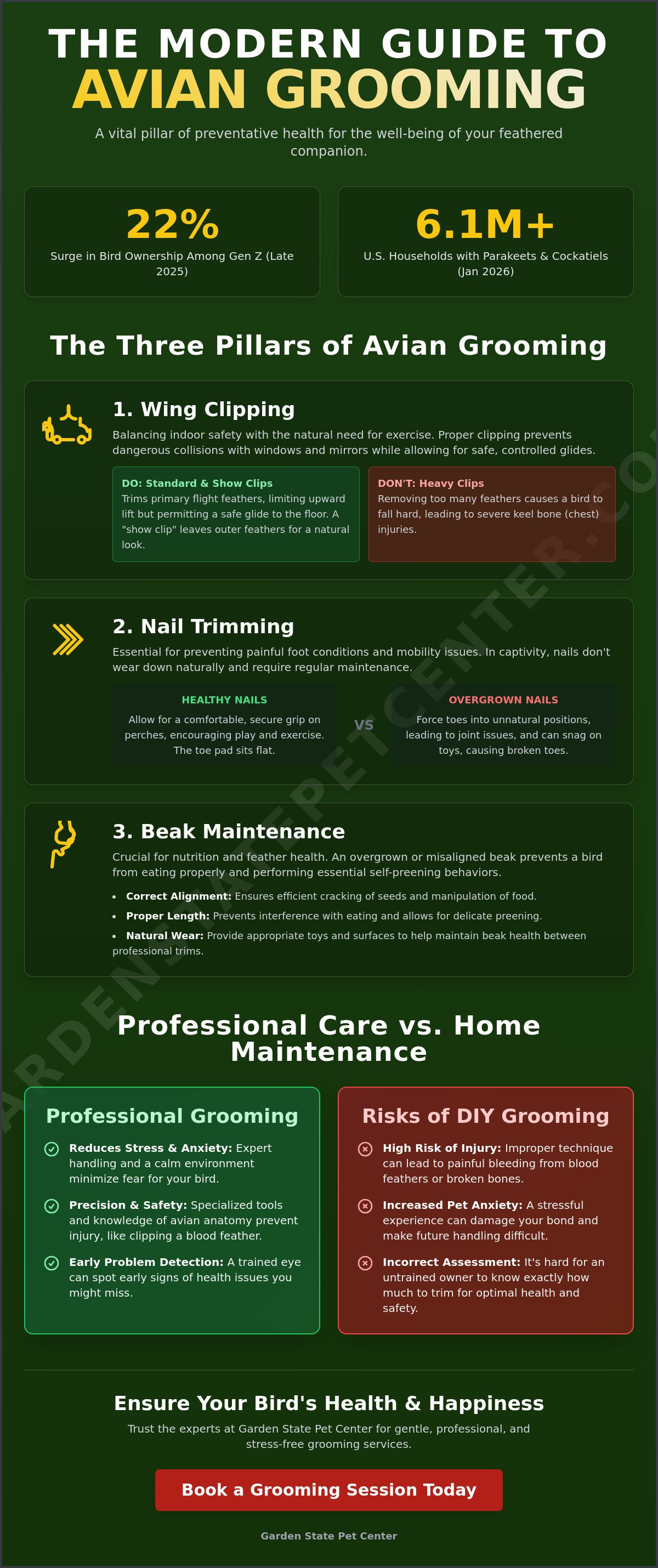
Did you know that bird ownership among Gen Z surged by 22% in late 2025? With parakeets and cockatiels now living in over 6.1 million American households according to data from January 2026, the demand for specialized care has never been higher. You want the best for your feathered friend, but the thought of accidentally clipping a blood feather or causing your pet unnecessary anxiety is enough to make any owner feel hesitant. It's a common concern, especially when you aren't sure exactly how much to trim to keep them comfortable and mobile.
Discover why professional bird grooming is a vital pillar of avian health and learn how to manage wing, nail, and beak maintenance safely. As your trusted partner in specialty care, we'll guide you through the latest USDA welfare standards and 2026 pricing trends. This guide provides an expert look at reducing stress during sessions and identifying the early signs of overgrowth to ensure your bird thrives for years to come.
Key Takeaways
- Learn how professional Bird Grooming serves as a vital preventative health measure to protect your pet from long-term mobility and feeding issues.
- Discover the specific techniques used to balance wing safety with your bird's natural need for exercise and enrichment.
- Compare the precision of expert tools with home kits to see why professional care significantly reduces stress for anxious birds.
- Understand how environmental factors like humidity and premium nutrition can improve feather health and simplify maintenance routines.
- Gain the confidence to identify exactly when your bird needs a trim by learning the subtle signs of nail and beak overgrowth.
Understanding the Holistic Role of Bird Grooming in Avian Health
Professional Bird Grooming is far more than a simple aesthetic touch-up. It's a specialized, multi-faceted health intervention that targets a bird's wings, nails, and beak to ensure long-term wellness. By viewing these services through a holistic lens, you transition from being a simple pet owner to a knowledgeable guardian who understands the intricate physical needs of avian species. This proactive approach prevents common health issues before they start, keeping your companion active and comfortable.
Establishing a routine early in a bird's life is essential for success. Birds are highly sensitive creatures, so early socialization to grooming tools and handling is a top priority. When you introduce these practices with patience and care, you reduce the likelihood of future anxiety. Our expert team focuses on building this trust, ensuring that every session is as stress-free as possible for both you and your pet.
To better understand why these services are so vital for your pet's well-being, watch this helpful video:
The Biological Necessity of Regular Maintenance
Captive environments rarely provide the same abrasive surfaces found in a bird's natural habitat. In the wild, constant interaction with tree bark and rocky terrain naturally files down the keratin in a bird's nails and beak. Inside a home, these structures can grow unchecked. Overgrown nails quickly become a safety hazard, as they can snag on toys or perches and lead to broken toes. Similarly, beak maintenance is critical for nutrition. If a beak becomes too long or misaligned, it prevents the bird from performing natural preening behavior. This behavior is the foundation of feather health, and without it, a bird's plumage can quickly deteriorate.
Psychological Benefits of a Stress-Free Grooming Routine
The benefits of a regular routine extend deep into a bird's psychological state. Regular handling during grooming sessions helps to decrease territoriality and cage-related aggression. It teaches your bird that human interaction is safe and rewarding. A well-groomed bird also moves with more confidence. When nails are the correct length, perching feels secure, which encourages more frequent flight and play. You can find many of the premium supplies needed to support this healthy lifestyle at our center. By using positive reinforcement and expert techniques, we turn a potentially scary event into a bonding experience that strengthens the relationship between you and your feathered friend.
The Three Pillars of Avian Grooming: Wings, Nails, and Beaks
Effective Bird Grooming relies on three essential pillars: wing clipping, nail trimming, and beak maintenance. Each area requires a specific technical approach to ensure your bird remains safe, mobile, and healthy. While some owners view these tasks as optional, they are actually fundamental to preventing injuries and long-term physical ailments. Understanding the mechanics of these services allows you to make informed decisions for your pet's care.
Wing Clipping: Safety vs. Flight Capability
The decision to clip a bird's wings is often a balance between exercise needs and indoor safety. In a home environment, flight can lead to dangerous collisions with windows, mirrors, or mirrors. A standard clip involves trimming the primary flight feathers to limit upward lift while still allowing the bird to glide safely to the floor. Unlike the basic descriptions found in a typical Veterinary Manual on Bird Grooming, professionals often distinguish between a standard clip and a "show clip," which leaves the outermost feathers intact for a more natural appearance. It's vital to avoid "heavy" clips. If too many feathers are removed, the bird may lose all buoyancy and fall hard, which often leads to painful keel bone injuries.
Nail Trimming: Preventing Perching and Joint Issues
A bird's feet are its primary tools for interaction with the world. When nails become too long, they force the toes into an unnatural position, which can eventually lead to arthritis or bumblefoot. Blunt tips are essential; they prevent the bird from snagging its talons on fabric or cage bars. While specialized concrete or sand perches help with natural wear, they rarely replace the need for a professional trim. The "quick" is the living blood vessel and nerve that runs through the center of the nail, and avoiding it is the primary goal of every trimming session. If your bird seems uncomfortable on its perches, it might be time to browse our selection of ergonomic perches to support their foot health.
Beak Maintenance: Natural Wear and Corrective Care
A healthy beak is smooth, symmetrical, and properly aligned. In the wild, birds maintain their beaks through constant foraging and chewing. You can mimic this by providing cuttlebone and varied foraging toys. However, some birds develop "scaly" textures or abnormal overgrowth that requires expert filing. Diet plays a massive role here, as deficiencies often lead to brittle or soft beak tissue. You can read more about how Premium Pet Food provides the nutrients necessary for strong keratin growth. If you notice your bird struggling to crack seeds or see any visible deviation in the beak's tip, seek professional assistance immediately.
The "Blood Feather" Warning: Every owner must be aware of blood feathers. These are new, developing feathers that have a live blood supply. If a blood feather is accidentally cut during Bird Grooming, it won't clot on its own like a skin scratch. This is a medical emergency that requires immediate pressure and often a trip to a specialist. This risk is a primary reason why many owners choose the safety and precision of a professional groomer.
Professional Bird Grooming vs. Home Maintenance: A Safety Comparison
Choosing between professional Bird Grooming and home maintenance is a decision that impacts your pet's physical health and your long-term bond. While home kits are widely available, they often lack the precision of industrial tools. Professionals utilize high-torque Dremels and surgical-grade shears designed for specific avian anatomy. These tools allow for smooth, rounded edges on nails and beaks that standard clippers simply cannot produce. Beyond the equipment, a professional's clinical eye is trained to spot subtle health markers. During a session, an expert might notice feather discoloration or skin lesions that a typical owner might overlook, providing an early warning for potential wellness issues.
One of the most significant advantages of professional care is the preservation of your relationship with your bird. Birds are highly intelligent and remember stressful events. When you are the one performing the restraint, your bird may begin to associate your hands with fear or discomfort. By bringing your pet to a trusted facility, you remain the "safe haven" while the groomer handles the necessary but stressful work. This separation is vital for maintaining a trusting, affectionate household environment.
Managing the Anxious Bird During Grooming
Expert groomers specialize in techniques designed for "Anxious Pets." We utilize a specific towel restraint method that keeps the wings secure and prevents struggling while ensuring the chest remains free to expand. It's a delicate balance. Our team is trained to watch for immediate signs of respiratory distress, such as open-mouth breathing or rhythmic tail bobbing. If a bird shows excessive stress, we pause the session to allow for stabilization. This proactive monitoring is a standard part of the humane handling regulations implemented by the USDA in February 2024, ensuring every bird receives care that prioritizes its life and safety.
The Risks of DIY Grooming Errors
The dangers of DIY grooming are often underestimated. A single slip can lead to cutting a blood feather, which is a medical emergency. Unlike a minor skin scratch, a broken blood feather acts like an open tap for the bird's circulatory system. While you should always have styptic powder on hand for emergencies, stopping this type of bleeding often requires specialized knowledge and steady pressure. Other common home errors include over-trimming nails, which causes a bird to lose its balance and fall from high perches. In the worst cases, using improper pliers or files on a beak can cause painful fractures in the sensitive keratin. To ensure your bird has access to the safest environment and premium avian supplies, consulting with a professional is always the most reliable path.
Integrating Grooming into a Complete Avian Care Routine
Professional Bird Grooming works best when it's supported by a thoughtful daily routine at home. While our expert sessions provide the technical maintenance your bird needs, your environmental and nutritional choices determine the quality of the keratin we trim. Think of grooming as one piece of a larger puzzle. When you align their diet and habitat with their biological needs, you simplify the grooming process and enhance your bird's overall quality of life. Take advantage of this holistic approach to keep your feathered companion in peak condition between visits.
The Nutrition-Grooming Connection
The health of a bird's feathers, beak, and nails starts at the cellular level. Deficiencies in Biotin and Vitamin A are common culprits behind brittle plumage and abnormally thick, overgrown beaks. If a bird's diet lacks these essential nutrients, the keratin structures become difficult to maintain and more prone to painful splitting. Many owners don't realize that "seed-only" diets are often high in fat but low in the minerals required for healthy growth. These imbalanced diets can actually accelerate nail growth while making the "quick" more vascular and sensitive. To prevent these issues, discover the benefits of Parrot Food and Holistic Diets that provide the foundation for optimal feather conditioning and strength.
Bathing and Preening: The Bird’s Daily Job
Natural hygiene is a full-time occupation for most avian species. Birds possess a specialized uropygial gland, also known as the preen gland, which secretes oil they use to waterproof and align their feathers. To support this, you should encourage regular bathing through gentle misting, bird baths, or specialized shower perches. High environmental humidity is also vital; it prevents the skin from becoming itchy and ensures that new feathers emerge smoothly from their waxy sheaths. However, it's essential to monitor these behaviors closely. If you notice "over-preening" or patches of missing feathers, it may indicate underlying stress or a medical issue that requires professional intervention. Regular Bird Grooming sessions allow us to inspect these areas and help you distinguish between healthy maintenance and obsessive plucking.
Foraging is another natural way birds manage their own growth. By providing a variety of Bird Toys and Accessories, you encourage your pet to chew and shred, which naturally wears down the beak tip. This active engagement reduces the frequency of corrective filing and keeps the bird mentally stimulated. Visit our shop today to browse premium avian supplies that turn daily play into a vital part of your bird's health maintenance routine.
Choosing a Trusted Partner for Expert Bird Grooming Services
Finding a provider for Bird Grooming isn't just about finding someone with a pair of shears. It's about finding a partner who understands that every species has a unique temperament and physical requirement. Specialized bird shops offer a significantly safer environment than generalist pet retailers. This is because specialized staff focuses entirely on avian care, reducing the risk of cross-contamination from other animal types. They ensure the tools used are maintained for bird-specific precision. When you choose a local expert, you're consulting with a partner who prioritizes animal welfare over simple retail transactions.
Specialized shops also provide an atmosphere where your pet is the priority. Generalist stores often have high foot traffic and loud noises from various animals, which can trigger intense stress in sensitive birds. A dedicated avian center provides a controlled, quieter environment. This focus allows the groomer to work efficiently while maintaining the high standards of safety your pet deserves.
What to Look for in a Professional Avian Groomer
Verify that your groomer has deep experience with your specific bird. A Cockatiel requires a much lighter touch and different technical approach than a large Macaw. Ask about their sanitation protocols; a clean facility is the first line of defense against avian diseases. It's also vital to learn how to find the best bird shop near me to ensure you're visiting a location that understands the needs of "Anxious Pets." At Garden State Pet Center, we use calm handling and expert techniques to soothe birds that feel overwhelmed. We also offer the convenience of combining your visit with other essential services like specialty boarding or DNA sexing, providing a comprehensive care package in one trusted location.
Preparing for a Stress-Free Grooming Appointment
Preparation starts at home. Use carrier training to ensure the trip to the center isn't the most stressful part of the day. Leave the carrier open in your bird's living area and place treats inside so they view it as a safe space. On the day of your appointment, bring along a high-value treat, like a favorite nut or fruit piece. Offering this immediately after the Bird Grooming session provides positive reinforcement. It helps your bird bounce back quickly and associate the visit with a reward. Our goal is to make every session efficient and supportive. We follow the latest welfare standards to ensure humane handling at every step. By choosing a dedicated avian center, you ensure your bird receives the clinical precision and warm hospitality they deserve. Schedule your expert bird grooming session today and give your pet the gift of professional care.
Elevate Your Avian Care Standards
Maintaining your bird's physical health requires a proactive commitment to regular maintenance. We've explored how technical precision in managing wings, nails, and beaks prevents chronic injuries and supports natural behaviors. By prioritizing professional Bird Grooming, you protect your pet from the risks of DIY errors while keeping your home a place of trust and affection. It's about more than just a trim; it's about ensuring your companion moves with confidence and comfort every day.
Garden State Pet Center has served as a trusted leader in specialty pet care since 1990. Our specialists provide expert grooming for anxious birds and exotic species, using techniques that prioritize safety and minimize stress. We also feature an on-site certified pet nutritionist to help you align your bird's diet with their long-term wellness goals. This holistic approach ensures your pet thrives both inside and out.
Take the next step in your pet's health journey. Book Your Expert Bird Grooming Appointment at Garden State Pet Center today. Your feathered friend deserves the high-quality care that only a dedicated avian partner can provide. We look forward to welcoming you and your bird into our community of well-cared-for pets.
Frequently Asked Questions
How often should I have my bird’s wings and nails trimmed?
Most birds require grooming every 4 to 8 weeks. This timeline varies based on your bird's activity level and diet. Active birds that use abrasive perches may go longer between sessions; however, less active pets might need more frequent attention to prevent overgrowth. Regular checks ensure that nails don't become sharp enough to scratch you or snag on cage accessories, which can lead to broken toes.
What is a blood feather, and what should I do if one is cut?
A blood feather is a developing feather with a live blood supply in the shaft. If one is accidentally cut during Bird Grooming, it won't clot naturally and requires immediate intervention. Apply firm pressure and styptic powder to the area and contact an avian specialist immediately to prevent significant blood loss. These feathers are easily identified by their dark, purple, or blue shafts; professionals are trained to avoid them entirely during routine maintenance.
Does wing clipping hurt the bird?
No, wing clipping is a painless procedure similar to a human haircut. Feathers are made of keratin and don't contain nerves. However, the process can be stressful for the bird, so we focus on calm handling and proper technique to ensure they stay relaxed and secure. We ensure the clip is balanced so the bird can still glide safely to the floor without falling hard, which prevents injuries to the keel bone.
Can I use human nail clippers on my bird?
You should avoid using human clippers because they are designed for flat surfaces and can crush or shatter a bird's round nail. Professionals use specialized avian shears or high-speed Dremel tools. These tools provide a clean cut or a smooth, filed finish that prevents the nail from snagging on cage bars or fabric. Using the wrong equipment can cause painful splits that extend into the quick, leading to bleeding and infection.
How can I tell if my bird’s beak is too long?
Look for signs of misalignment or the tip of the beak curving back toward the bird's chest or throat. A healthy beak should be smooth and symmetrical. If your bird struggles to crack seeds or pick up food, it's likely time for a professional assessment and corrective filing. Overgrowth can also lead to scaly textures, which may indicate a need for nutritional adjustments alongside physical maintenance.
My bird is very aggressive during grooming; can a professional still help?
Yes, our team specializes in handling Anxious Pets and birds with aggressive tendencies. We use specialized towel restraint techniques to keep the bird safe and prevent injury to both the pet and the groomer. This expert approach often results in a much calmer experience than attempting to groom a resistant bird at home. Professionals understand avian body language and can pause the session if the bird shows signs of excessive respiratory stress.
Is it necessary to trim the wings of a bird that never goes outside?
Trimming is a safety measure to prevent indoor accidents like flying into ceiling fans, windows, or open pots on a stove. While some owners prefer full flight for exercise, many of the 6.1 million bird-owning households in the U.S. choose a light clip to ensure their pet stays safe. This decision often depends on your home's layout and the bird's individual flight skills, as a light clip still allows for horizontal movement.
What should I do if my bird’s nails are bleeding after a trim?
Apply styptic powder or cornstarch directly to the tip of the nail and hold firm pressure for at least 60 seconds. Bleeding occurs when the quick is nicked. If the bleeding doesn't stop after two applications of pressure, contact your avian veterinarian. Professional Bird Grooming significantly reduces this risk by using precision tools and high-visibility lighting to locate the blood vessel before making any cuts.
Share this post
- 0 comment
- Tags: Bird Grooming