

Foraging toys for conures that fit your bird’s play style


A conure needs toys for more than filling cage space. Play provides enrichment, and foraging toys for conures let birds explore and work for treats without replacing regular meals. A useful starting point is about four to six cage toys, adjusted to the cage’s size and layout. The best choices depend on how your bird likes to play.
It’s tempting to look for one toy that will keep your bird busy, but its favorite activities are a better guide than a toy’s appearance. A bird that loves to shred may enjoy different options from one that prefers to chew, climb, or uncover food.
Learn why toys matter, how to rotate them to maintain variety, and how to match a toy’s challenge to your conure’s play style. You’ll also find practical ways to introduce unfamiliar toys gently, so your bird can investigate at its own pace and build confidence through play.
Key Takeaways
- Use toys to enrich your conure’s day, not as a replacement for regular meals.
- Start with about four to six toys, adjusting the mix to suit your cage and bird.
- Rotate one or two toys every one to three weeks, or when your conure loses interest.
- Choose challenges around how your bird prefers to play, such as chewing, shredding, climbing, or searching for treats.
- Watch how your conure uses each toy and keep its play space clear enough for comfortable movement.
1. Why do conures need toys?
Conures need toys for daily enrichment, not just decoration inside a cage. Chewing, shredding, climbing, and searching give birds different ways to explore their surroundings. Foraging toys for conures add food-finding challenges, but should enrich play rather than replace regular meals. Offer familiar food separately to keep your bird’s ordinary eating routine clear.
Match the activity to what your bird already chooses. A conure that tears paper may enjoy pulling treats from a paper cup; a persistent chewer may prefer suitable natural wood, such as balsa, cholla cactus, or manzanita. A bird that investigates objects with its beak may enjoy lifting a loose, accessible cover to uncover a treat. These examples turn ordinary curiosity into purposeful activity.
Keep the first food puzzle simple. Place a favorite treat where your conure can see it, then gradually make it less obvious as the bird learns. If an unfamiliar toy causes hesitation, move it closer over several days and let the bird approach freely. Demonstrating how to uncover food can help, but don’t force a cautious bird to touch the toy.
How much do foraging toys for conures typically cost? Costs vary with materials, size, construction, and the activity a toy offers. A simple treat holder and a more elaborate, multi-part puzzle differ in design, so compare the toy’s challenge and fit rather than choosing by appearance alone.
Where can you buy conure foraging toys in the United States? Look for bird toys at pet stores and online retailers that specialize in bird supplies. Choose a toy sized for your conure, with accessible food compartments and materials suited to chewing or shredding.
What are signs a conure is frustrated or unsafe while using a foraging toy? Watch for repeated frantic pulling, persistent retreat, or difficulty reaching visible food. Stop the session if your bird becomes caught, struggles with a part, or chews an area you can’t supervise. Remove the toy and offer an easier challenge instead.
Stay nearby while your conure explores an unfamiliar toy, and observe how its beak, feet, and body interact with each part. Make sure the bird can move freely and the toys don’t crowd the space needed to stretch and flap. If a challenge seems too hard, leave a favorite treat partly visible. Increase the difficulty only after your bird can use the easier setup confidently.
2. Toy rotation and cage toy variety
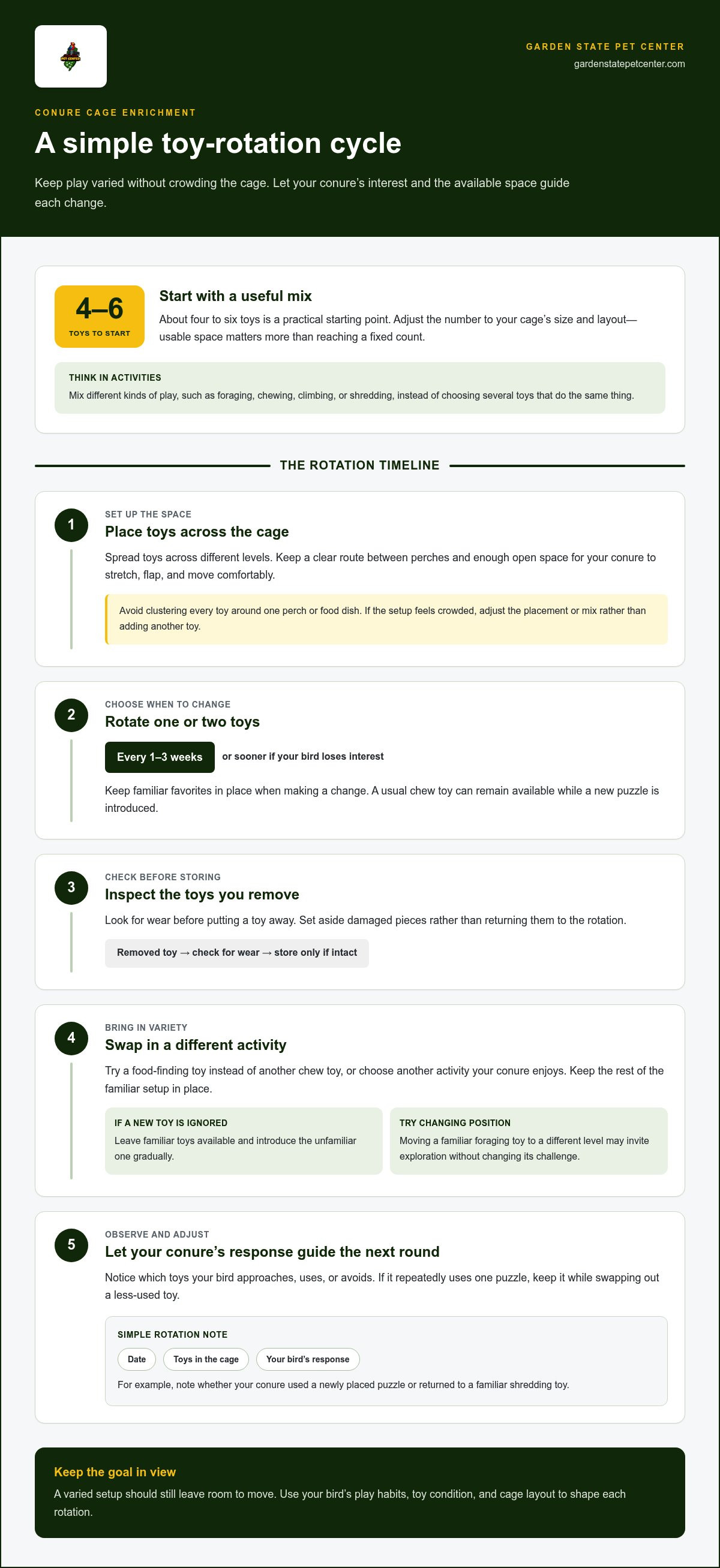
A practical starting point is about four to six toys in the cage, adjusted to its size and layout. Include different activities rather than several toys that do the same thing. For example, combine a foraging challenge with a chewable toy and something suited to climbing or shredding. This gives your conure options without filling every open space.
Rotate one or two toys every one to three weeks, or sooner if your bird loses interest. Keep the rest of the familiar setup in place when introducing a change. A conure that ignores a newly added puzzle may still engage with its usual chew toy, making the transition less abrupt. Note which toys your bird approaches, uses, or avoids, then let those observations guide the next rotation.
Use a simple rotation routine:
- Choose one or two toys to remove, leaving familiar favorites available.
- Check the removed toys for wear before storing them; set aside damaged pieces.
- Bring in a different activity, such as a food-finding toy instead of another chew toy.
- Watch how your conure responds, then decide what to keep in the next rotation.
Spread toys across different levels to encourage movement and exploration. Place one foraging option higher and another lower, while keeping a clear route between perches. Avoid clustering every toy around the same perch or food dish. Your conure should still have room to stretch, flap, and move without bumping into toys. Usable cage space matters more than reaching a fixed toy count.
Think about variety across the whole setup, not just the number of objects. If your conure repeatedly uses one puzzle, keep it while swapping out a less-used toy. If it ignores a new item, leave familiar toys in place and introduce the unfamiliar one gradually. Position can affect interest, too: moving a familiar foraging toy to a different level may invite exploration without changing the challenge.
Keep a brief rotation note with the date, toys in the cage, and your bird’s response. For example, record whether your conure used a newly placed puzzle or returned to a familiar shredding toy. Over time, these notes reveal useful patterns: favorite activities, ignored placements, and toys that hold attention. Use those observations to adjust the mix, keeping the cage varied while preserving open space and clear routes.
Treat toy placement as part of the rotation decision, not just the choice of which object to add or remove. When you change the arrangement, check that the foraging toys aren’t all at one level. Place them at different levels throughout the cage to encourage movement and exploration. The goal isn’t to fill available space. Most conures benefit from approximately four to six toys in their cage, depending on cage size and placement, so consider the combination and positions together. If the layout feels crowded, adjust the placement or mix rather than adding another item just for variety. After a change, reassess the distribution and total to keep the setup suited to the available space.
3. Selecting toys for individual play styles
Choose toys by watching what your conure does with everyday objects. A bird that tears paper may enjoy pulling apart shreddable layers, while a persistent chewer may prefer natural wood. If your bird reaches, climbs, or swings during play, consider a toy that encourages those movements. The most engaging choice reflects your bird’s actions, not just its color or shape.
For food-focused birds, choose a puzzle that matches their current skill. An easy opening or visible treat helps a beginner understand the goal. A bird that quickly solves that challenge may enjoy compartments or an adjustable string that changes access. Keep the task achievable: if your conure pecks once and walks away, simplify the puzzle rather than assuming it dislikes foraging.
What size foraging toy is suitable for different conure species? Small toys suit green-cheeked conures and similar small species, while medium-large toys are recommended for scarlet-fronted and Patagonian conures. Also consider whether your bird can comfortably reach, grip, and manipulate the toy in its cage.
Size is about how a toy moves, not just its label. A foraging wheel that seems manageable to a person may still be too large for a green-cheeked conure to spin. Look for a challenge your bird can operate with its beak or feet, and observe its first attempts. If the toy blocks movement or your bird can’t manipulate it, choose a smaller or simpler design.
For a bird that prefers hands-on play, choose pieces it can move, turn, or dismantle. A toy with an adjustable string can offer changing difficulty and material to shred. For a bird that approaches objects cautiously, choose a compact, simple design rather than a large, noisy puzzle. Let your conure’s behavior guide which features matter most.
Match the challenge to your bird’s response, then adjust one feature at a time. If your conure solves a puzzle quickly, make the treat less visible or use a more involved opening. If it hesitates, make the treat easier to reach. This small change helps distinguish a challenge that needs adjustment from a toy that doesn’t match your bird’s preferred play style.
Finally, assess how the toy fits in the cage. A toy that suits your conure’s beak can still crowd a perch or interfere with movement. Position it where your bird can approach without an awkward reach. Supervise early interactions with an unfamiliar design, and note whether your conure chews, pulls, climbs, or searches. These observations make your next choice more personal and practical.
4. What materials should be avoided in conure foraging toys?
Choose materials with a clear purpose and a known bird-safe use. Natural wood, including balsa, cholla cactus, and manzanita, can suit chewing. For simple DIY enrichment, examples include coconut shells, muffin cups, coffee filters, dried pasta, dried loofah, sticks with holes, vine balls, and crinkle paper. These examples are not a reason to use any found material; select items intentionally and watch how your conure handles them.
Be especially selective about rope used to assemble toys. Raffia, sisal, and seagrass are identified as parrot-safe options. Don’t substitute an unknown cord or string just because it looks similar. Inspect the toy as your bird uses it, and remove it if damage changes how its parts hang or move. Supervise your conure with unfamiliar toys until you understand how it interacts with them.
Bell design matters, too. Ordinary jingle and cowbell toys can let curious beaks reach their clappers, so they aren’t the preferred choice described here. Elongated stainless steel bells are an alternative because curious beaks can’t reach their clappers. Check that the bell remains intact during use, rather than judging its suitability by sound or appearance.
Use this material check before offering a homemade or purchased toy:
- Identify each material, such as wood, rope, paper, or metal.
- For rope components, choose raffia, sisal, or seagrass rather than an unknown substitute.
- For chewable pieces, consider natural woods such as balsa, cholla cactus, or manzanita.
- For bells, avoid ordinary jingle or cowbell designs with reachable clappers.
- Watch your conure’s first interactions and remove any toy that becomes damaged or behaves unexpectedly.
Outdoor branches need particular care. Branches collected outdoors can serve as chew toys if they’re parrot-safe, but that doesn’t make every branch suitable. Choose only branches you can identify as parrot-safe, and don’t add an unidentified stick just because it fits in the cage. Apply the same care to DIY materials: use the listed examples deliberately rather than mixing in household scraps of uncertain material.
Include the toy’s construction in your material check. A suitable wood or paper element can still be poorly assembled for your bird’s play. Observe how your conure pulls, chews, and reaches; supervise new designs and reassess them as they wear. The material should support the intended activity, while the toy’s condition and your bird’s behavior guide whether it stays in use.
5. How often should conure foraging toys be cleaned or replaced?
Use a toy’s condition and contents to decide when it needs attention. A treat puzzle with crumbs or leftover food needs cleaning before you refill it. A toy without food debris may need less frequent cleaning, but inspect it during routine cage care. The material matters: hard surfaces and absorbent paper or wood need different cleaning approaches.
Check food-holding toys after each use. Remove uneaten treats and visible residue before adding fresh food, so old pieces don’t remain hidden in a compartment. Look into corners, folds, cups, and hollow areas. A treat lodged behind a moving part can be easy to miss, especially if your conure empties only one side of a puzzle.
Use this inspection sequence as you maintain a toy:
- Empty leftover food from each compartment before refilling.
- Look over the toy for droppings, damp spots, crumbs, or other visible soiling.
- Check wood, paper, rope, and metal parts for changes in shape or condition.
- Clean reusable parts according to their material, then let them dry before offering food again.
- Remove pieces that have become damaged or difficult to inspect.
Replace a toy when damage changes how your conure can use it. A broken edge, loose component, or worn opening may create a different interaction than the original design intended. Frayed raffia, sisal, or seagrass also needs close inspection because your bird may pull and chew those fibers. If a part has come loose or the toy no longer holds food securely, remove it from use.
Natural materials change as birds chew them. A balsa block reduced to small fragments no longer offers the same experience as an intact piece. Likewise, a paper cup or coffee filter used for food-finding may need to be discarded once torn or soiled. Reassess after play, not just when changing toys: a conure can alter a toy quickly through active chewing.
Keep a simple note alongside your rotation record. Write down the toy, its material, when you last cleaned it, and any damage you noticed. For example, note whether a food puzzle collected crumbs or a wooden piece developed a sharp break. These observations help you spot changes and decide which toys remain practical for your bird. Let cleanliness and condition, rather than a fixed calendar, guide each decision.
Consider maintenance alongside the way you introduce foraging. Start conures new to foraging with an easy option, then gradually offer more complicated toys. Keep that progression in mind as you choose which items to introduce, while continuing to inspect each toy for cleanliness and damage.
Cage space matters when arranging toys. Leave enough open space for your conure to stretch, flap, and move without bumping into toys. Make room for movement when positioning items, and reassess the arrangement whenever you change or replace toys.
Garden State Pet Center: Premium Pet Food
Garden State Pet Center offers Pet Toys and Accessories for bird owners choosing enrichment that suits a conure’s play style. If you’re comparing toy materials, sizes, or food-finding options, explore the bird-focused selection and consider how each choice fits your bird’s habits and cage setup. Premium Pet Food is also available for everyday feeding, separate from treats used in foraging activities. Choose a toy that supports your conure’s preferred way to chew, shred, climb, or search, then observe how your bird interacts with it. For help finding a practical next step for your bird, contact Garden State Pet Center.
Keep Building Better Play
Your conure’s play preferences can change as it grows more confident, so let curiosity guide your next choice. Treat each new toy as a chance to learn what captures your bird’s attention, then use that insight to shape future enrichment. The right foraging toys for conures aren’t just a purchase; they’re part of a thoughtful routine that reflects your bird’s personality.
For a practical next step, explore options that suit your bird’s interests and everyday care. Garden State Pet Center offers Pet Toys and Accessories, alongside Premium Pet Food and Exotic Birds. That specialized selection can help you keep enrichment and daily feeding in view as you plan for your bird’s needs. Choose a play challenge that feels approachable, observe how your conure responds, and build from there. Contact Garden State Pet Center to continue the conversation and find a welcoming next step for your bird.
Frequently Asked Questions
Why do conures need toys?
Toys give conures meaningful ways to explore, manipulate objects, and search for food. Try a simple food-finding activity by showing your bird its dish, then placing the dish inside a paper bag. Let your conure approach and investigate at its own pace. This turns a familiar feeding routine into a new experience and lets you observe whether your bird prefers investigating, pulling, or reaching.
What are the best foraging toys for conures?
Choose a toy your bird can use with interest and without getting stuck. Start with a familiar food and an easy challenge, such as making the treat partly visible. If your conure enjoys exploring containers, a paper bag activity can be a useful starting point: show the food dish, then place it inside the bag. Observe what your bird tries first and use that preference to guide future choices.
What types of foraging toys are safe for conures?
Choose toys made with bird-suitable materials and a design your conure can manipulate. Examples include chewable natural wood and simple paper-based food puzzles. A paper bag can introduce food searching without a complicated mechanism: show your bird the food dish, place it inside, and let your bird explore. Supervise unfamiliar designs to see how your conure interacts with them, and remove a toy if damage changes its parts or use.
How much do foraging toys for conures typically cost?
Prices vary depending on the complexity and materials, ranging from budget-friendly DIY paper options to more elaborate interactive puzzles available at Garden State Pet Center. Simple shreddable and cardboard items often cost just a few dollars, while durable wooden foraging boxes represent a slightly larger investment in your conure's daily enrichment.

Article by
Victor Santucci
Victor Santucci Jr. is the owner of Garden State Pet Center and a Certified Clinical Pet Nutritionist specializing in premium pet nutrition, raw and fresh feeding, holistic pet wellness, birds and exotic animals. Through years of hands-on retail and animal-care experience, Victor helps pet parents make informed decisions about nutrition, enrichment and species-appropriate care.
Share this post
- 0 comment
- Tags: bird cage setup, bird toys, conures, foraging toys, foraging toys for conures, parrot enrichment, pet bird care, toy rotation