

Large parrot travel carriers for macaws and other large birds


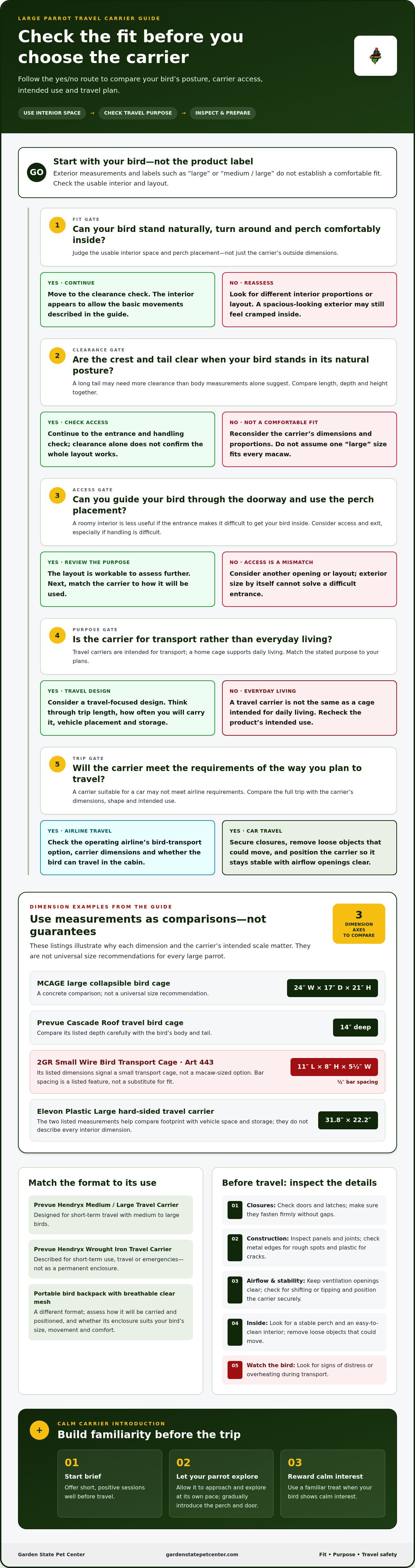
There is no standard size for a large parrot travel carrier. The right fit depends on your bird’s body and whether it can stand naturally, turn around, and perch comfortably inside. A carrier that looks spacious from the outside may still feel cramped if its usable interior space or layout does not suit your bird.
Choosing a travel carrier can feel like a trade-off between room to move and practical features for getting your bird safely in and out. This guide will help you compare dimensions for macaws and other medium to large birds, assess carrier style and travel features, and understand why a carrier intended for short-term transport is different from a home cage. You’ll also find ways to introduce the carrier calmly before a trip, so you can make a considered choice around your bird’s size, comfort, and travel needs.
Key Takeaways
- Match the carrier’s usable interior space to your bird’s body and natural posture, rather than choosing by the outside dimensions alone.
- Compare length, depth, and height together; a carrier’s dimensions can differ substantially across these measurements.
- Choose a travel-focused design for transport, and distinguish it from a cage intended for everyday living.
- Assess practical travel features such as access, ventilation, secure closures, and ease of cleaning against your bird’s needs.
- Introduce the carrier with short, positive sessions before travel to help your parrot become more comfortable with it.
Large parrot and macaw carriers
A macaw needs a carrier suited to its body, posture, and travel conditions. Exterior dimensions alone can mislead; check the usable space inside, door opening, perch placement, and construction. The large collapsible bird cage listed under MCAGE measures 24 inches wide, 17 inches deep, and 21 inches tall. Those measurements offer a concrete comparison, not a universal size recommendation for every large parrot.
Compare the carrier’s dimensions with your bird’s natural stance. Your bird should be able to stand upright without its crest or tail pressing against the carrier, turn around, and settle on a stable perch. A long tail may need more clearance than body measurements alone suggest. Check the doorway, too: a roomy interior is less useful if the entrance makes it difficult to guide your bird inside.
How can you acclimate a large parrot to a travel carrier? Start with brief, positive sessions well before travel. Let your parrot approach and explore at its own pace, then gradually introduce the perch and door. Reward calm interest with a familiar treat.
Look at the carrier’s intended scale before choosing. The Prevue Cascade Roof travel bird cage is 14 inches deep, so compare that depth carefully with a macaw’s body and tail. By contrast, the 2GR Small Wire Bird Transport Cage - Art 443 measures 11 inches long, 8 inches high, and 5 ½ inches wide. Its ½-inch bar spacing is a specific feature, but its listed dimensions signal a small transport cage, not a macaw-sized option. Don’t judge suitability by a product’s “transport cage” label alone.
What risks should you watch for when transporting a large parrot? Check for doors or latches that could open, a carrier that shifts or tips, blocked airflow, and signs that your bird is distressed or overheated. Before setting out, secure the closures, remove loose objects that could move, and position the carrier so it stays stable.
For a large parrot travel carrier, assess more than its advertised size. Check the fit with your bird standing naturally, then consider how the carrier will be carried and secured. A collapsible cage measuring 24 by 17 by 21 inches may suit some travel needs, while another bird may need different proportions. Match the design to your parrot, rather than assuming one large label fits every macaw. A calm introduction and a careful fit check make the carrier choice more practical.
Travel carriers for medium and large birds
Travel carriers vary in size, shape, and intended use, so compare those details with your bird’s build and the trip. The Prevue Hendryx Medium / Large Bird Travel Carrier is designed for short-term travel with medium to large birds. A travel carrier is for transport; a home cage supports daily living. Choose based on how you plan to use it, not its size label alone.
Consider the Elevon Plastic Large hard-sided bird travel carrier as a dimensional example. It measures 31.8 inches by 22.2 inches. Those two measurements help you compare its footprint with your vehicle space and storage area. They don’t describe every interior dimension, so review the complete carrier layout. Look at how the bird sits, where the perch fits, and whether the entrance allows easy access. A large exterior measurement alone doesn’t establish a comfortable fit.
Construction and intended use also vary. The Prevue Hendryx Wrought Iron Travel Carrier is described for short-term use, travel, or emergencies, which distinguishes it from a permanent enclosure. Before choosing, consider the trip’s length, how often you will carry your bird, and where the carrier will sit. Match its stated purpose to your travel plans and your bird’s needs.
Use this practical comparison before deciding:
- Check the fit: Compare the bird’s standing posture with the carrier’s interior shape.
- Review access: Consider how your bird enters and exits, especially if handling is difficult.
- Plan the route: Think through carrying, vehicle placement, and storage at your destination.
- Match the use: Separate short-term travel designs from everyday cages.
A portable bird backpack with breathable clear mesh is another available format. Its backpack design differs from a hard-sided carrier, so consider how each option will be carried and positioned. Portability alone does not make a format suitable for every bird. Assess your bird’s size, movement, and comfort with the enclosure. A bird that shifts frequently, for example, may need a different interior layout from one that settles quietly.
Consider the complete trip before choosing. Picture loading the carrier, moving it through doorways, and setting it down at your destination. Compare these steps with its shape, access points, and intended use. The Prevue Hendryx options show why labels such as “medium / large” need context. Weigh your bird, the carrier, and your travel routine together rather than relying on one measurement or marketing description.
Carrier features for travel
Assess construction, airline acceptance, and secure positioning in a car. Each matters at a different stage of the trip.
Materials and Construction Safety
Inspect every panel, joint, door, and latch before use. A large parrot may test closures with its beak, so the door should fasten firmly without gaps. Check metal edges for rough spots and plastic surfaces for cracks. Make sure ventilation openings remain clear when the carrier sits against a seat or wall. A stable perch and easy-to-clean interior also simplify travel preparation.
Airline Rules for Carriers
Airlines set their own rules for transporting birds and accepting carriers. For a macaw, confirm the airline’s bird-transport option, carrier dimensions, and whether the bird can travel in the cabin. A carrier suitable for a car may not meet airline requirements. Before booking, check the operating airline’s rules and compare them with the carrier’s exterior dimensions, door, and ventilation.
Prepare the carrier to meet the applicable requirements. Keep your bird secure, leave airflow openings unobstructed, and fasten the door. Check what documentation and handling arrangements the route requires. Do not assume one airline’s policy applies to another flight, including a connection operated by a different airline. A written travel plan can help you identify restrictions before reaching the airport.
Securing a Carrier in a Car
Place the carrier on a level surface and prevent it from sliding or tipping during turns and stops. Use a seat belt only if the carrier is designed for secure restraint. Follow the manufacturer’s instructions, and do not route the belt across a door that could open. Keep the carrier upright and ensure the belt or nearby luggage does not block ventilation. Test stability before putting your bird inside.
Plan the car setup before departure. Clear loose items from the seat area and check that the carrier stays in place when the vehicle starts or stops gently. Do not place heavy objects on top, and keep the carrier away from direct airflow from heating or cooling vents. These steps help create a stable travel space without crowding your bird.
Use this final feature check before travel:
- Closure: Fasten each latch and inspect the door.
- Airflow: Keep vents clear on every side.
- Interior: Remove loose items that could shift.
- Position: Keep the carrier upright and stable.
- Route: Match carrier arrangements to airline requirements.
For a large parrot travel carrier, assess each feature in context. A secure latch matters during handling, while unobstructed vents matter wherever the carrier sits. Airline travel involves separate acceptance rules, and a car journey requires stable positioning. Consider the entire route from departure to arrival rather than relying on any single feature.
Carrier sizes
Compare the carrier’s interior, entrance, and exterior footprint separately. Product dimensions can refer to different measurements, and the exterior size does not show how much usable room is inside. Use a tape measure to note your bird’s standing height and body length, including its tail. Then compare these measurements with the interior layout and usable perch space. For a large parrot travel carrier, checking the interior dimensions is essential.
Check width, depth, and height as separate dimensions. The large collapsible bird cage listed under MCAGE measures 24 inches wide, 17 inches deep, and 21 inches tall. The Elevon Plastic Large hard-sided bird travel carrier measures 31.8 inches by 22.2 inches. Those figures show why product comparisons need care: a listing may provide different dimensions, and the figures alone don’t establish a comfortable fit for every bird.
Use this sizing sequence before choosing:
- Measure your bird: Note its natural standing posture, body length, and tail clearance.
- Read the listing: Separate exterior dimensions from interior measurements.
- Compare access: Check the doorway against your bird’s body and your handling approach.
- Picture the trip: Consider how the carrier’s outside footprint fits your vehicle and storage space.
For example, compare the 2GR Small Wire Bird Transport Cage - Art 443, listed at 11 inches long, 8 inches high, and 5 ½ inches wide, with your bird’s actual size. Its measurements illustrate why “transport cage” doesn’t mean suitable for every species. The ½-inch bar spacing is another listed measurement, but spacing alone doesn’t determine whether the cage’s overall size works for a particular bird.
Consider how the interior shape affects usable space. A sloped roof, projecting perch, or inward-facing latch can reduce clearance. A macaw with a long tail may need a different layout from a similarly sized bird with a shorter tail. Check whether your bird can stand naturally and shift position without pressing against the sides. Then make sure the carrier can still fit securely in your vehicle.
Don’t choose by a “large” label alone. Compare product specifications, inspect the entrance, and picture your bird inside. The Prevue Cascade Roof travel bird cage, for example, is listed at 14 inches deep. That measurement is useful for comparison, but depth by itself can’t tell you whether a specific parrot fits comfortably. Use the complete set of dimensions and the bird’s posture together.
Separate fit for your bird from practicality during travel. A carrier may have ample interior space yet be awkward to lift or position. Compare its footprint with the space available in your car while keeping the door and vents accessible. Choose a large parrot travel carrier that balances interior comfort with manageable transport. Measure first, compare dimensions, and assess the complete setup before travel.
Which carrier materials and construction are safest for large parrots?
A material name alone does not establish whether a carrier is suitable for a large parrot. Assess the entire construction, including the frame, panels, joints, door, closures, and ventilation. For example, the Prevue Hendryx Wrought Iron Travel Carrier identifies wrought iron in its name, while the Elevon Plastic Large hard-sided bird travel carrier identifies plastic construction. Inspect the specific carrier, not just its material label.
Start with the door and every latch. Open and close them several times, checking for looseness, sharp edges, or gaps around the frame. Inspect each panel and joint for cracks, bends, or separation. A carrier that has been dropped or stored poorly deserves a closer look before use. Do not use it if a closure will not hold or a panel is damaged.
Next, inspect the interior. Carefully check accessible edges, seams, and the perch area for protruding wires, rough surfaces, or fittings that could catch feathers or toes. Confirm that the perch is secure and does not block the entrance. Remove any unsecured bowls or accessories that could shift during travel.
Ventilation also depends on how the carrier is built and positioned. Look for openings on the carrier itself, then make sure a seat, wall, or cover won’t block them. The Elevon hard-sided carrier and wrought iron travel designs may have different panel layouts. Assess the actual openings rather than assuming one material provides better airflow. Keep the bird’s view and access to air unobstructed.
Use this inspection routine before each trip:
- Examine the shell: Look for cracks, bends, damaged mesh, or separated joints.
- Test closures: Fasten every latch and check that the door stays shut.
- Check the interior: Remove loose items and inspect edges and perch fittings.
- Review placement: Keep ventilation openings clear in the vehicle.
Construction also matters while carrying the carrier. Lift it by its intended handle and check whether the frame flexes or the door shifts. Do not lift it by a removable perch, door, or accessory. The carrier should remain steady when you move it. Test its stability carefully at a low height before placing your bird inside.
Compare product descriptions with a hands-on inspection. The Prevue Hendryx Wrought Iron Travel Carrier is described for short-term use, travel, or emergencies. That purpose clarifies its role but does not replace checking its condition, closures, and interior. A suitable choice combines sound construction, secure access, clear ventilation, and a fit for your bird and journey.
Garden State Pet Center: Premium Pet Food
Garden State Pet Center offers premium pet food for birds and other pets, supporting everyday care alongside thoughtful travel preparation. Keep your parrot’s familiar feeding routine in mind before a trip, and pack its usual food separately from travel gear. Familiar toys and accessories can also support your bird’s routine at home. These essentials complement carrier planning but do not replace a carrier suited to your bird and journey.
For bird owners reviewing their care supplies, explore the bird food and supplies available through Garden State Pet Center. Contact Garden State Pet Center or visit gardenstatepetcenter.com to learn more.
Make the Next Trip Familiar
Make carrier use part of a steady travel routine rather than a last-minute decision. Before departure, plan how you will move your bird from its home environment to the vehicle, and have familiar care supplies ready. A well-chosen large parrot travel carrier is one part of preparation; your bird’s usual food and familiar enrichment can help maintain a consistent routine.
Garden State Pet Center offers premium pet food, toys and accessories, and exotic birds. These products support bird care beyond travel planning, whether you are maintaining familiar feeding habits or choosing enrichment for home. Keep your individual bird’s needs in mind as you prepare for an outing.
For a friendly next step, contact Garden State Pet Center and explore ways to support your bird’s everyday care. With a considered plan and familiar routines, you can approach travel more confidently together.
Frequently Asked Questions
What size travel carrier does a large parrot need?
Choose a carrier that lets your parrot stand naturally and reposition without pressing against the sides. Measure your bird from beak to tail and note its standing height, then compare those measurements with the usable interior, not just the exterior. For a long-tailed bird, check the clearance behind the perch. A roomy entrance also makes it easier to guide your bird inside without forcing an awkward turn.
What are the best travel carriers for large parrots in the United States?
There is no single best model for every bird or trip. Compare carriers by intended use, interior layout, access, and how they will be transported. The Prevue Hendryx Medium / Large Bird Travel Carrier is designed for short-term travel with medium to large birds. Treat these as options to assess, not a universal ranking.
What features should a large parrot travel carrier have for car trips?
For car travel, prioritize secure closures, unobstructed ventilation, and stable positioning. Before loading your bird, place the empty carrier where it will ride and check that it stays upright without blocking vents. Keep loose objects away from the door and interior. If using a seat belt, follow the carrier’s restraint instructions and make sure the belt will not press against the latch.
Which carriers fit macaws, cockatoos, and other large parrot species?
Choose according to your individual bird’s dimensions and shape, not its species name alone. A macaw’s tail clearance, a cockatoo’s crest, and your bird’s preferred posture can all affect usable space. Compare its standing height and length with the interior, then consider perch placement and the doorway. A carrier that suits one bird of a species may not fit another with different proportions.
How much do large parrot travel carriers cost?
Pricing for a quality large parrot travel carrier typically ranges from $50 to over $200 depending on the materials, brand, and included accessories. At Garden State Pet Center, you can find options across different price points to fit your specific budget and travel needs.
How do hard-sided and soft-sided parrot travel carriers compare?
A hard-sided carrier has a defined shape and footprint, while a breathable-mesh backpack offers a different way to carry your bird. Compare how each can be positioned and carried, and whether its interior suits your bird’s movement and comfort.

Article by
Victor Santucci
Victor Santucci Jr. is the owner of Garden State Pet Center and a Certified Clinical Pet Nutritionist specializing in premium pet nutrition, raw and fresh feeding, holistic pet wellness, birds and exotic animals. Through years of hands-on retail and animal-care experience, Victor helps pet parents make informed decisions about nutrition, enrichment and species-appropriate care.
Share this post
- 0 comment
- Tags: avian travel, bird travel cage, bird travel tips, large parrot travel carrier, macaw care, macaw carrier, parrot transport