

Natural Bird Perches for Large Parrots: The 2026 Buying Guide


The toughest perch in your parrot’s cage may not be the best one. A setup filled with identical dowels can limit the variety your bird’s feet need, while a soft branch may be reduced to splinters in days. Choosing natural bird perches for large parrots means balancing foot-friendly shapes and textures with wood that can handle a powerful beak.
It’s reasonable to worry about more than wear and tear. You also need confidence that a perch’s wood is safe for your bird, and that its size and surface suit your parrot’s feet. A varied “textural ecosystem” can make the cage more engaging than relying on one uniform perch.
This guide will help you compare natural wood options, recognize woods to avoid, choose useful perch diameters, and care for perches over time. You’ll learn how to build a more enriching setup that supports foot health and stands up better to daily chewing, with practical guidance informed by Garden State Pet Center’s specialization in exotic birds since 1990.
Key Takeaways
- Compare natural bird perches for large parrots by wood type, texture, and your bird’s chewing habits to find a practical balance of comfort and durability.
- Check the wood species and how it was prepared before bringing a perch into your parrot’s cage; avoid treated lumber and uncertain materials.
- Choose perch diameters and locations with your bird’s movement in mind, and provide distinct spots for resting, feeding, and activity.
- Build a cleaning routine around the perch’s surface and condition, and replace any piece that develops damage or becomes difficult to keep clean.
Beyond the Dowel: Why Large Parrots Require Natural Wood Perches
A straight dowel gives your parrot a place to land, but a cage built around one uniform diameter asks the feet to grip the same way all day. Repeated pressure on similar areas may contribute to irritation and sores. Natural branches vary in shape and thickness, encouraging small changes in grip and distributing contact across more of the foot. For large parrots, including macaws and cockatoos, their body weight makes comfortable, stable footing especially important.
Think of a perch as one part of a bird’s daily environment, not simply a seat. A varied setup can support movement and offer opportunities to climb, chew, and explore. General references to birdcage design and materials help illustrate how perches fit into the wider enclosure, but your bird’s comfort and behavior should guide the arrangement.
Understanding Avian Pododermatitis (Bumblefoot)
Pododermatitis, often called bumblefoot, refers to inflammation or injury affecting the foot. Watch for redness, thinning skin, or a bird that favors one leg. These signs can have different causes, so don’t try to diagnose or treat a sore foot by changing perches alone. Contact an avian veterinarian for guidance.
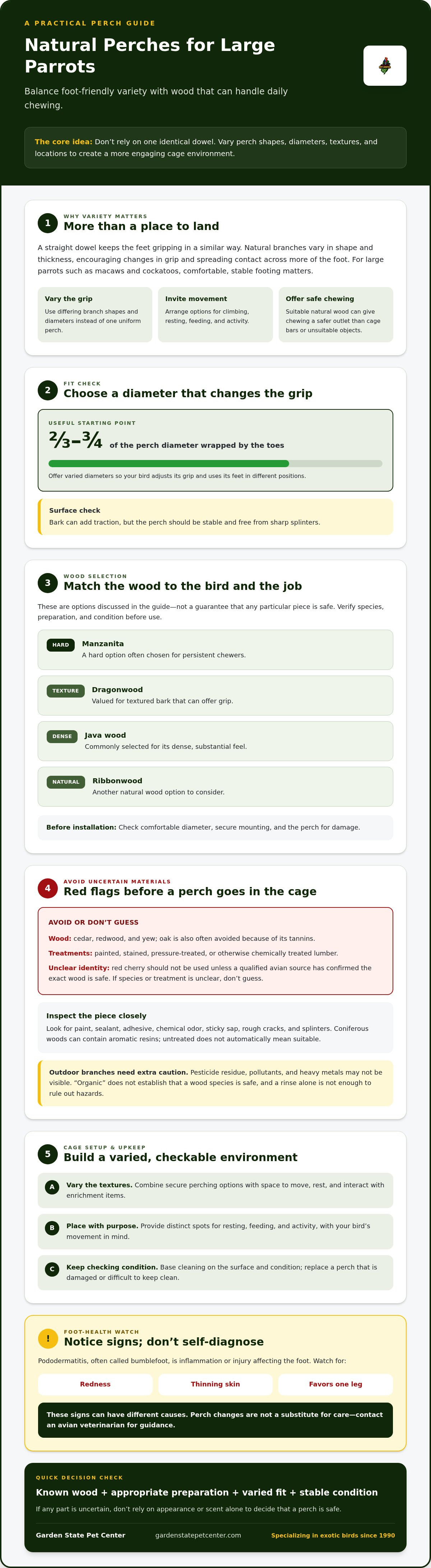
Offer perches with varied diameters so your bird adjusts its grip and uses its feet in different positions. A useful starting point is a diameter that lets the toes wrap around roughly two-thirds to three-quarters of the perch. Natural bark can add traction for a heavy bird, but check that surfaces are stable and free from sharp splinters. Different sizes support movement; they aren’t a substitute for veterinary care when symptoms appear.
The Enrichment Factor: More Than Just a Seat
Parrots naturally investigate and chew their surroundings. A suitable natural wood perch can give that destructive instinct a safer outlet than cage bars or other unsuitable objects. Bark and branch contours also provide varied textures to explore with the beak and feet. Different wood types may have distinct natural characteristics, though don’t assume scent alone indicates safety.
Build a small “textural ecosystem” rather than relying on one branch to meet every need. Combine secure perching options with space to move, rest, and interact with enrichment items. Irregular shapes can make the cage feel less repetitive and offer a more engaging environment inspired by the varied branches of a canopy. Garden State Pet Center has specialized in exotic birds since 1990; explore its bird collection for a broader look at bird supplies and accessories.
Safe Wood Species vs. Toxic Hazards: A Comprehensive Selection Guide
Identify the wood and check how it was harvested and prepared before a perch enters your parrot’s cage. Manzanita, Dragonwood, Java wood, and Ribbonwood are commonly used for bird perches, but a familiar name alone doesn’t confirm that a particular piece is safe. Species, treatments, coatings, and contamination all matter. For a useful veterinary overview of perch materials and preparation, see veterinary guidance on bird perches.
Top Recommended Woods for Large Parrots
Choose a wood that suits both your bird’s chewing strength and the job the perch needs to do. Manzanita is a hard option often chosen for persistent chewers. Dragonwood is valued for its textured bark, which can offer grip, while Java wood is commonly selected for its dense, substantial feel. Ribbonwood is another natural option to consider. Check each perch for secure mounting, comfortable diameter, and any damage before use.
Know Which Woods to Avoid
As a cautious starting point, avoid cedar, redwood, and yew, along with painted, stained, pressure-treated, or otherwise chemically treated lumber. Oak is also often avoided because of its tannins, and red cherry should not be used unless a qualified avian source has confirmed the exact wood is safe. If the species or treatment is unclear, don’t guess. A bird may chew and ingest material from its perch.
Spotting the Red Flags in Natural Wood
A branch collected outdoors can look clean and still carry risks. Pesticide residue, pollutants, and heavy metals may not be visible. “Organic” describes how something was grown or marketed; it doesn’t establish that a wood species is safe for parrots. Backyard branches also require reliable identification and careful preparation, so a familiar tree name or a rinse isn’t enough to rule out hazards.
Inspect commercial perches for paint, sealant, adhesive, chemical odor, sticky sap, and rough cracks or splinters. Coniferous woods can contain aromatic resins, so don’t assume a softwood branch is suitable simply because it’s untreated. Kiln-drying may help control moisture, but it doesn’t make an unsafe species safe or remove every possible contaminant. Confirm the wood type and preparation with the supplier, and discard pieces with unknown coatings or residues.
For natural bird perches for large parrots, dependable sourcing is part of bird safety, not just convenience. Garden State Pet Center has specialized in exotic birds since 1990 and ships bird accessories nationwide. Explore its bird supplies and accessories as you compare options, and verify the wood species and current availability before choosing a perch.
Comparing Durability and Texture: Which Wood Fits Your Bird?
Natural wood isn’t equally resistant to a strong beak. As a general comparison, Java wood is often considered the hardest of these options, followed by high-hardness Manzanita, while Grapevine is softer and may wear down sooner under heavy chewing. Treat this as a practical guide, not a guarantee: a branch’s thickness, condition, and your parrot’s chewing habits all affect how long it lasts.
Texture matters, too. Smooth wood is easier to wipe clean, while bark and irregular surfaces can offer extra grip and variety. Roughness may help wear nails during normal activity, but it shouldn’t be treated as a substitute for routine nail checks. Watch how your bird grips the perch, and inspect its feet for irritation if a surface seems overly abrasive.
Manzanita vs. Java Wood: Match the Perch to the Job
Manzanita’s dense, hard surface can suit persistent chewers, and a relatively smooth finish may make routine cleaning simpler. Java wood is also valued for durability; its naturally branching forms can provide varied routes and angles for climbing, including lateral movement. Either can work in a suitable setup. Choose based on your bird’s behavior, the perch’s shape, and how securely it fits the cage or stand, rather than assuming one wood is best for every parrot.
Hardness is a trade-off. A determined chewer may quickly damage softer wood, but an exceptionally hard perch won’t satisfy every bird’s need to chew. Pair sturdy perches with appropriate chew toys and enrichment so your parrot has safe outlets for different behaviors.
Grapevine and Sandblasted Finishes
Grapevine’s irregular shape and textured surface can provide useful grip and variety, but it may not last as long as harder woods with a large beak working on it. Sandblasting removes softer outer material and can leave a textured surface. Some birds may find that texture useful; others may have sensitive feet. Check the surface before installation and monitor your bird’s comfort, removing any perch that causes rubbing or irritation.
Consider longevity, not just the initial purchase. A perch that suits your parrot’s chewing style and remains intact can mean fewer replacements over time. Still, don’t keep a damaged perch simply because it was costly. Reassess it regularly and replace it if it splinters, loosens, or becomes difficult to clean. For natural bird perches for large parrots, a mix of textures and appropriate chew options can create a more useful setup than choosing one wood type alone.
Explore the collection of premium bird perches and accessories to compare options for your bird’s environment.
Sizing and Placement Strategy for Large Parrot Cages
A well-chosen perch can still cause problems if it’s too thick, too thin, or poorly placed. Rather than relying on a fixed diameter for every macaw or cockatoo, assess how your bird’s toes sit around each perch. As a starting guide, the toes should wrap roughly two-thirds to three-quarters of the way around. If they overlap, the perch may be too narrow; if they can’t curl around it adequately, it may be too wide. Natural branches that taper offer multiple gripping positions in one perch.
Plan Perches Around Daily Activities
Think in zones, not just a row of places to sit. A practical “three perch” arrangement provides a sleeping spot, a comfortable place near food and water, and an activity perch that encourages movement. It’s a planning aid, not a strict rule: adapt it to your bird’s size, cage layout, and habits.
Place the preferred sleeping perch high enough to feel secure, while leaving clear space above and around it. Before securing any branch, check that your parrot can turn, stretch, and fan its wings without hitting cage bars, toys, or other perches. Leave room for the tail to hang without brushing the cage floor or pressing against the wall.
Create a Safe Route Through the Cage
Arrange perches so your bird can climb between them without needing to leap across a large gap. Staggering positions and heights can encourage movement, but keep routes clear of sharp corners and obstacles. Check that each perch is stable under your parrot’s weight and doesn’t wobble when the bird lands.
Plan for droppings, too. Avoid placing food and water directly beneath a favorite perch, where they can become contaminated. Position bowls away from perches above them, and observe where your bird usually rests before finalizing the layout. A small adjustment can make feeding areas easier to keep clean.
Nail length can affect a bird’s grip, but don’t try to solve a balance or foot concern by trimming nails without appropriate guidance. If your parrot struggles to perch, shows discomfort, or has overgrown nails, seek help from an avian veterinarian or qualified bird-care professional.
Use these principles to build a setup around your bird’s actual movements. For natural bird perches for large parrots and other bird accessories, explore the bird collection and check that each option fits your cage and your parrot’s grip.
Maintenance and Sourcing: Ensuring Longevity for Your Bird's Environment
Natural bark adds useful texture, but grooves can trap food, droppings, and moisture. Check perches daily for fresh mess, loose fittings, and damage. Wipe or spot-clean as needed, then make time for a more thorough wash regularly. Cleaning frequency depends on how your parrot uses the perch and how quickly it becomes soiled.
Clean Bark Without Damaging It
Remove the perch before washing. Use a soft-bristle brush to lift debris from crevices, then scrub with hot water and a small amount of mild, unscented soap. Rinse thoroughly so no residue remains. Let the wood dry completely before returning it to the cage; damp, porous wood can encourage deterioration.
Vinegar solutions, steam, and veterinary disinfectants such as F10 may be considered for cleaning, but don’t assume every method suits every perch. Follow the product label for bird-safe use and rinsing, and confirm the material can tolerate heat or moisture. Steam can leave wood wet or damage it, while repeated soaking may shorten a perch’s useful life. Avoid bleach and harsh detergents that can leave residues or penetrate porous surfaces. Sunlight can help dry a removed perch, but don’t rely on sun exposure as a guaranteed method of disinfection.
Know When to Retire a Perch
Inspect the wood and mounting hardware during cleaning. Remove a perch if it develops deep structural cracks, sharp splinters, loose connections, or damage that makes it unstable. Surface wear from chewing may be normal, but a compromised branch can break under a large parrot’s weight. Replace it rather than trying to repair a damaged perch with glue, coatings, or unverified materials.
Choose a Traceable Source
A specialist avian retailer can help you ask the right questions: What wood species is this? How was it prepared? What is the mounting hardware made from? Don’t assume a natural-looking branch is untreated or that every metal fitting is suitable for a bird that may chew it. Stainless steel is commonly considered for bird hardware, but confirm the material and inspect fittings for corrosion or damage.
Garden State Pet Center specializes in exotic birds and ships bird accessories nationwide. That experience makes it a resource for comparing supplies, but verify the wood and hardware details for any specific perch rather than assuming a particular sourcing or material standard. With natural bird perches for large parrots, regular inspection and careful cleaning help protect both the perch and your bird’s environment.
Build a Better Perching Setup for Your Parrot
The right setup isn’t about finding one perfect branch. Choose verified, bird-safe wood and vary perch shapes and textures to encourage comfortable gripping and everyday activity. Check each perch’s fit and placement, keep feeding areas clear of droppings, and clean and inspect the wood regularly. Replace any branch with deep cracks, splinters, or unstable hardware.
Use these principles to choose natural bird perches for large parrots that suit your bird’s size, chewing habits, and cage layout. Garden State Pet Center has specialized in exotic birds since 1990, ships bird accessories nationwide, and has a certified pet nutritionist on staff. Explore the bird accessories as you plan a more enriching environment for your parrot. Thoughtful choices can help make your bird’s home safer, more engaging, and better suited to its daily needs.
Frequently Asked Questions
What is the safest wood for large parrot perches?
There isn’t one safest wood for every parrot; choose an identified species that’s untreated and prepared for bird use. Manzanita is a commonly used hard perch wood. Maple, mulberry, and pear are also cited as safe options when properly sourced. Avoid cedar, redwood, yew, oak, and treated lumber, and don’t rely on appearance alone. If the species or treatment is unclear, check with an avian veterinarian or a knowledgeable bird-care specialist before use.
How do I know if a perch is the right size for my Macaw?
Watch how your Macaw’s toes wrap around the perch. As a starting point, they should curve about two-thirds to three-quarters of the way around it, without overlapping or being forced to stretch. Offer varied diameters so your bird can shift its grip, and check that each perch is stable. If your Macaw struggles to balance, shows foot redness, or favors one leg, consult an avian veterinarian rather than relying on a size change alone.
Can I use branches from my own backyard for my parrot?
Sometimes, but only if you can confidently identify the tree and rule out contamination. Backyard branches may carry pesticide residue or other pollutants that aren’t visible. Avoid wood from treated areas, and don’t use an unknown species or a branch with sap, mold, or signs of chemical exposure. Thorough cleaning doesn’t make toxic wood safe. If you can’t confirm the species and its safety, choose a perch from a reputable bird-supply source instead.
How often should I replace natural wood perches?
Replace a perch when its condition makes it unsafe, rather than following an arbitrary calendar. Inspect it regularly for deep cracks, sharp splinters, loose mounting hardware, or damage that could cause it to break under your bird’s weight. Chewing marks alone don’t necessarily mean a perch needs immediate replacement, but check that the remaining wood is stable and easy to clean. Remove questionable pieces promptly, and never keep a structurally damaged perch in use.
Are sand-coated perches good for large parrots?
Sand-coated perches aren’t the best default choice for a large parrot. A rough abrasive surface may irritate the feet, especially if the bird spends long periods on it. Don’t depend on a perch coating to manage nail length. Provide stable natural perches with varied diameters and textures instead, and check your parrot’s feet for redness or worn skin. If you’re concerned about nails or foot comfort, ask an avian veterinarian for individualized guidance.
How do I clean a natural wood perch with bark?
Remove the perch and scrub bark crevices with a soft-bristle brush, hot water, and a small amount of mild, unscented soap. Rinse thoroughly to remove residue, then let the wood dry completely before reinstalling it. Clean visible droppings promptly and inspect the branch as you wash it. Avoid bleach and harsh detergents, which can leave residues or soak into porous wood. Discard a perch that remains soiled or develops cracks or splinters.
Why is my parrot chewing his natural perch so much?
Chewing is a normal way for parrots to explore and interact with their surroundings, and natural wood can provide an outlet for that behavior. Still, watch whether your bird is simply stripping bark or rapidly damaging the perch until it becomes unstable. Offer appropriate bird toys and other safe enrichment, and inspect the branch frequently. If chewing suddenly increases or comes with changes in appetite, behavior, or health, contact an avian veterinarian.
Is Java wood better than Manzanita for large birds?
Neither is automatically better; the right choice depends on your bird’s chewing habits, grip, and how you’ll use the perch. Both are used for bird perches, but individual branches can differ in shape, texture, and durability. Compare the diameter, surface, stability, and condition of the specific pieces rather than choosing by wood name alone. Offer varied perching options, and confirm the species and preparation with the supplier if the details aren’t clear.

Article by
Victor Santucci
Victor Santucci is the owner of Garden State Pet Center in Audubon, NJ, where he specializes in premium pet nutrition, exotic animals, and expert-level care. With years of hands-on experience and a passion for helping pets thrive, Victor is dedicated to educating pet owners on proper nutrition, enrichment, and species-specific care. His mission is simple: provide every pet with the highest quality products and every customer with honest, knowledgeable guidance.
Share this post
- 0 comment
- Tags: bird cage setup, bird care, cage accessories, exotic bird care, large parrots, natural bird perches for large parrots, natural wood perches, parrot foot health, parrot perches