

Digestive enzymes for dogs on a raw diet: sources and functions


A raw diet doesn’t replace the digestive enzymes a dog produces naturally. The pancreas makes enzymes that help break down fat, protein, and starch, but dogs don’t produce cellulase. Understanding digestive enzymes for dogs on a raw diet can help explain how food is processed, but supplements don’t automatically improve digestion in a healthy dog.
It’s understandable to wonder whether raw food supplies enzymes that cooked or processed food lacks. Heat can destroy enzymes naturally present in food, but that doesn’t mean every dog needs a supplement or that raw feeding will resolve digestive problems.
This guide explains what key digestive enzymes do, how raw ingredients and heat processing affect them, and which signs may indicate a digestive issue. These include weight loss despite a normal or increased appetite and soft, greasy stools. You’ll also learn why those signs aren’t a diagnosis on their own, and how a dog’s natural enzyme production fits into digestive health.
Key Takeaways
- Enzymes help break food into nutrients, but healthy dogs already produce key digestive enzymes in the pancreas.
- Raw ingredients can contain naturally occurring enzymes, while heat processing can reduce or destroy them.
- Weight loss despite a normal or increased appetite, along with soft, greasy stools, can signal a digestive problem that needs attention.
- When changing foods, the National Center for Biotechnology Information recommends starting with a 90% old-food and 10% new-food mixture for a few days, then moving to 80% and 20%.
- Learn how to distinguish normal digestion from signs that may warrant a closer look at your dog’s diet and digestive health.
What Are Digestive Enzymes?
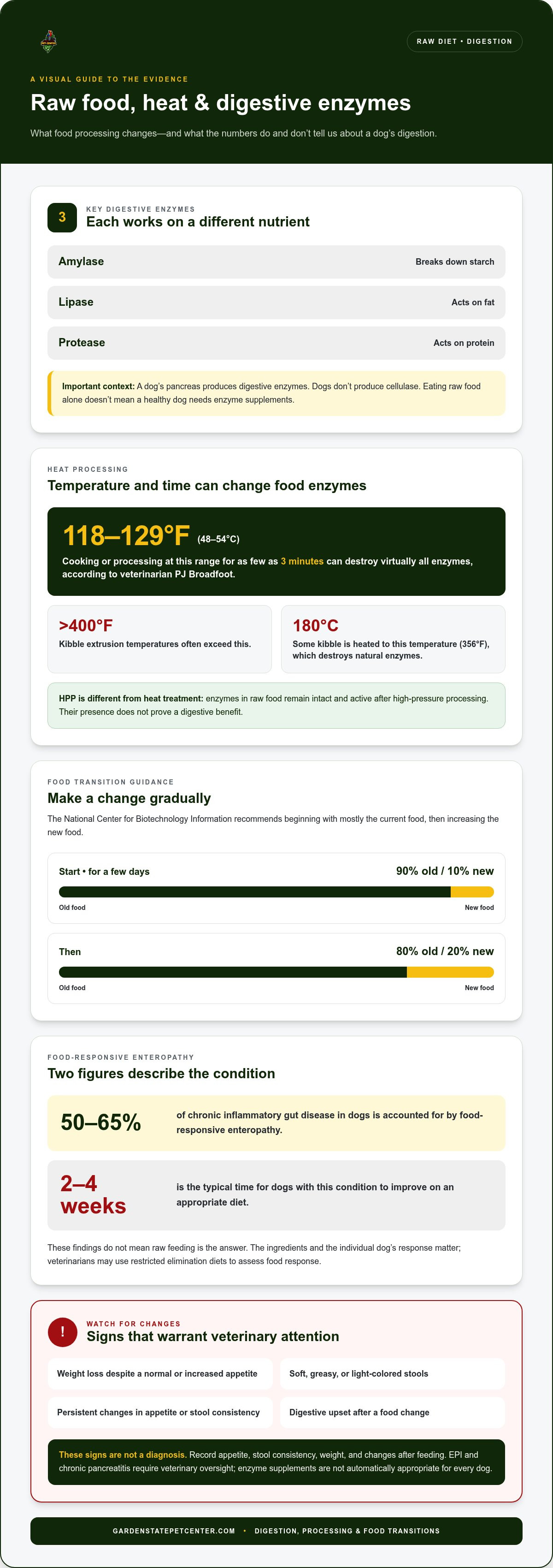
Digestive enzymes break food into smaller components the body can absorb. In dogs, amylase digests starch, lipase acts on fat, and protease acts on protein. The pancreas produces some digestive enzymes, so eating raw food doesn’t automatically mean a dog needs supplements. The key question is whether a diagnosed condition affects enzyme production, not whether the food is raw.
Evidence doesn’t support routine enzyme supplements for every healthy dog. A study of healthy adult dogs found that adding digestive enzymes to food did not increase digestibility. Whether supplements are appropriate depends on the dog’s health and should be discussed with a veterinarian. If a healthy dog develops digestive changes, note what’s happening and discuss persistent symptoms with a veterinarian instead of assuming an enzyme deficiency.
Enzymes and probiotics do different jobs. Enzymes break down food; probiotics are beneficial bacteria in the gut that support digestion and immunity. Probiotics don’t replace pancreatic enzymes, and enzyme products don’t replace beneficial gut bacteria. Choose according to the issue being addressed, rather than treating the two as interchangeable supplements.
Exocrine pancreatic insufficiency (EPI) involves inadequate production of pancreatic digestive enzymes. Dogs with EPI may need pancreatic enzyme replacement with meals. Chronic pancreatitis also requires particular care, but it doesn’t mean owners should start enzymes independently. Raw feeding a dog with EPI or chronic pancreatitis calls for veterinary supervision.
There’s no single U.S. price for digestive enzyme supplements; costs vary by product and package. The appropriate amount also depends on the product and the dog’s diagnosed needs, so follow product directions and veterinary guidance rather than guessing. Porcine pancreas is a common enzyme source; check the protein source on the label if your dog has food allergies.
Enzymes can cause gastrointestinal upset, including diarrhea and nausea. Don’t give antacids or acid reducers at the same time unless a veterinarian advises on dose and timing. For prescribed pancreatic enzymes, follow the directions for giving them with food. These details matter when a dog has EPI or takes medication alongside a new supplement.
Transition raw food gradually to help reduce temporary digestive upset. The National Center for Biotechnology Information recommends beginning with a 90% old-food/10% new-food mixture for a few days, then moving to an 80%/20% mixture. A raw diet also needs appropriate proportions of muscle meat, organs, bones, and supplements when needed.
Monitor appetite, stool consistency, weight, and changes after feeding. Weight loss despite a normal or increased appetite, along with soft, greasy, or light-colored stools, can occur with EPI and warrants veterinary attention. Before starting raw feeding, rule out parasites, infections, and other underlying conditions. A record of specific changes gives a veterinarian useful context for assessing digestion and diet.
Enzymes in raw food and the effects of heat processing
Raw ingredients can contain naturally occurring enzymes, while heat processing can reduce or destroy them. That distinction matters, but it doesn’t show that raw food improves digestion or that every dog needs enzyme supplements.
Enzymes and Food Breakdown
Digestive enzymes break food into smaller components the body can absorb and use. Amylase acts on starch, while lipase and protease help break down fat and protein. Digestion makes nutrients available for the body’s processes, including energy production. Enzymes assist digestion; they don’t make a diet complete or correct a nutritional imbalance.
Heat changes the enzyme content of food. Veterinarian PJ Broadfoot is cited as saying that cooking or processing food at approximately 118°F to 129°F (48°C to 54°C) for as few as three minutes can destroy virtually all enzymes. Kibble extrusion temperatures often exceed 400°F. Some kibble is heated to 180°C (356°F), a temperature that destroys natural enzymes.
High-pressure processing (HPP) is different from heat treatment: enzymes in raw food remain intact and active after HPP. However, finding active enzymes in food doesn’t prove they provide a digestive benefit. A 2025 review found scientific support lacking for commonly claimed digestive benefits of raw meat diets for cats and dogs. Food’s processing method alone can’t establish whether a diet suits an individual dog.
Digestive Effects of Raw Food
Food-responsive enteropathy is digestive disease that improves when a dog eats an appropriate diet. Persistent digestive signs may relate to food rather than an enzyme shortage. Veterinarians use elimination diets to assess food response. These diets restrict ingredients, ideally using a protein the dog has rarely eaten, and exclude other foods during the trial.
Food-responsive enteropathy accounts for roughly 50-65% of chronic inflammatory gut disease in dogs. Dogs with this condition typically improve within two to four weeks on an appropriate diet. That finding doesn’t show raw feeding is the answer; the diet’s ingredients and the dog’s response matter. Sudden diet changes, food intolerances, low-quality ingredients, and excess carbohydrates can also contribute to runny stools.
Some dogs may have temporary digestive upset when changing to raw food. Watch for changes in appetite and stools, and record which food was introduced. Raw feeding dogs with exocrine pancreatic insufficiency or chronic pancreatitis calls for veterinary supervision. It also requires caution for dogs with severely compromised immune systems.
Digestive enzyme supplements can cause diarrhea and nausea. Prolonged contact may irritate or ulcerate the mouth or esophagus, so offer food or water afterward to help wash enzymes down. Avoid inhaling powdered enzymes, which can irritate the respiratory tract. For advice on matching food choices to digestive needs, explore dog food options.
Signs of possible digestive enzyme deficiency
Exocrine pancreatic insufficiency (EPI) occurs when the pancreas doesn’t provide enough digestive enzymes. Affected dogs can lose weight despite a normal or increased appetite, because eating eagerly doesn’t ensure food is digested and nutrients are absorbed. Soft, greasy, or pale stools are another recognized sign. This combination deserves attention, especially when it persists.
Signs associated with enzyme problems can be mistaken for other digestive issues. Loose stools, for example, might result from food intolerance, infection, or another underlying condition. Chronic flatulence can occur when a dog eats too quickly or has food sensitivities. Gas alone doesn’t establish a lipase deficiency or another enzyme problem; consider it alongside appetite, stool quality, and weight.
- Weight: Note whether your dog is losing weight while eating normally or more than usual.
- Stools: Record whether they’re persistently soft, greasy, or light-colored.
- Appetite: Compare changes in food-seeking with changes in body condition.
- Gas: Track chronic flatulence and whether it follows fast eating or particular foods.
A brief feeding and symptom log can make patterns clearer. Record meals, treats, stool appearance, appetite, weight changes, and when each sign began. For example, noting greasy stools after multiple meals is more useful than describing one unusual bowel movement. Include recent food changes, since their timing can help distinguish a diet-related pattern from an ongoing problem.
Digestive difficulties can affect how an animal uses nutrients, including proteins and fats. Lipase helps digest fat, so greasy stools alongside weight loss are particularly relevant signs to report. However, no single stool description identifies which enzyme is involved. A veterinarian assesses the full pattern and considers EPI, food-responsive disease, parasites, and infection before recommending treatment.
Long-lasting intestinal inflammation can have food-related causes, so digestive symptoms don’t automatically indicate an enzyme deficiency. Food-responsive enteropathy, for example, is assessed through a restricted elimination diet, not by assuming a supplement will help. A diet trial limits ingredients and excludes other foods so the response can be observed. Keep the trial consistent and record changes in stool and appetite.
Seek veterinary assessment for ongoing weight loss, persistent greasy or pale stools, or chronic digestive changes. Bring your feeding log and describe when the signs started, what the stools look like, and whether appetite has changed. Those details help distinguish a possible enzyme problem from other causes. Avoid starting supplements based only on gas or one episode of diarrhea, since supplements can also cause digestive upset.
Digestive enzyme types and functions
A dog’s digestive enzymes act on specific nutrients, helping make food components absorbable. The main examples are lipase, protease, and amylase. Each has a different target: fat, protein, or starch. Knowing these roles helps explain what an enzyme supplement is intended to support, without assuming every digestive change means an enzyme shortage.
Lipase helps digest fats in food. Protease breaks down proteins into smaller components, while amylase acts on starch. These enzymes work on different ingredients, so one type can’t simply replace another. For example, a product containing amylase supports starch digestion, not the breakdown of fat by lipase.
- Lipase: acts on dietary fats.
- Protease: acts on proteins, including those in animal-based ingredients.
- Amylase: acts on starches in foods such as grains or some vegetables.
Dogs produce some digestive enzymes in the pancreas. A healthy dog’s own enzyme production is part of normal digestion. A raw diet doesn’t show that the pancreas cannot produce or release enzymes. Likewise, natural enzymes in food don’t establish that a dog will digest every meal more efficiently.
Enzyme activity depends on a match between the enzyme and its substrate. Protease acts on protein, for example, while amylase acts on starch. If an ingredient contains little of the nutrient an enzyme targets, there’s less relevant material for that enzyme to act on. Reviewing the food’s ingredients and the enzyme types listed on a supplement can clarify what each is intended to do.
Dogs don’t produce cellulase on their own. Cellulase breaks down cellulose, a component of plant cell walls. This doesn’t mean every dog needs cellulase supplementation; it describes one limit of dogs’ natural enzyme production. A dog’s overall diet and health still matter when considering digestive support.
Exocrine pancreatic insufficiency, or EPI, involves inadequate production of digestive enzymes. In this case, enzyme replacement addresses a specific diagnosed need rather than serving as a general wellness supplement. A chronic digestive sign alone doesn’t identify which enzyme is involved or whether a supplement is appropriate. The distinction between targeted treatment and routine supplementation is essential.
Use enzyme names as a guide, not as a diagnosis. Lipase, protease, and amylase each describe different digestive functions, while a dog’s symptoms can have many causes. If digestive changes persist, record the foods and ingredients your dog eats and discuss the pattern with a veterinarian. That history can help assess whether the issue relates to diet, pancreatic function, or another condition.
Dogs’ natural digestive enzymes
A dog’s digestive system already produces enzymes, so raw food doesn’t switch digestion from “off” to “on.” The pancreas produces enzymes that help process fat, protein, and starch. This natural production is central to digestion, whether a dog eats raw food or kibble. The useful question is whether the dog’s own enzyme production is functioning properly.
Each enzyme acts on a particular food component. Pancreatic lipase helps digest fat, protease helps digest protein, and amylase helps digest starch. These enzymes help the body access nutrients from meals. Adding enzymes through food or supplements doesn’t mean the dog’s pancreas has stopped working, and natural enzymes in raw ingredients don’t prove that a diet is more digestible.
Dogs don’t produce cellulase on their own. Cellulase breaks down cellulose, a structural component of plants. This helps explain why dogs don’t digest all plant material in the same way as animals that produce cellulase. It doesn’t establish a need for a cellulase supplement or show that raw food suits every dog better.
Dogs also produce stomach acid with a pH of 1-2. Acid and enzymes have distinct roles in digestion, and a dog’s digestive system relies on more than the enzymes present in a meal. Raw food may contain naturally occurring enzymes, but those do not replace the enzymes a dog produces. Kibble processing can destroy natural food enzymes, yet that fact alone doesn’t show that dogs eating kibble require supplements.
The distinction matters most when normal enzyme production is impaired. With exocrine pancreatic insufficiency (EPI), the pancreas doesn’t provide enough digestive enzymes, and replacement may be part of treatment. That differs from giving supplements to a healthy dog simply because its food is raw. Raw feeding dogs with EPI or chronic pancreatitis requires veterinary supervision.
Keep the takeaway practical: food type and enzyme need are separate questions. A dog eating raw food still relies on its own digestive function, while a dog eating processed food isn’t automatically enzyme-deficient. Persistent weight loss despite appetite, or soft, greasy stools, can be associated with EPI and deserves veterinary assessment. Don’t use those signs alone to diagnose an enzyme problem.
For a closer look at food choices, explore dog food options and consider how the full diet supports your dog’s needs. A nutrition discussion is especially useful when digestive signs persist or a diagnosed condition changes feeding decisions.
Garden State Pet Center: Premium Pet Food
Garden State Pet Center offers premium pet food for owners comparing food choices after learning how enzymes support digestion. Turn to the store when you want to consider your dog’s diet as a whole, rather than choosing an enzyme supplement based only on whether the food is raw or processed.
Bring a clear picture of your dog’s current food, feeding routine, and any digestive changes you’ve noticed. Those details can guide a practical conversation about food options and your priorities. Persistent weight loss or greasy stools call for veterinary assessment; choosing food isn’t a substitute for diagnosing a possible health condition.
Explore premium food options with your dog’s nutritional needs in mind, and contact Garden State Pet Center to discuss your feeding choices.
Make Your Dog’s Next Food Choice Thoughtfully
Let your dog’s individual needs guide the next step. If you’re considering digestive enzymes for dogs on a raw diet, focus on the wider feeding picture and keep notes on ingredients and digestive changes. A pet nutrition consultation can help you talk through food choices without treating a supplement as an automatic fix.
Garden State Pet Center offers premium pet food, pet toys and accessories, and exotic birds. These serve different pets and needs, while a conversation about food can help you decide what to explore for your dog. Persistent symptoms such as weight loss or greasy stools need veterinary assessment, rather than a food discussion alone.
Bring your questions and feeding notes to the conversation. Contact Garden State Pet Center to discuss your pet’s food choices and take the next step with confidence.
Frequently Asked Questions
Are there any proven digestive benefits of a raw diet for dogs?
Scientific support for commonly claimed digestive benefits of raw meat diets remains limited. A 2025 review found scientific support lacking for those claims in cats and dogs. That doesn’t establish that every dog responds the same way to every food. If you’re assessing a diet, track changes in appetite, stool, and body condition, and consider the ingredients and nutritional balance rather than treating “raw” as proof of a digestive benefit.
What Makes Dog/Cat Poop Smell and What Can Help?
Stool odor can change with a dog’s food or digestive health, but odor alone doesn’t identify a cause. Sudden diet changes, food intolerances, low-quality ingredients, and excess carbohydrates can contribute to runny stools. Note changes in food, treats, stool consistency, and smell together. If the change persists or comes with weight loss, share your record with a veterinarian; one unpleasant bowel movement can’t diagnose an enzyme problem.
Why Is Kibble Deficient in Enzymes?
Heat processing can destroy natural enzymes in food, but that doesn’t mean kibble makes a dog’s own digestive enzymes deficient. Kibble extrusion temperatures often exceed 400°F, which destroys naturally occurring food enzymes. Dogs still produce digestive enzymes in the pancreas. So, the distinction is between enzymes in the food and enzymes the dog makes; the food’s processing method alone doesn’t show that a supplement is needed.
What digestive enzymes do dogs produce naturally, and what do they digest?
Dogs produce pancreatic enzymes including lipase, protease, and amylase. Lipase helps digest fat, protease breaks down protein, and amylase acts on starch. Dogs don’t produce cellulase, which breaks down cellulose in plant cell walls. These roles describe normal digestive function, not a way to determine enzyme levels at home. A dog’s symptoms and health history matter more than simply identifying enzymes on a food label.
What ingredients and enzyme types should dog digestive enzyme supplements contain?
Consider the enzyme types and the supplement’s protein source rather than assuming every formula suits every dog. Lipase, protease, and amylase act on fat, protein, and starch, respectively. Porcine pancreas is a common source of digestive enzymes for dogs, so check the label if your dog has food allergies. For digestive enzymes for dogs on a raw diet, a diagnosed need should guide supplement decisions.
How can owners tell whether a dog on a raw diet has digestive problems or an enzyme deficiency?
Owners can notice warning patterns, but symptoms alone can’t confirm an enzyme deficiency. Weight loss despite a normal or increased appetite, along with soft, greasy, or light-colored stools, can occur with exocrine pancreatic insufficiency. Record meals, appetite, stool appearance, weight changes, and when signs began. Persistent changes deserve veterinary assessment, since parasites, infections, food intolerance, and other conditions can also affect digestion.

Article by
Victor Santucci
Victor Santucci Jr. is the owner of Garden State Pet Center and a Certified Clinical Pet Nutritionist specializing in premium pet nutrition, raw and fresh feeding, holistic pet wellness, birds and exotic animals. Through years of hands-on retail and animal-care experience, Victor helps pet parents make informed decisions about nutrition, enrichment and species-appropriate care.
Share this post
- 0 comment
- Tags: canine nutrition, digestive enzymes, digestive enzymes for dogs raw diet, dog health, gut health, pet digestion, raw dog food, raw feeding