

Heavy Chewer Dog Toys: How to Choose Safer, Longer-Lasting Options in 2026


The toughest-feeling toy isn’t automatically the safest choice for a powerful chewer. The right heavy chewer dog toys depend on how your dog plays, not just how sturdy a toy seems. If toys are torn up quickly, choosing a replacement can be frustrating, especially when you’re watching for loose pieces your dog could swallow.
You’re right to look for toys that last, but no toy is truly indestructible. A good match balances durability with your dog’s size, chewing style, and play habits. Some very hard materials can also pose a risk to teeth, so strength alone isn’t the whole story.
This guide explains how to assess your dog’s chewing behavior, compare common materials and designs, and spot when a toy needs closer inspection or should be removed. You’ll also find practical ways to make play safer, from supervising a new toy to checking it for wear. Garden State Pet Center offers dog toys and ships pet supplies and accessories nationwide, giving you a place to explore options for your chewer.
Key Takeaways
- Judge chewing style by what your dog does with toys, not by breed or a “heavy chewer” label.
- Compare rubber, nylon, and treat-dispensing designs by intended activity and practical limitations.
- Use your dog’s size and play habits to narrow down suitable heavy chewer dog toys.
- Watch how your dog tests a new toy, inspect it regularly, and remove it if damage makes play unsafe.
- Reassess your choice as you learn more about your dog’s habits and the toy’s wear.
Heavy Chewer Dog Toys: Why Your Dog Destroys Toys So Quickly
A toy’s label can’t tell you exactly how your dog will use it. One dog may carry a toy around and nibble occasionally. Another may settle in for focused gnawing, bite the same spot repeatedly, or grab and shake it with force. These observable habits are a better starting point than breed stereotypes. They help explain why a toy may last for one dog but fail quickly for another.
“Durable” means designed to withstand more wear during its intended use. “Indestructible” would mean impossible to damage, and no dog toy can honestly promise that. Choose based on the play you observe, then watch how your dog handles the toy.
What does it mean for a dog to be a heavy chewer?
Look for persistent gnawing, focused chewing, or toys that show damage soon after play begins. A heavy chewer isn’t defined by size alone or by a label on packaging. Two dogs of similar size may interact very differently: one may gently mouth a toy, while the other repeatedly bites, pulls, or concentrates on one area.
Observe a typical play session before choosing. Notice whether your dog chews steadily, tosses and retrieves, or switches between biting and tugging. Supervise a new toy so you can see which behavior dominates and whether your dog uses it as intended. Dogs also learn to moderate bite strength; Bite Inhibition in Dogs offers background on that process, though it can’t predict how an individual dog will treat a toy.
Chewing isn’t automatically a sign of a problem. Dogs may chew as part of ordinary play, and quickly damaging a toy doesn’t by itself explain why they do it. Focus on what you can observe: the intensity and duration of chewing, the toy’s wear, and whether your dog is biting, pulling, or shaking it. These details make your choice more practical and individual.
Why can ordinary toys fail quickly?
Different play actions put different demands on a toy. Repeated biting concentrates pressure on a small area, while pulling and shaking apply force in other directions. A toy intended for fetch or gentle play may not suit a dog that spends a long time gnawing. Likewise, a chew toy may not be designed for vigorous tugging. Match the toy’s intended activity to what your dog actually does.
Labels such as “tough” or “heavy chewer” can help you browse, but they can’t guarantee how long a toy will last for your dog. Size matters too: a design that’s awkward to grip may encourage different handling, while an unsuitable size can make play less appropriate. Consider your dog’s build alongside its habits, and use the dog toy selection to explore options by category.
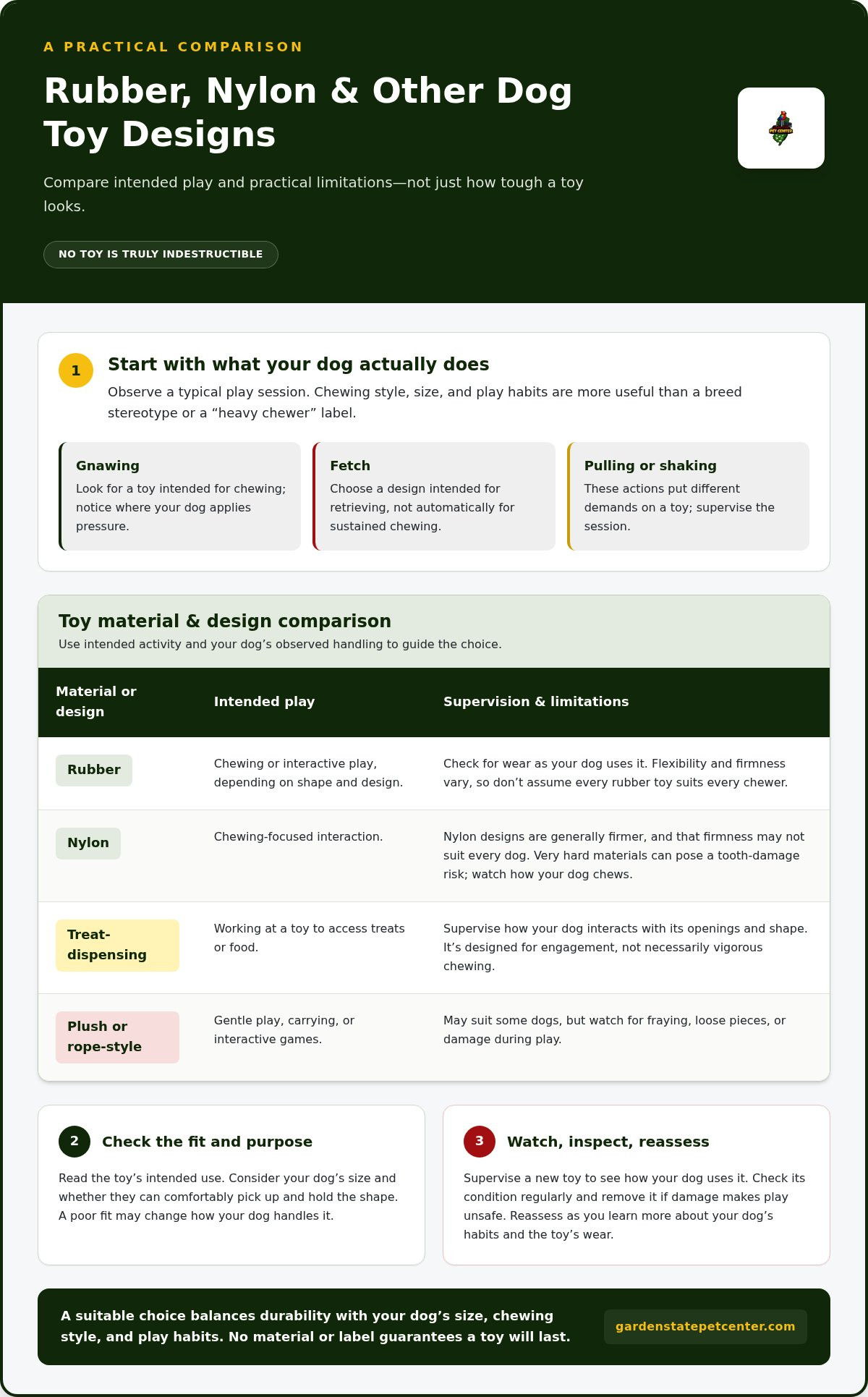
- Gnawing: Look for a toy intended for chewing, and observe where your dog applies pressure.
- Fetch: Choose a design intended for retrieving rather than assuming it will also suit sustained chewing.
- Pulling or shaking: Consider how this play style may stress the toy, and supervise the session.
Use these patterns as a starting point, not a guarantee of performance. A suitable toy fits your dog’s size and observed play, and remains appropriate as you monitor its condition.
Materials and Designs in Heavy Chewer Dog Toys: What to Compare
Material matters, but it’s only part of the decision. Compare what a toy is designed to do with how your dog plays, then consider its shape, size, and the attention it needs during use. No material is right for every dog, and even a sturdy design can wear down or prove unsuitable for a particular chewer.
Rubber, nylon, and treat-dispensing designs
Rubber toys often have some give, while nylon designs are generally firmer. Treat-dispensing toys add an enrichment element by giving a dog a way to interact with food or treats. These broad categories don’t guarantee how a specific toy will feel or perform. Construction, shape, and your dog’s chewing habits all matter. Choose according to the toy’s intended use, and supervise to see how your dog handles it.
| Material or design | Intended play | Supervision and limitations |
|---|---|---|
| Rubber | Chewing or interactive play, depending on shape and design | Check for wear as your dog uses it. Flexibility and firmness vary, so don’t assume every rubber toy suits every chewer. |
| Nylon | Chewing-focused interaction | Its firmness may not suit every dog. Very hard materials can pose a tooth-damage risk, so watch how your dog chews. |
| Treat-dispensing | Working at a toy to access treats or food | Supervise to see how your dog interacts with its openings and shape. It’s designed for engagement, not necessarily vigorous chewing. |
| Plush or rope-style | Gentle play, carrying, or interactive games | These may suit some dogs, but watch for fraying, loose pieces, or damage during play. |
Use this comparison as a starting point, not a safety ranking. For more context on chewing behaviors and why dogs may chew destructively, see the ASPCA’s Understanding Destructive Chewing. Toy choice is one part of understanding a dog’s behavior, not a diagnosis.
Match toy shape to its purpose
A chew-focused design is meant for mouthing and gnawing; a fetch toy is shaped for throwing and retrieving. Interactive designs may invite gripping, tugging, or treat-seeking. Check whether your dog can comfortably pick up and hold the toy. Size and shape influence grip, and a poor fit may change how your dog plays with it.
Read the toy’s intended use and follow its guidance. A dog that tends to pull or shake may need closer observation with a toy made for gentler play. Likewise, watch how your dog uses a treat-dispensing design rather than assuming it’s a chew toy. The phrase “heavy chewer” on a label can help narrow a search, but it can’t predict an individual dog’s experience with heavy chewer dog toys.
As you compare dog toy options, focus on the play purpose and design that fit your dog’s routine. Explore dog toys as you consider which category best matches the way your dog chews, retrieves, or interacts.
How to Compare Heavy Chewer Dog Toys for Your Dog
Choose by fit, function, and your dog’s actual habits rather than relying on a broad “tough” label. Narrow the options by starting with your dog’s build and chewing style, then checking whether the toy’s size, construction, and intended activity make sense. Follow the manufacturer’s use guidance, and treat the first play sessions as a chance to see how well the match works.
Start with your dog’s size and chewing habits
Record what you observe during ordinary play. Does your dog settle into steady gnawing, chew in short bursts, or try to pull and shake toys? These patterns reveal more than breed alone. Compare your dog’s build with the manufacturer’s sizing guidance, and choose a toy your dog can handle as intended. Don’t assume two dogs of the same breed need the same design.
Evaluate construction, fit, and play purpose
Compare the toy’s stated dimensions with your dog’s mouth and grip, then consider its construction and described activity. A chew-focused design and a fetch toy serve different purposes. Use each as the manufacturer directs, and supervise to assess how your dog interacts with it. A good fit supports the intended play, but doesn’t guarantee a particular lifespan.
- Start with size and style. Note your dog’s build and usual pattern of chewing, pulling, shaking, or retrieving. Use the manufacturer’s sizing guidance rather than guessing from breed.
- Identify the play purpose. Decide whether you’re looking for a toy for chewing, fetch, tug, or treat-based interaction. Match that activity to what your dog actually does, not what you hope the toy will encourage.
- Compare dimensions and grip. Check the toy’s measurements and shape against your dog’s ability to pick it up and hold it comfortably. A shape that’s difficult to grip may lead to a different style of play.
- Review construction and use instructions. Look at how the toy is made and read the manufacturer’s guidance. Don’t use a toy for vigorous chewing if it’s described for another purpose.
- Observe the first sessions. Stay nearby and notice whether your dog uses the toy as intended. If the play style doesn’t suit its design, set it aside and reassess the match.
The best toy design is the one that fits your dog’s size and the way your dog actually plays. Keep these criteria in mind as you compare heavy chewer dog toys, and adjust your choice based on what you observe rather than expecting one label to settle the question.
Use the same practical criteria as you browse dog toys: compare intended play, fit, and construction to focus on options that make sense for your dog’s routine.
Are Indestructible Dog Toys Real? Safer Play for Powerful Chewers
No dog toy is truly indestructible. A toy marketed as durable may withstand more wear than a standard design, but that doesn’t make it damage-proof or risk-free. Dogs vary in how they chew, and the same toy can hold up differently depending on the dog’s habits and how often it’s used. Treat claims about toughness as a starting point, not a promise.
Supervision matters when your dog is trying a toy for the first time. Stay nearby and watch how your dog grips, bites, and handles it. A toy that seems intact at first may change during play, and noticing those changes helps you decide whether its design still suits your dog. Follow the manufacturer’s instructions for use and care.
What should owners check before and during play?
Before play, look over the toy for existing damage, loose parts, or changes in shape. During a session, watch for cracks, tears, fraying, or pieces that begin to come loose. These are reasons to take the toy away. A damaged toy shouldn’t be treated as reliably safe just because it was durable when new.
Build a quick inspection into your routine: check the toy before handing it over, keep an eye on how your dog uses it, then look it over again afterward. Pay attention to seams, openings, edges, or any part your dog repeatedly targets. If you can’t tell whether damage affects safe use, set the toy aside rather than leaving it with your dog.
For safer play, supervise your dog, follow the toy’s instructions, and remove it as soon as you notice damage or loose pieces.
When should a toy be replaced?
Replace a toy when it’s cracked, torn, misshapen, frayed, or shedding pieces. There’s no universal replacement schedule: a dog that chews intensely or uses a toy often may wear it down faster than a dog who plays with it occasionally. Check its condition regularly, and don’t wait for a piece to come off before deciding it’s past its useful life.
Notice patterns, too. If your dog repeatedly damages the same type of toy, reconsider its design and intended activity. A toy made for gentle interaction may not be a good fit for sustained chewing. Choosing a different design can be more practical than replacing the same kind repeatedly, but supervise the new option and assess how your dog handles it.
Make inspection part of play, not an occasional afterthought. Keep toys in rotation only while they remain in suitable condition, and remove any that no longer match your dog’s behavior. That approach helps you make informed choices about heavy chewer dog toys without mistaking durability for a guarantee. Explore dog toys for supervised play as you consider a design that fits your dog’s habits.
Find Heavy Chewer Dog Toys That Fit Your Routine
A useful toy should work for your dog and for the way you supervise play at home. Before deciding, ask: Is the size appropriate for your dog’s build? Is the toy intended for an activity your dog enjoys? Does its design suit the way your dog handles toys? Can you supervise and inspect it as needed? These checks help narrow down heavy chewer dog toys without relying on a promise that any toy will last indefinitely.
Build a practical toy rotation
A small rotation can include toys for different activities, such as chewing, fetch, or interactive play. You don’t need to leave every toy out at once. Offer one that fits the activity, observe how your dog uses it, and put it away afterward if that helps you track its condition. Supervise unfamiliar toys closely until you understand how your dog interacts with them.
Make inspection part of the routine. Before offering a toy, look for cracks, tears, loose parts, or fraying. Remove any damaged toy rather than returning it to the rotation. Keep notes if useful: which toy your dog chooses, how they play with it, and what wear appears. Those observations can help refine your choices over time, but no single toy can promise longer use or a change in behavior.
Reassess as your dog’s habits become clearer
A toy that seems like a good match at first may need to be reconsidered as you learn more about your dog’s play. Perhaps your dog mostly retrieves it or focuses on chewing one particular area. Check whether the toy is still being used for its intended purpose and remains in suitable condition. If the same design repeatedly shows damage during your dog’s usual play, consider another type rather than automatically replacing it with an identical one.
Use the dog-toy category as a starting point, then compare each option’s intended activity, sizing guidance, design, and care instructions against your checklist. Garden State Pet Center offers a dog toy selection to explore as you look for a suitable fit. Pet supplies and accessories ship nationwide, so you can browse from wherever you are.
Keep the routine manageable: choose an appropriate size, offer toys for the right play purpose, supervise unfamiliar options, and set aside anything damaged. Revisit your choice as your dog’s habits and the toy’s wear become clearer. Ready to explore options for your chewer? Shop dog toys.
Make Your Next Toy Choice With Confidence
Let your dog’s real-life play guide what you try next. A useful match isn’t only one that holds up; it should also fit your routine and give your dog an appropriate way to play. Notice whether the toy gets used for its intended purpose and whether supervising that activity feels manageable. That practical measure can help you decide what to keep in the rotation and what to choose differently next time.
Think of choosing heavy chewer dog toys as an ongoing process, not a one-time search for a perfect, permanent option. Your observations become more useful with each new design you introduce. Focus on a sensible match over bold promises, and adjust as you learn what suits your dog.
Ready to browse? Explore dog toys and take the next step toward a play routine that feels right for your chewer. A thoughtful choice is a good place to start.
Frequently Asked Questions
Is there such a thing as an indestructible dog toy?
No dog toy can be guaranteed to withstand every dog. “Indestructible” is a marketing claim, not a promise that a toy can’t be damaged. A toy that looks intact after a short session may show wear after repeated use. Pay attention to how your dog handles it, and don’t assume it’s still suitable just because it survived yesterday’s play.
What material is best for a heavy chewer dog toy?
There’s no single best material for every dog. Rubber, nylon, and treat-dispensing designs vary in firmness, flexibility, and purpose, so compare the specific toy’s instructions with your dog’s usual play. A dog that gnaws steadily may need a different design from one that mainly retrieves or pulls. If your dog regularly damages a particular style, use that as a reason to consider another design rather than relying on a “tough” label.
Are hard chew toys safe for dogs?
Not every hard chew toy is appropriate for every dog. Very hard materials can pose a risk of tooth damage, so consider your dog’s chewing style and follow the toy’s use directions. Don’t treat firmness as proof of safety or suitability. If your dog has a history of dental concerns, seems uncomfortable chewing, or you’re unsure what’s appropriate, ask your veterinarian for advice tailored to your pet.
How do I choose the right size toy for a heavy chewer?
Use the manufacturer’s sizing guidance, then consider your dog’s build and how they handle toys. Breed alone won’t tell you whether a particular shape or size is a good fit. A dog that likes to carry toys, for instance, may need a different shape from one that pins a toy down to chew. Supervise the first sessions and remove the toy if it becomes damaged or no longer seems suitable.
When should I throw away a damaged dog toy?
Remove a toy as soon as damage makes it unsuitable for play. Broken sections, loose pieces, sharp or rough areas, and changes in shape are practical warning signs. Don’t wait until the toy falls apart. Check it before play and during supervised sessions, since damage can develop while your dog is using it. Follow the manufacturer’s care or replacement instructions, and don’t return a damaged toy to the play rotation.
Can I leave my heavy chewer alone with a new toy?
Supervise your dog with a new toy until you’ve seen how they use it. A dog may chew, pull, or focus on one part of the design, and observing a session helps you see how the toy holds up. Check it afterward and follow the manufacturer’s directions. Don’t leave your dog with a toy that’s damaged or unsuitable for their play style.
Why does my dog destroy every toy?
Your dog may be using toys in ways their designs weren’t intended to handle, such as sustained gnawing on a toy made for fetch or repeated pulling on one meant for gentler play. Material, construction, and frequency of use can also affect wear. Note which actions lead to damage, then use that pattern to guide your next choice. Frequent destruction alone doesn’t explain the cause of a dog’s behavior.

Article by
Victor Santucci
Victor Santucci Jr. is the owner of Garden State Pet Center and a Certified Clinical Pet Nutritionist specializing in premium pet nutrition, raw and fresh feeding, holistic pet wellness, birds and exotic animals. Through years of hands-on retail and animal-care experience, Victor helps pet parents make informed decisions about nutrition, enrichment and species-appropriate care.
Share this post
- 0 comment
- Tags: aggressive chewers, dog chew safety, durable dog toys, heavy chewer dog toys, pet care tips, safe dog toys, tough dog toys