

Raw Dog Food Near Me: Find the Right Food and Store in 2026


Searching for “raw dog food near me” can help you find nearby options, but the closest store may not be the right fit for your dog or household. Product listings alone don’t explain how raw formats differ, whether a food is nutritionally complete, or how to handle it safely at home.
Before choosing, compare the food’s intended use, storage needs, and serving directions. Raw options include frozen and freeze-dried products, and label claims can be difficult to compare at a glance. Safe storage and handling also matter when raw food is part of your routine.
This guide explains the main raw-food formats, what to look for on labels, and practical steps for responsible handling. At Garden State Pet Center, an on-site certified pet nutritionist can help you compare raw and other premium food formats with your dog’s needs in mind.
Key Takeaways
- Use “raw dog food near me” as a starting point, then compare products by your dog’s needs and your household’s routine.
- Check whether a product is a complete diet or a topper or supplement, and review its stated life-stage suitability.
- Compare raw, freeze-dried raw, and gently cooked foods by storage, preparation, serving directions, and everyday convenience.
- Follow the product’s directions and safe-handling practices, and involve your veterinarian in diet changes related to health needs.
- An on-site certified pet nutritionist can help you compare food formats and understand label information.
Looking for Raw Dog Food Near Me? Start with What You Need
A search for raw dog food near me can quickly turn up stores and products, but it won’t tell you which format suits your household or what a package’s claims mean. Before browsing, consider your dog’s needs, the information you want to compare, and the practical details of storing and serving the food. Those factors are more useful than proximity alone.
Raw dog food is uncooked food for dogs, sold in different recipes and preparation formats. The term describes how it’s prepared, not whether it’s nutritionally complete or suitable for every dog. Retail staff can explain product categories and label language. A nutrition consultation can support food selection, but it isn’t a veterinary diagnosis or a substitute for advice about a health condition.
What does raw dog food include?
Frozen raw food is kept frozen for storage and must be handled according to its package directions. Freeze-dried raw is a different format: moisture is removed during processing, changing how the food is stored and prepared for serving. Follow each product’s directions rather than assuming the formats are interchangeable.
Recipes can include different animal proteins and ingredient combinations. Compare the actual ingredient list instead of relying on a broad label like “raw.” Some products are intended as complete meals, while others are toppers or supplements. The Raw feeding overview provides broader context about raw diets, their different approaches, and ongoing discussion around them.
What to look for in a raw-food source
Look for clear, current package information, including feeding directions and storage guidance. Check whether the product is intended as a complete diet or for supplemental use. If a label’s wording is unclear, knowledgeable staff can help explain what the package says without making assumptions about your dog’s individual health.
Comparing categories in one place can make the differences easier to see. Garden State Pet Center carries raw dog food alongside freeze-dried, air-dried, gently cooked, and other premium dog-food options. Its on-site certified pet nutritionist can help shoppers compare formats and interpret label information. Browse the dog food collection to explore categories and decide what you’d like to compare.
Before choosing, consider whether the format fits your storage space and routine, and whether the package explains how to serve it. For a diagnosed condition or a diet change related to medical care, involve your veterinarian. Clear product details and the right kind of guidance make for a more useful comparison.
How to Judge Raw Dog Food Nutrition and Recipe Claims
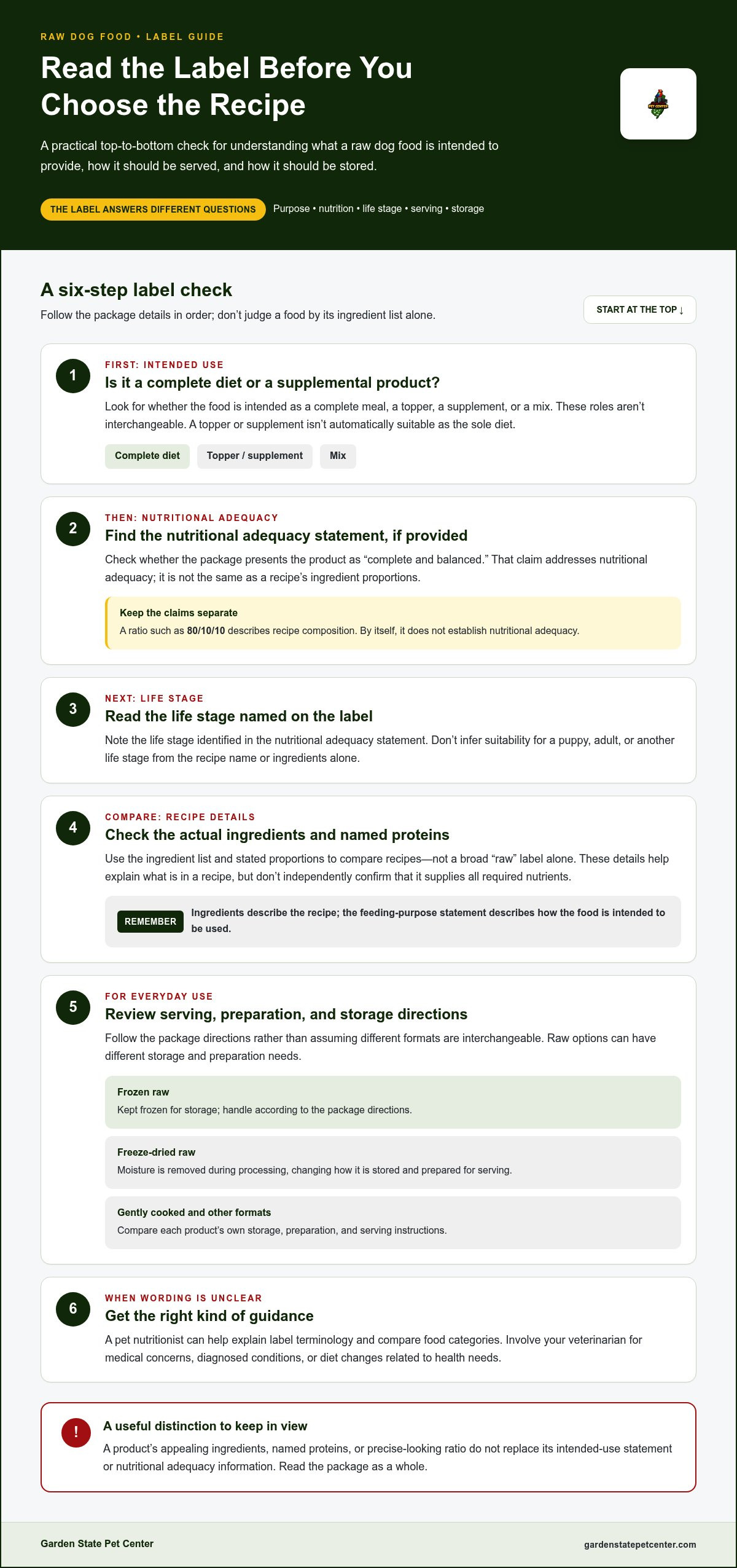
A package can feature appealing ingredients or a precise-looking recipe ratio and still leave an important question unanswered: is the food intended to provide a dog’s full daily nutrition, or is it meant to be fed alongside another diet? Check the label’s intended use before comparing claims. “Complete and balanced” describes a nutritional adequacy claim; an ingredient ratio describes a recipe’s composition. One does not prove the other.
This distinction matters whether you’re comparing products after searching for raw dog food near me or browsing store shelves. A food marketed as a topper or supplement isn’t automatically suitable as the sole diet. Likewise, a mix listing meat, bone, and organs, or a ratio such as 80/10/10, doesn’t by itself establish nutritional adequacy. Ingredient information helps you understand a recipe, but it can’t replace the product’s feeding-purpose statement.
How to read a raw-food label
Read the package as a whole, not just the ingredient panel. Find the nutritional adequacy statement, if provided, and note the life stage it identifies. Review that alongside the feeding directions, ingredient information, and storage and preparation instructions. These details answer different questions: what the food is intended to provide, how to serve it, and how to store it as directed.
Pay attention to the exact wording. A product may be labeled for supplemental or intermittent feeding rather than as a complete diet. Don’t infer suitability for a puppy, adult, or another life stage from the recipe name or ingredients alone. AAFCO wording and current standards can change, so verify relevant label language against current AAFCO guidance. If the package is unclear, a pet nutritionist can help explain the terminology; your veterinarian can advise on medical concerns.
Complete meals, mixes, and supplemental products
Match the product’s stated role to how you plan to feed it. A complete diet is represented as meeting a dog’s nutritional needs for the life stage named on its label. A topper or supplement is designed to be added to another food, while a mix may need additional ingredients or preparation. These categories aren’t interchangeable, so don’t treat a “mix” as a full meal unless its package says it’s suitable for that use.
Recipe details still matter, but they’re only part of the evaluation. A short ingredient list, named proteins, or stated proportions can help you compare recipes; none independently confirms that a product supplies all required nutrients. Follow the feeding directions, and consult your veterinarian before changing your dog’s diet, especially if your dog has a health condition, known sensitivities, or specific dietary needs.
For broader context on comparing food types and selection factors, explore this dog food collection. Garden State Pet Center’s on-site certified pet nutritionist can help shoppers compare food categories and interpret label information. Your veterinarian remains the right resource for diagnosis and medical diet advice.
Raw, Freeze-Dried, or Gently Cooked: Compare Formats and Safety
Food format affects more than what goes into the bowl. It also shapes storage, preparation, and cleanup. No format is automatically the safest, healthiest, or best fit for every dog. Compare package directions with your household’s routine, and handle raw products carefully.
| Format | Preparation and serving | Storage and routine |
|---|---|---|
| Frozen raw | Keep frozen as directed, then thaw and portion according to the package. Use clean utensils and surfaces. | Requires freezer space and planned thawing. Follow the label’s instructions for thawing, serving, and storing leftovers. |
| Freeze-dried raw | Serve as directed. Some products call for rehydration; others have different instructions, so check the package. | Often offers a shelf-stable storage routine before opening, but follow the specific product’s storage directions after opening. |
| Gently cooked | This is cooked food, not a raw-food subtype. Follow the package for portioning and serving. | Storage and handling vary by product. Use its label for refrigeration, serving, and leftover instructions. |
What changes between frozen raw and freeze-dried raw?
Both formats are sold as raw, but they create different kitchen routines. Frozen raw needs appropriate freezer storage and safe thawing before serving. Freeze-dried food is lightweight and may not need refrigeration before opening, but serving directions can differ, including whether water should be added. Don’t assume freeze-dried means complete and balanced. Check the product’s nutritional statement and intended use, as well as its preparation directions.
How does gently cooked food compare?
Gently cooked food offers another preparation format to consider. Its storage and serving steps depend on the product, so don’t apply raw-food thawing instructions or assume it can be stored like dry food. Read the label when comparing options. Browsing the dry dog food collection can also help you consider other feeding formats alongside raw and gently cooked options.
Handle raw food with care. FDA guidance recommends washing hands after handling raw pet food, cleaning and disinfecting surfaces and utensils that touch it, and thawing it safely in the refrigerator or microwave. Don’t rinse raw meat, since splashing can spread bacteria. Keep preparation areas separate from food-prep surfaces used by people, and follow the product’s directions for serving and storage. The FDA and CDC also warn that handling raw pet food can pose risks to people, particularly young children, older adults, pregnant people, and those with weakened immune systems.
Before choosing a format, consider freezer or pantry space, preparation time, and whether your household can follow handling directions consistently. Garden State Pet Center’s on-site certified pet nutritionist can help shoppers compare food categories and label information. Discuss your dog’s individual health needs or a diet change with your veterinarian.
Use This Checklist to Choose and Handle Raw Dog Food
A good choice has to work for your dog and your household. Before bringing home a new food, use this checklist to review nutrition, daily routines, and safe handling. If a package leaves you uncertain, get help interpreting its directions rather than guessing.
A practical selection and handling checklist
- Consider your dog’s needs. Note life stage, known sensitivities, health conditions, and any dietary advice you’ve received. Discuss a planned diet change with your veterinarian, especially if your dog has a medical condition or needs a specific diet.
- Check the product’s intended role. Read the current package to see whether it’s intended as a complete diet or as a topper, supplement, or other supplemental food. Don’t assume it’s suitable as your dog’s sole food based on its name or ingredients.
- Review life-stage information and feeding directions. Look for the life stage identified on the label, where provided, and use the package’s feeding instructions as a reference. They aren’t individualized medical advice, so ask your veterinarian how to account for your dog’s particular needs.
- Make sure the format suits your routine. Consider available freezer space, preparation time, and whether you can consistently store and serve the food as directed. A format that fits your home is easier to handle responsibly.
- Read storage and temperature instructions. Use the product’s directions for refrigeration, freezing, and storage after opening. Keep raw pet food separate from ready-to-eat human food during storage and preparation.
- Follow thawing and serving steps. Check the package for how to thaw, portion, and serve the food. Don’t apply one product’s directions to another or rely on a general timeline when the manufacturer’s instructions are available.
- Clean up carefully. Wash your hands after handling raw food. Clean and disinfect utensils, bowls, and food-contact surfaces that have touched it before using them for other tasks.
- Plan how to introduce a change. Follow the package’s transition guidance if it provides one, and discuss the change with your veterinarian when your dog has health concerns. Avoid inventing a serving amount or transition schedule; your dog’s circumstances may call for individualized advice.
Keep the package or a clear photo of its directions handy, especially if you’re comparing formats after searching for raw dog food near me. That way, you can refer to the specific storage and serving instructions instead of relying on memory. A pet nutritionist can help explain food categories and label language, while your veterinarian is the right resource for health conditions and medical diet decisions.
For support comparing dog-food categories and label details, explore Garden State Pet Center’s food options and get knowledgeable nutrition guidance.
Find Raw Dog Food and Nutrition Guidance at Garden State Pet Center
Finding raw dog food near me is a useful first step, but choosing food gets easier when you can compare formats and understand their labels. Garden State Pet Center carries raw dog food and other premium options, including freeze-dried, air-dried, and gently cooked food. Comparing these choices can help you consider different preparation and storage routines rather than assuming one format suits every dog or household.
Get guidance for comparing premium dog foods
An on-site certified pet nutritionist can help you compare food categories and make sense of label information. Bring your dog’s current food label, or a clear photo, along with questions about feeding directions, storage, or product descriptions. Comparing the wording on packages can make it easier to understand how formats differ.
This guidance supports food selection; it isn’t veterinary diagnosis or treatment. Share relevant context, such as your dog’s life stage, known sensitivities, or questions about a diet change. For a health condition, medical diet advice, or symptoms, consult your veterinarian. Whether you’re new to raw food or an experienced owner, knowledgeable guidance can help you organize questions and compare options thoughtfully.
Explore dog food options and take the next step
Browse the dog food collection to explore categories, from raw to other premium formats. As you compare, check the current package for its intended use, feeding directions, and storage instructions. The certified pet nutritionist can help explain food categories and label language so you can make a more informed comparison.
A short list of questions can keep the conversation focused: Is this food intended as a complete diet or for supplemental feeding? What does the package say about storage and serving? Which details should you discuss with your veterinarian? These questions help separate practical food guidance from medical care. You can also compare the convenience of different formats with your household’s routine.
You don’t need to arrive knowing every term. Bring the label or product information you’re reviewing, explain what you’d like to compare, and take time to understand the package directions. Garden State Pet Center’s selection of premium dog-food categories and on-site nutrition guidance can help you explore options with less guesswork.
Explore Garden State Pet Center to browse dog-food options and compare them with knowledgeable support.
Make Your Next Food Choice With Confidence
Your next step doesn’t have to be choosing a format today. Turn uncertainty into a short list of questions about your dog’s needs, the label, and the routine each food requires. If you searched for raw dog food near me, use proximity to begin a more informed comparison, not to make the decision for you.
Garden State Pet Center offers a curated selection of raw and other premium dog-food formats. Its on-site certified pet nutritionist can help you compare categories and understand product information, whether you’re exploring raw food for the first time or weighing it against another option. For questions about a health condition or a medically guided diet change, keep your veterinarian involved.
Compare the options at your own pace, and use the package directions and knowledgeable guidance to choose what fits your dog and household. Explore Garden State Pet Center to browse dog-food options.
Frequently Asked Questions
Is raw dog food nutritionally complete?
Some raw dog foods are formulated as complete diets, while others are intended for supplemental feeding. Check the current package for its nutritional adequacy statement and the life stage it covers. A product described as a topper shouldn’t be assumed to supply everything a dog needs as its only food. If the label’s intended use is unclear, get help interpreting it before making it the main diet.
Can I mix raw dog food with kibble?
Raw food and kibble can be included in the same feeding plan, but the products’ intended uses and portions matter. Adding raw food on top of a complete kibble diet may change the meal’s overall nutrient and calorie balance. Follow both packages’ directions, introduce changes thoughtfully, and ask your veterinarian for advice if your dog has a medical condition or needs a specific diet. Handle the raw portion with care.
How much raw food should I feed my dog?
Use the feeding directions on the specific product as a starting point. Serving amounts depend on factors such as the food’s calorie content and your dog’s age, size, activity, and body condition. Don’t rely on a universal percentage or portion rule for every dog. Track how your dog is doing and discuss adjustments with your veterinarian, especially if weight, appetite, or energy changes after a diet switch.
Can puppies eat raw dog food?
A puppy should only be fed a product whose current label indicates it is suitable for the puppy’s growth stage, and the choice should be discussed with a veterinarian. Puppies have changing nutritional needs, so a food intended for adult maintenance may not be appropriate. Consider household handling, too: raw pet food can pose a food-safety concern for people, especially young children and others at higher risk of infection.
Do dogs need supplements when eating raw food?
Not necessarily. Whether a supplement is appropriate depends on the dog’s overall diet and the role of the food being fed. Adding vitamins or minerals without guidance can create an unsuitable balance, particularly if the main food is already complete. Check the label first, then discuss specific concerns with your veterinarian or a pet nutrition professional. Don’t use supplements to make an incomplete recipe seem complete without expert direction.
Can a dog with allergies eat raw food?
A dog with suspected food allergies may be able to eat a raw product, but raw preparation doesn’t make a food hypoallergenic or treat an allergy. The relevant ingredients and the dog’s individual history matter. Ask your veterinarian about identifying the suspected trigger and choosing an appropriate diet plan. Keep a record of foods, treats, and reactions, since extra ingredients or frequent changes can make patterns harder to interpret.
Is freeze-dried dog food the same as raw dog food?
Freeze-dried raw food is a raw-food format, but it differs from frozen raw in how it’s prepared, stored, and served. Follow the product’s directions, including whether it should be rehydrated. “Freeze-dried” alone doesn’t establish that a food is raw or nutritionally complete. Check the package for preparation method, intended feeding role, and life-stage information before choosing it for your dog.

Article by
Victor Santucci
Victor Santucci Jr. is the owner of Garden State Pet Center and a Certified Clinical Pet Nutritionist specializing in premium pet nutrition, raw and fresh feeding, holistic pet wellness, birds and exotic animals. Through years of hands-on retail and animal-care experience, Victor helps pet parents make informed decisions about nutrition, enrichment and species-appropriate care.
Share this post
- 0 comment
- Tags: canine diet, dog nutrition, freeze-dried dog food, frozen pet food, pet health, raw dog food, raw dog food near me, safe food handling