

How to Reduce Parrot Screaming: A Calm, Practical Guide


Learning how to reduce parrot screaming starts with understanding what your bird’s calls may be communicating. Frequent noise can disrupt household routines, and it’s natural to wonder whether your parrot is calling normally or feeling distressed. A loud reaction may also give a bird the attention they’re seeking, even when that wasn’t your intention.
Parrots use their voices to connect with their flock. Screaming may also be linked to boredom, fear, loneliness, or another unmet need, but the sound alone can’t tell you which. Start by tracking when the calls happen, what’s going on around your bird, and how people respond. Then make calm, consistent changes that address likely needs and encourage quieter ways to get attention.
This guide explains how to spot patterns, avoid reactions that may reinforce screaming, and build a routine with appropriate interaction and enrichment. You’ll also learn when a sudden change in vocal behavior calls for prompt assessment by an avian veterinarian. The goal isn’t to silence normal communication, but to understand your bird and respond in a way that supports their well-being.
Key Takeaways
- Judge vocal patterns by their frequency, context, intensity, and effect on daily life rather than relying on an arbitrary noise threshold.
- Use a simple ABC log to connect what happens before a scream with your parrot’s behavior and the response that follows.
- Learn how to reduce parrot screaming with a consistent plan that addresses likely needs and rewards suitable quieter behavior.
- Avoid shouting or frightening responses, which can undermine trust and make it harder for your bird to learn which behaviors receive attention.
- Notice when persistent distress or a sudden change in vocal behavior calls for veterinary assessment or further behavior-focused support.
How to Reduce Parrot Screaming by Understanding What Is Normal
Parrots communicate with their voices. Calls can help them stay connected with familiar people, respond to activity around them, or express interest in what’s happening. The aim of learning how to reduce parrot screaming isn’t to silence a bird. It’s to understand whether a vocal pattern fits that individual’s routine and welfare.
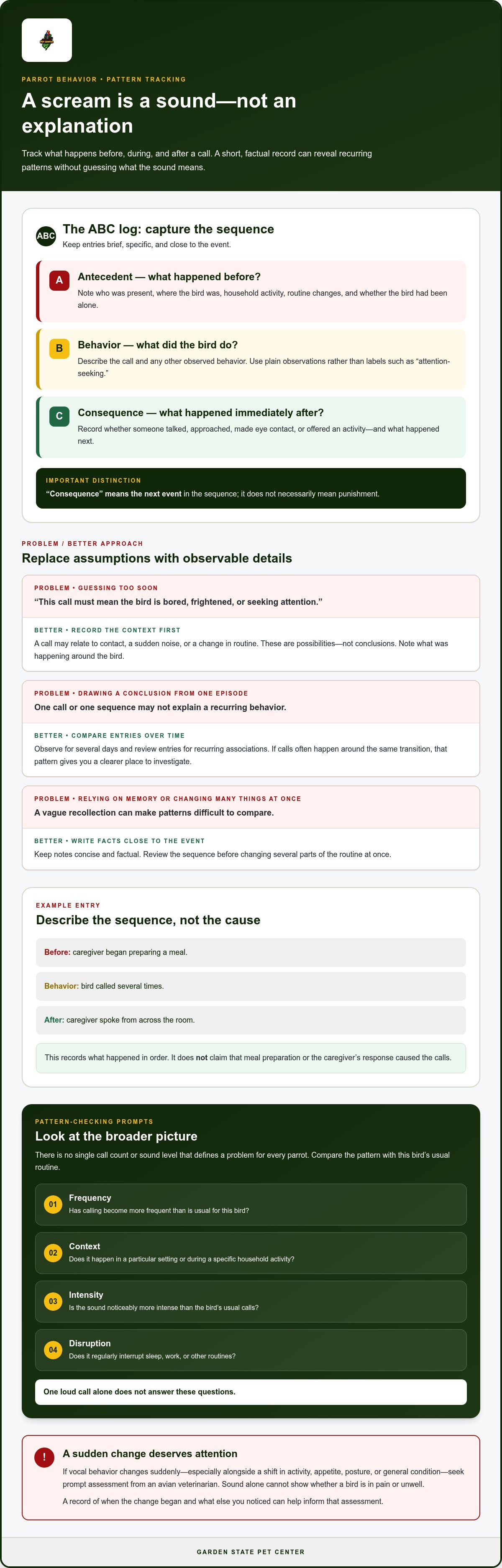
There isn’t one sound level or number of calls that defines a problem for every parrot. Consider the pattern through four lenses: frequency, context, intensity, and disruption. Has calling become more frequent than is usual for this bird? Does it happen in a particular setting or during a specific household activity? Is the sound noticeably more intense, or does it regularly interrupt sleep, work, or other routines? One loud call alone doesn’t answer those questions.
Excessive screaming is a repeated vocal pattern that differs from a parrot’s usual communication and causes enough concern or disruption to merit investigation. This definition offers a starting point without treating every vocal bird as a problem or relying on an arbitrary threshold.
Observe before deciding what a sound means. For several days, note the time, where the bird is, what people are doing, whether anything has changed in the room, and how caregivers respond. A short, factual record can reveal whether calls tend to occur when the household leaves, during busy moments, or at a familiar point in the daily routine. Record what you see rather than assuming a cause. The same call may serve different purposes in different situations.
When is parrot screaming normal communication?
Vocal calling is part of parrot social communication, though individual birds vary in how often and loudly they call. General information about parrot behavior and vocalization can help put this communication in context. Compare your bird’s current routine with their usual pattern. Note whether calls happen at familiar times, during social interaction, or in response to ordinary household sounds. Occasional loud calls, by themselves, don’t establish a behavior problem.
When should a change in screaming raise concern?
Pay attention when a vocal pattern changes suddenly, especially if you also notice a shift in activity, appetite, posture, or general condition. Sound alone can’t reveal whether a bird is in pain or unwell, so don’t try to diagnose the cause by listening. If the change is sudden or occurs alongside signs of illness, seek prompt assessment from an avian veterinarian. A clear record of when the change began and what else you’ve noticed can help inform that assessment.
Why Parrots Scream: Identify Triggers Before Changing Your Response
A scream is a sound, not an explanation. The same call might happen when a parrot is seeking contact, responding to a sudden noise, or reacting to a change in routine. These are possibilities, not conclusions. Look at what was happening around the bird before deciding what the call means. Guessing too soon can lead to a response that misses the underlying need.
Start an ABC log to make observations easier to compare. ABC stands for antecedent, what happened before; behavior, what the bird did; and consequence, what happened immediately afterward. “Consequence” here means the next event, not necessarily a punishment. Keep entries brief and factual. Include changes in sleep schedule, room setup, household activity, attention, and access to enrichment.
Could boredom, stress, or social needs be contributing?
Limited opportunities for activity, environmental changes, or less social contact may be relevant, but one episode can’t confirm a cause. Note whether calls repeatedly happen during a predictable transition, such as people leaving a room, or during periods when the bird is alone. Record what has changed in the bird’s routine or surroundings, and whether the timing matches the vocal pattern.
Include enrichment in your notes: what activities are available, whether the bird engages with them, and when they’re offered. Suitable toys and other bird supplies may support a broader enrichment routine, but adding an item alone doesn’t establish why a bird is calling or guarantee a change in behavior. Bird toys and supplies can be one part of considering the environment alongside social contact, daily activity, and routine.
How can an ABC log reveal a screaming trigger?
Write down useful details close to the event rather than relying on memory at the end of the day. For example, an entry might say: “Before: caregiver began preparing a meal. Behavior: bird called several times. After: caregiver spoke from across the room.” This records a sequence without claiming that the activity or response caused the calls.
- Before: Record who was present, household activity, location, routine changes, and whether the bird had been alone.
- Behavior: Describe the call and what the bird did, using plain observations rather than labels such as “attention-seeking.”
- After: Note whether anyone talked, approached, made eye contact, or offered an activity, and what happened next.
Review entries for recurring associations before changing several parts of the routine at once. If calls often appear around one transition, that pattern gives you a clearer place to investigate than a single incident does. Identifying patterns helps you choose a more appropriate response. Careful observation is a practical first step in learning how to reduce parrot screaming while staying responsive to your individual bird.
What Not to Do When Your Parrot Screams & What to Try
A loud call can test anyone’s patience, but shouting back, startling your bird, or using physical punishment can frighten them and damage trust. These reactions also don’t tell you what the bird needs. If a parrot experiences a raised voice as attention, even a frustrated response may make the exchange more rewarding from the bird’s perspective.
Consistency matters, too. If a call sometimes brings conversation, sometimes brings an activity, and sometimes gets no response, it can be difficult to tell which behavior is receiving attention. Aim for a calm, predictable response, while first considering whether the bird may be calling because of a real need or distress. Simply ignoring a scream isn’t suitable for every situation and isn’t guaranteed to change the pattern.
| Unhelpful reaction | Why it may backfire | Safer alternative |
|---|---|---|
| Yelling or calling loudly in response | The bird may experience the raised voice as social attention. | Keep your voice and movements calm, then notice and respond to a quieter moment. |
| Hitting, threatening, or startling the bird | Physical punishment and intimidation can cause fear and undermine trust. | Give the bird space and use patient, non-threatening interaction. |
| Responding differently from one episode to the next | Inconsistent reactions can make it harder for the bird to learn what earns attention. | Choose a steady response that considers the bird’s likely need and reinforces a suitable alternative. |
Why can yelling back or punishment make matters worse?
A parrot may perceive a caregiver’s voice, approach, or eye contact as attention, even if the caregiver means to interrupt the noise. Hitting or intimidation is harmful and isn’t an acceptable behavior strategy. Instead, when the bird is safe and their needs appear met, look for a brief pause or another calm behavior. Offer attention then, so a quieter behavior can serve a similar social purpose. If the calling continues or suggests distress, reassess rather than relying on ignoring it.
Make the alternative clear and worthwhile. If your parrot calls when you leave the room, for example, you might return during a natural pause and calmly greet them. The aim isn’t to withhold needed contact; it’s to notice which moments you reinforce. As you practice how to reduce parrot screaming, track what you do after calls and whether your response stays consistent.
Should you cover a cage to stop screaming?
Covering a cage as a time-out or punishment can make the experience frightening, and changing light or access doesn’t reveal why the bird is vocalizing. A cover isn’t a universal solution. Focus instead on a predictable routine, safe opportunities for activity, and careful observation of how your bird responds to changes. Appropriate bird toys and supplies may contribute to enrichment as part of that broader routine, not as a guaranteed fix for screaming.
How to Reduce Parrot Screaming with a Consistent Daily Plan
A steady plan helps you respond thoughtfully instead of reacting differently each time a call interrupts the day. Use what you’ve observed to choose a manageable change, then give your parrot a fair chance to learn what behavior earns attention. Progress may vary, so focus on the pattern and your bird’s well-being, not on a promise of silence.
- Observe. Note when the screaming happens and what is going on around your parrot. Look for a repeatable situation rather than treating one episode as proof of a trigger.
- Address a likely need. Consider whether your bird may need social contact, activity, a more predictable transition, or a calmer environment. Respond to signs of distress rather than ignoring them as part of a training plan.
- Teach an alternative. Choose a simple behavior that works in the same situation, such as pausing quietly before you approach or speak.
- Reinforce. When that quieter behavior happens naturally, respond promptly and calmly so your bird can connect the behavior with the attention or interaction they value.
- Review. Track what you changed and what happens afterward. Adjust one manageable factor at a time so you can see whether the pattern shifts.
How do you teach and reward a quieter alternative?
Pick an alternative that’s practical for both you and your bird. If your parrot calls while you’re nearby, you might wait for a brief calm pause, then offer a quiet greeting or attention. Keep the response consistent: notice the pause and reinforce it soon after it occurs. This helps make the desired behavior clear without requiring a rigid schedule or expecting instant results.
Try not to give the exact response you’re working to change immediately after a scream, such as rushing over to start an interaction, unless your bird needs help. Notice what happens in the moment and look for a suitable quieter opportunity to connect. The goal is to reinforce a behavior that can meet a similar need, not to withdraw care or social contact.
How can enrichment and routine support calmer behavior?
Build suitable activity into the day in ways that fit your parrot. You might offer a safe, species-appropriate activity or an opportunity to explore and forage, then observe whether your bird engages with it. Rotating options can keep familiar activities interesting, but enrichment is one part of care, not a guaranteed way to stop screaming. Explore bird toys and supplies as possible additions to a broader routine.
Predictable interaction and rest can also support a bird’s daily rhythm. Consider when your parrot is typically active, when the household is busy, and where calm social time might fit. Make one change at a time, such as offering an activity before a predictable transition, and record what follows. That way, you can refine the routine based on your own bird rather than making several changes at once and guessing what mattered.
For practical enrichment options, explore bird toys and supplies that may suit your parrot’s routine and interests.
When to Seek Extra Support for Parrot Screaming
Some vocal patterns need more than routine adjustments. Seek additional support if screaming persists despite careful observation and consistent changes, becomes more intense, or appears alongside signs of distress. A sudden shift deserves particular attention, especially if your parrot’s general condition or behavior has changed as well. You don’t need to determine the cause on your own before asking for help.
When should a caregiver seek an avian health assessment?
Contact an avian veterinarian promptly about a sudden change in vocal behavior or screaming accompanied by other health concerns. A new sound or increased calling can’t identify a medical problem by itself, and a caregiver’s notes aren’t a diagnosis. A log can still be useful: share when the change began, what you’ve observed, and any changes in your bird’s routine or condition. That context can help the veterinarian assess the concern.
For a pattern that has developed gradually, keep separating health questions from behavior questions. A veterinarian can assess health concerns, while your observations can help clarify when and where the calls happen. If health issues have been assessed but the pattern remains difficult to manage, discuss behavior-focused support with the veterinarian. They may help identify appropriate next steps, including a referral for more specialized behavior guidance.
How can trusted bird-care resources support the next step?
Practical home adjustments can continue alongside professional guidance, but they shouldn’t replace a health assessment when one is warranted. Review the bird’s environment and daily opportunities for engagement, and make changes gradually so you can observe their effect. Toys and other suitable supplies may contribute to enrichment, but they aren’t a guaranteed treatment for screaming or a substitute for understanding its context.
Nutrition is another part of overall bird care, though it isn’t a direct behavior treatment. Garden State Pet Center has an on-site Certified Pet Nutritionist for nutrition questions. Keep that support distinct from diagnosing or addressing a vocal behavior concern. A nutrition conversation can help with diet questions, while sudden changes or health concerns belong with an avian veterinarian.
Take the next step at a pace that supports your bird’s well-being. If suitable enrichment items would be useful as part of your broader care routine, explore bird-care supplies.
Take One Calm Step Forward
Choose one small, supportive change to carry into your next day with your parrot. It might be setting aside a predictable moment for connection or making an existing activity easier to access. Keep your expectations gentle. The aim of learning how to reduce parrot screaming is not to erase your bird’s voice, but to build a routine that respects their communication and works for your household.
Give yourself room to notice what feels manageable for both of you. A calm response, repeated with care, can help strengthen trust even while you’re still learning what your parrot needs. If a change in vocal behavior feels sudden or comes with signs that your bird may be unwell, make professional health assessment the next step.
Enrichment can be one helpful part of a bird’s broader care routine. Garden State Pet Center offers bird food, toys, and supplies, with boarding for birds and other small animals. Explore trusted bird food, toys, and supplies as you plan a thoughtful next step for your feathered companion.
Stay patient with your bird and with yourself. Small, attentive choices help you move forward together.
Frequently Asked Questions
Why does my parrot scream when I leave the room?
Your parrot may be calling to keep in contact when you move out of sight. Try a calm, brief verbal response from another room, then notice whether your bird settles or continues calling. Track whether it happens only when you leave or also when doors close, footsteps sound, or household activity changes. Those details can help distinguish a response to separation from a broader pattern tied to sounds or transitions.
Can ignoring a screaming parrot reduce the behavior?
Sometimes, but ignoring a call by itself isn’t a dependable approach. First consider whether your bird may need attention, activity, or help, and make sure the setting is safe. If the bird is settled and the call appears to be seeking interaction, avoid making a dramatic response the immediate result. Instead, notice and respond to a calm pause. If distress continues, reassess rather than simply withholding attention.
Should I cover my parrot’s cage when it screams?
Don’t use a cage cover as a punishment or a quick way to make a call stop. Covering changes light and visibility, but it doesn’t explain what prompted the sound and may add stress for some birds. Keep nighttime sleep arrangements separate from responses to daytime vocalizing. If you use a cover as part of an established sleep routine, observe your bird’s comfort and keep the routine predictable.
How can I tell whether my parrot is screaming from boredom or stress?
You can’t tell from the sound alone. Look for context: does calling happen during long stretches without activity, after a change in the room, or when a familiar person leaves? Note what your bird was doing before and after, along with changes in appetite, activity, or comfort. Repeated associations can suggest what to explore, but they don’t prove boredom or stress. A sudden change alongside health concerns warrants veterinary assessment.
What should I do if my parrot suddenly starts screaming more?
Arrange prompt assessment with an avian veterinarian, especially if the vocal change comes with other noticeable changes in behavior or general condition. Don’t assume the sound identifies a particular illness or cause. Write down when the change began, whether it happens in certain situations, and what else you’ve observed. This record can help explain the pattern during an appointment, but it can’t replace a professional health assessment.
Can toys and foraging activities help reduce parrot screaming?
They may support a more engaging daily routine, particularly if your parrot enjoys exploring, chewing, or working to find food. Choose safe, species-appropriate activities and observe how your individual bird responds; not every toy suits every parrot. Introduce an activity during a calm period and note whether your bird uses it. Enrichment can contribute to welfare, but it isn’t a guaranteed fix or a substitute for investigating the reason for calls.
How long does it take to change a parrot’s screaming behavior?
There’s no set timeline. The pace can depend on what’s prompting the calls, your bird’s history, and how consistently caregivers respond. To work on how to reduce parrot screaming, track small changes rather than expecting an overnight shift: note whether calls happen in the same situations, whether calm pauses occur, and how your bird responds to routine adjustments. If the pattern worsens or your bird seems distressed, seek additional guidance.

Article by
Victor Santucci
Victor Santucci Jr. is the owner of Garden State Pet Center and a Certified Clinical Pet Nutritionist specializing in premium pet nutrition, raw and fresh feeding, holistic pet wellness, birds and exotic animals. Through years of hands-on retail and animal-care experience, Victor helps pet parents make informed decisions about nutrition, enrichment and species-appropriate care.
Share this post
- 0 comment
- Tags: avian health, bird behavior, bird training, how to reduce parrot screaming, parrot care, parrot enrichment, parrot screaming, pet bird tips, positive reinforcement