

Leopard Gecko Care 101: The Ultimate 2026 Beginner’s Guide


What if the "easiest" reptile to own actually requires 20 years of expert precision to truly thrive? You want the best for your pet, but it's easy to feel overwhelmed by conflicting debates on substrate safety or the $300 to $450 initial setup costs. We understand the anxiety of wanting to get every detail right from day one. At Garden State Pet Center, we serve as a trusted resource for reptile enthusiasts because we believe that confidence comes from professional knowledge and premium supplies.
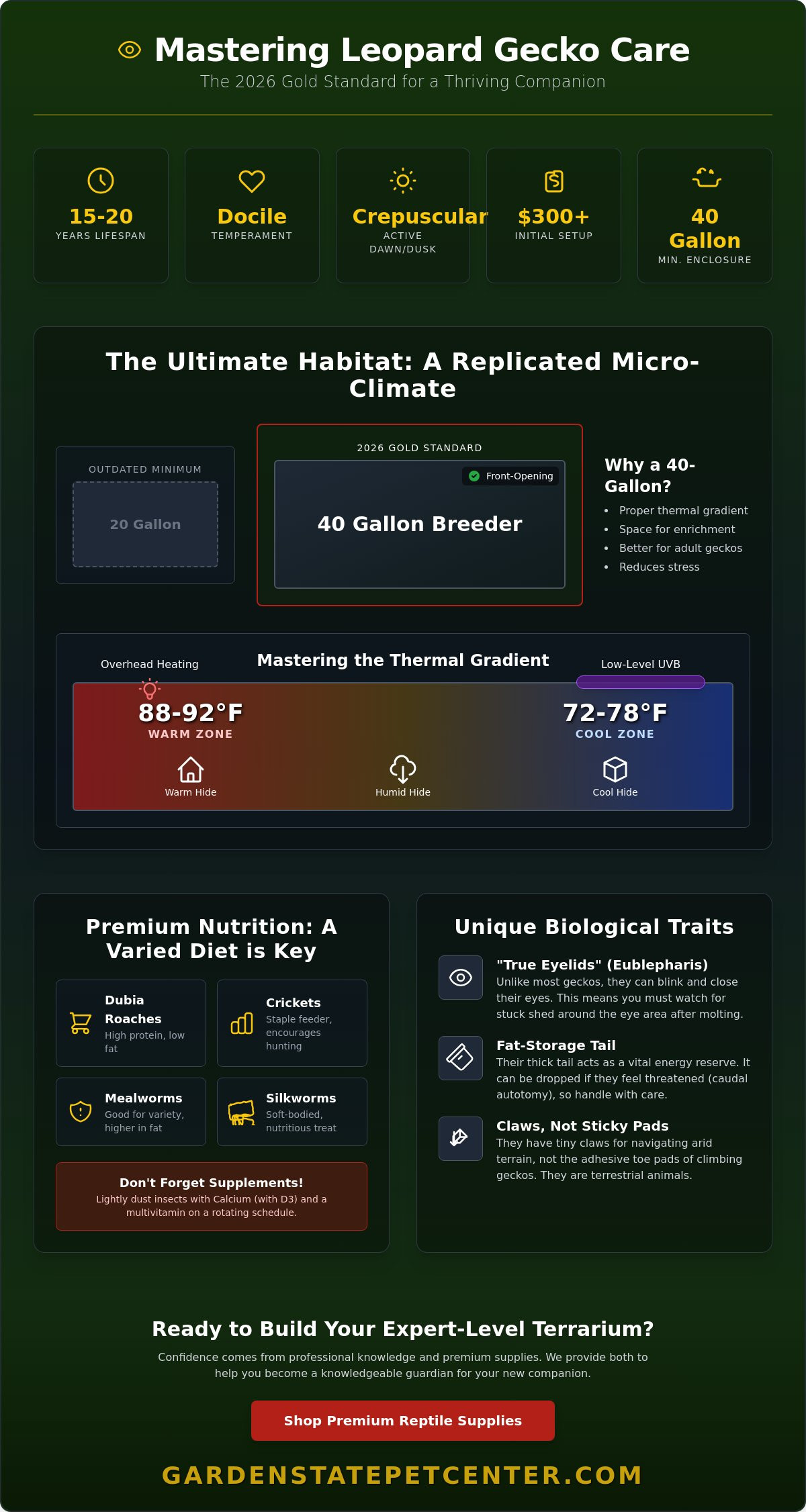
These geckos possess distinct biological traits that separate them from their cousins. While leopard geckos are ground-dwellers, you can explore the fascinating world of arboreal species and their variations at Crested Gecko Morph Guides. Their genus name, Eublepharis, literally translates to "true eyelid." While most geckos have a clear scale over their eyes that they must lick to clean, leopard geckos can blink and sleep with their eyes closed. This makes them less prone to certain eye injuries but requires you to monitor their shed cycles closely to prevent stuck skin around the lids. Their thick tails serve as a vital fat storage organ, acting as a fuel tank for times when food is scarce. You should handle them with care, as they can drop their tails if they feel threatened, a process called caudal autotomy. Finally, they lack the sticky toe pads found in climbing species. Instead, they have tiny claws designed for navigating the rocky, arid terrain of their native Pakistani and Indian landscapes.
Discover how to master leopard gecko care with our definitive 2026 guide to husbandry and long-term health. We'll help you navigate the essentials of specialized nutrition and habitat design so you can create a beautiful, safe environment for your new companion. This guide provides a clear path through everything from maintaining a strict 88-92°F warm zone to selecting the right UVB lighting and a diverse rotation of feeder insects. You'll gain the clarity needed to ensure your gecko enjoys a full, 20-year lifespan in a stunning, expert-level terrarium setup.
Key Takeaways
- Discover why a 40-gallon front-opening terrarium is the modern gold standard for accessibility and your pet's security.
- Learn to replicate an arid micro-climate by mastering the thermal gradient with expert-recommended overhead heating equipment.
- Elevate your leopard gecko care by providing a varied, premium diet of live insectivore staples for optimal growth.
- Build a foundation of trust using choice-based handling methods that respect your gecko's natural docile temperament.
- Identify the specific visual signs of health and vitality to ensure your companion enjoys a thriving 20-year lifespan.
Understanding Leopard Geckos: The Ideal First Reptile
The Leopard gecko (Eublepharis macularius) stands out as the most popular choice for new keepers, and for good reason. Often called the "golden retriever" of the reptile world, these lizards are famous for their docile temperament and ease of handling. Unlike many exotic pets that remain skittish, a well-socialized gecko often becomes quite curious about its human partners. However, high-quality leopard gecko care starts with a long-term commitment. These animals aren't short-term hobbies; they regularly live for 15 to 20 years in captivity. You'll also notice they are crepuscular, meaning they're most active during the dim light of dawn and dusk. This schedule often aligns perfectly with a typical workday, allowing you to enjoy their personality when you get home.
Discover more about their unique personality and basic needs in this helpful overview:
Unique Characteristics: Eyelids, Tails, and Toes
These geckos possess distinct biological traits that separate them from their cousins. Their genus name, Eublepharis, literally translates to "true eyelid." While most geckos have a clear scale over their eyes that they must lick to clean, leopard geckos can blink and sleep with their eyes closed. This makes them less prone to certain eye injuries but requires you to monitor their shed cycles closely to prevent stuck skin around the lids. Their thick tails serve as a vital fat storage organ, acting as a fuel tank for times when food is scarce. You should handle them with care, as they can drop their tails if they feel threatened, a process called caudal autotomy. Finally, they lack the sticky toe pads found in climbing species. Instead, they have tiny claws designed for navigating the rocky, arid terrain of their native Pakistani and Indian landscapes.
The Knowledgeable Guardian Approach
Becoming a successful keeper means shifting from being a "pet owner" to a "knowledgeable guardian." This mindset involves proactive observation. You should spend time daily watching your gecko's posture, appetite, and activity levels. Success begins with sourcing your animal from a reputable environment. We recommend reading our guide on Choosing the Right Reptile Store to ensure you start with a healthy, ethically bred animal. At Garden State Pet Center, we take pride in being a trusted partner for your journey. Explore our premium reptile collection and supplies to find everything you need for a thriving setup. By focusing on expert-led leopard gecko care, you ensure your new companion stays vibrant for decades.
Designing the Ultimate Leopard Gecko Habitat: A Step-by-Step Setup
Creating a home for your lizard is about more than just finding a glass box; it's about replicating a specific arid micro-climate. While older guides often suggested a 20-gallon tank as a minimum, 2026 standards for expert leopard gecko care now favor a 40-gallon breeder terrarium. This larger footprint provides the necessary space for a proper thermal gradient, allowing your pet to move between warm and cool zones effectively. We always recommend front-opening enclosures. Reaching in from the side rather than the top prevents you from looking like a predator to your gecko, which significantly reduces their stress during handling and maintenance.
Choosing the Right Enclosure
You'll primarily choose between glass and PVC materials. Glass is the traditional choice and offers excellent visibility, though it can struggle with heat retention in cooler rooms. PVC enclosures are becoming the "trusted" choice for many enthusiasts because they hold heat and humidity more efficiently. If you're unsure which model fits your home, check out our guide on Reptile Terrariums: The Ultimate Buyer’s Guide for 2026 for detailed comparisons. Once you've selected your tank, place it in a quiet area away from direct sunlight to maintain stable internal temperatures.
Substrate: The Great Debate Settled
Choosing what goes on the floor of the tank is a critical decision. You must avoid loose calcium sand or walnut shells because geckos often ingest these materials, leading to life-threatening impaction. For a naturalistic approach that encourages digging behavior, we recommend a 70/30 mix of organic topsoil and play sand. This blend provides a stable surface that won't collapse. If you're in a quarantine period with a new animal, paper towels are a safe, hygienic option that allows you to monitor health easily. To find the right materials for your setup, you can browse our selection of high-end terrariums and reptile-safe supplies.
After settling the floor, you'll need to focus on the "rule of three" for hides. Your gecko requires at least three distinct shelters to feel secure:
- Warm Hide: Placed directly over or under the heat source.
- Cool Hide: Located on the opposite end of the enclosure.
- Humid Hide: Filled with damp moss or paper towels to aid in shedding.
Expert leopard gecko care also involves providing enrichment to keep your pet active. Use flat slate rocks to create basking platforms and add sterilized driftwood for low-profile climbing. These textures help wear down their tiny claws naturally. You can even include drought-resistant plants like air plants or succulents to add a touch of life to the environment. As noted in the RSPCA leopard gecko care sheet, providing a complex environment is essential for preventing boredom and promoting natural behaviors. By building a layered, textured habitat, you're not just keeping a pet; you're curating a thriving ecosystem.
Mastering Temperature, Lighting, and Humidity
Creating a precise environment is the most technical aspect of leopard gecko care, but it's also the most critical for your pet's long-term health. Because geckos are ectotherms, they rely entirely on their surroundings to regulate their body temperature. You must establish a "thermal gradient," which is a range of temperatures from one side of the enclosure to the other. This allows your gecko to move to the warm side to digest a meal or retreat to the cool side to rest. Without this gradient, your pet's metabolism can stall, leading to lethargy and illness.
The Science of Heat: Basking Spots vs. Ambient Temps
Modern husbandry standards have shifted away from under-tank heat mats. While mats provide surface heat, overhead sources like Halogen heat lamps or Deep Heat Projectors (DHP) provide Infrared-A and Infrared-B, which penetrate deep into the gecko's muscle tissue. Your basking surface temperature should reach 94-97°F, while the cool side remains between 70-77°F. You must use a dimming thermostat to control these temperatures; without one, heating elements can reach dangerous levels that cause burns or heat stroke. Night-time temperature drops are natural and beneficial for metabolic health. For more clinical details on these requirements, you can consult veterinary information on leopard geckos to understand how heat affects their internal systems.
Lighting for Health: UVB and Day/Night Cycles
While leopard geckos were once thought to thrive in the dark, we now know that low-level UVB lighting is essential for vitamin D3 synthesis. You should provide a Ferguson Zone 1 UVB light, typically a 2.4% to 7% T5 linear bulb, depending on the height of your enclosure. This lighting prevents Metabolic Bone Disease (MBD), a painful condition that softens the bones and can be fatal if left untreated. Establish a strict 12-hour light and 12-hour dark cycle to regulate your pet's internal clock. Avoid using "colored" night bulbs, such as red or blue lights, as geckos can see this light and it disrupts their sleep patterns. If you need to upgrade your current setup, you can find premium reptile supplies at Garden State Pet Center to ensure your lighting is up to 2026 standards.
Humidity is the final piece of the puzzle. You should aim for an ambient humidity level of 30-40% throughout the terrarium, which usually matches the average household level. However, your gecko must have access to a humid hide maintained at 70-80% humidity. This localized moisture is vital for a clean shed, particularly around their toes and eyelids. Use a digital hygrometer to monitor these levels daily, as analog dials are often inaccurate by as much as 20%. By mastering these three pillars, you provide a foundation that allows your gecko to thrive rather than just survive.
Premium Nutrition: Feeding for Optimal Growth and Health
Leopard geckos are strict insectivores. Their digestive systems don't process plants, fruits, or vegetables; they thrive solely on insect protein. Providing high-quality leopard gecko care means moving beyond the basic "crickets only" approach. A varied diet is the best way to ensure your pet receives a full spectrum of amino acids and minerals. In the wild, they consume a massive variety of invertebrates, and you should aim to replicate that diversity in your home setup. By rotating through different staple feeders, you prevent nutritional gaps and keep your gecko engaged with their environment.
Staple Feeders vs. Occasional Treats
Not all insects offer the same nutritional value. Dubia roaches are widely considered the gold standard because they have a high protein-to-shell ratio and don't jump or smell. Crickets are another excellent staple that encourages natural hunting behaviors, while silkworms provide a unique boost of calcium and healthy fats. You should contrast these with "treat" insects like waxworms or superworms. While geckos love them, waxworms are exceptionally high in fat and can lead to obesity or "addiction" where the gecko refuses healthier options. Feed juveniles every day to support their rapid growth, but scale back to 2-3 times per week for healthy adults. You can shop our reptile supply collection for escape-proof feeding bowls and precision tongs to make every meal session successful.
Hydration and Supplementation
Insects are essentially empty vessels until you prepare them through a process called gut-loading. You must feed your feeder insects high-quality vegetables or specialized bug diets for at least 24 hours before offering them to your gecko. This ensures that the vitamins inside the insect's gut pass directly to your pet. Beyond gut-loading, a strict dusting schedule is mandatory. Use a premium calcium powder with Vitamin D3 for most feedings, and rotate in a reptile multivitamin twice a month. Many trusted keepers also leave a small, shallow dish of pure calcium (without D3) in the enclosure. This allows the gecko to lick the powder and self-regulate their calcium levels as needed.
Hydration is just as vital as solid food. Always provide a shallow water dish filled with fresh, clean water. Geckos aren't strong swimmers, so the dish shouldn't be deeper than the gecko's chin to prevent any risk of drowning. Scrub the dish every few days to prevent biofilm or bacterial buildup. By combining premium insect variety with expert-level supplementation, you provide the building blocks for a vibrant, long-lived companion. This proactive approach to leopard gecko care ensures your pet maintains a thick, healthy tail and strong bone structure for decades.
Handling, Socialization, and Common Health Signs
Building a relationship with your new companion is one of the most rewarding parts of leopard gecko care. Unlike mammals, reptiles don't seek out affection, but they can certainly learn to trust you through consistent, gentle interaction. We advocate for a choice-based handling method. This means you offer your hand as a stationary platform and allow the gecko to climb on when it feels comfortable. Forcing interaction or chasing them around the tank can lead to extreme stress or even tail dropping. Always wash your hands thoroughly before and after every interaction. This simple practice protects your pet from outside contaminants and prevents the transmission of Salmonella to your household.
Monitoring your gecko's physical condition is a daily responsibility. A healthy gecko exhibits clear, bright eyes and an alert posture, often watching its surroundings with curiosity. The most obvious indicator of health is a thick, plump tail, which serves as their primary fat storage. You should be aware of specific red flags that require immediate attention. "Stick tail," where the tail becomes thin and bony, is a sign of underlying parasites or severe malnutrition. Other concerns include extreme lethargy or a refusal to eat for more than 7 to 10 days. By catching these signs early, you act as a proactive guardian for your pet's welfare.
Socializing Your Gecko: The First 30 Days
The first 30 days are the most critical for an "Anxious Pet." When you first bring your gecko home, resist the urge to handle them for at least the first 7 days. They need this time to acclimate to the new sounds and smells of your home. Start socialization by placing your hand in the tank for five minutes a day without moving it. This allows the gecko to investigate your scent without fear. Never grab your gecko from above. In the wild, birds of prey are their primary predators, so a hand descending from the ceiling triggers a flight response. Always approach from the side at their eye level to build a foundation of safety and trust.
Shedding and Hygiene Maintenance
You'll notice your gecko's skin turning a ghostly white every few weeks as they prepare to shed. This is a natural process where they often peel and eat their own skin to recycle nutrients and hide their scent. Sometimes, skin gets stuck on their tiny toes or eyelids, which can lead to infection or even the loss of a digit. If you see stubborn skin after 24 hours, you can provide a "gecko sauna." Place the gecko in a shallow container with warm, wet paper towels for 15 minutes to soften the tissue. If you're planning a trip and need professional oversight for these delicate needs, consider our Expert Pet Boarding services. We ensure your pet receives specialized leopard gecko care while you are away, giving you peace of mind.
Start Your Journey with Confidence
Mastering leopard gecko care is a rewarding commitment that transforms a simple terrarium into a thriving, arid ecosystem. By prioritizing a 40-gallon enclosure with precise thermal gradients and overhead heating, you establish the foundation for a 20-year lifespan. Success lies in the details, from the mandatory gut-loading of premium insects to the choice-based handling methods that build lasting trust with your pet. You've now gained the expert knowledge needed to move past conflicting advice and provide a high-quality home for your new companion.
Since 1990, the team at Garden State Pet Center has acted as a trusted resource for pet owners nationwide. We provide specialized nutrition consultations, habitat design expertise, and professional boarding services for your peace of mind. Whether you're a first-time owner or a seasoned hobbyist, we're here to help you navigate every shed and feeding session with clinical precision. Take the next step in your reptile-keeping journey by visiting us for the high-end supplies your pet deserves.
Shop Our Premium Reptile Collection for Your Gecko Needs
We can't wait to see your beautiful new setup and help your gecko thrive for decades to come.
Frequently Asked Questions
Do leopard geckos need a heat lamp at night?
Leopard geckos don't require a light-emitting heat lamp at night because it disrupts their natural circadian rhythm. If your room temperature stays above 65°F, they don't need any supplemental night heat at all. If your home drops below that threshold, use a non-light-emitting source like a ceramic heat emitter. A natural temperature drop is actually healthy for their metabolism and mimics their native environment.
Can two leopard geckos live together in the same tank?
Two leopard geckos should never live together in the same enclosure regardless of their gender. They are naturally solitary animals, and cohabitation often leads to territorial aggression, severe injuries, or even death. Even if they appear to be "cuddling," they are likely competing for the best basking spot. Keeping them separate ensures each animal has equal access to heat, hides, and premium nutrition without stress.
How often should I clean my leopard gecko’s terrarium?
You should spot clean your gecko's terrarium every day to remove waste and uneaten insects. A full deep clean is required at least once every 30 days to maintain high-quality leopard gecko care. During this monthly scrub, you must remove all substrate and disinfect every surface with a reptile-safe cleaner. This strict schedule prevents the buildup of harmful bacteria and keeps your pet's environment smelling fresh and looking beautiful.
Why is my leopard gecko not eating?
A leopard gecko may stop eating due to incorrect enclosure temperatures, upcoming shedding, or high stress levels. Check your digital thermometer to ensure the warm side is reaching 88-92°F; if the environment is too cold, their metabolism stalls and they can't digest food. If they are turning white, they are likely preparing to shed and will resume eating once the process is complete.
What is the best substrate for a leopard gecko in 2026?
The professional standard for leopard gecko care in 2026 is a 70/30 mix of organic topsoil and play sand. This loose substrate allows for natural burrowing behaviors without the high risk of impaction associated with calcium sand. If you are currently in a quarantine period for a new pet, use paper towels for 60 days. This makes it easier to monitor their health and verify they are parasite-free.
How do I know if my leopard gecko is happy?
You can tell your gecko is thriving when they show curiosity, maintain a thick tail, and have clear, bright eyes. While "happiness" is hard to measure in reptiles, a well-adjusted gecko will explore their tank during dawn and dusk. They should also have a consistent appetite and move easily between the warm and cool zones. If they are hiding 24 hours a day, it might be time to re-evaluate your setup.
Is a 20-gallon tank big enough for an adult leopard gecko?
A 20-gallon long tank is the absolute minimum for an adult, but a 40-gallon breeder is the ideal 2026 standard. Larger enclosures provide more room for the three essential hides and a better thermal gradient. We recommend the 40-gallon size because it allows for more enrichment like climbing branches and rocks. Providing this extra space is a proactive way to ensure your pet stays active and healthy throughout their life.
Do leopard geckos bite, and does it hurt?
Leopard geckos rarely bite, and when they do, it usually feels like a small, startling pinch rather than a painful injury. Most bites occur by accident during feeding sessions if the gecko misses the insect and hits your finger. They are exceptionally docile reptiles that prefer to retreat rather than attack. As long as you use a choice-based handling method, you'll likely never experience a bite from your companion.

Article by
Victor Santucci
Victor Santucci is the owner of Garden State Pet Center in Audubon, NJ, where he specializes in premium pet nutrition, exotic animals, and expert-level care. With years of hands-on experience and a passion for helping pets thrive, Victor is dedicated to educating pet owners on proper nutrition, enrichment, and species-specific care. His mission is simple: provide every pet with the highest quality products and every customer with honest, knowledgeable guidance.
Share this post
- 0 comment
- Tags: beginner's guide, gecko care, gecko diet, leopard gecko, leopard gecko care, pet care, reptile care, reptile husbandry, terrarium setup