

Multivitamin drops for pet birds: choosing a suitable formula


The right bird vitamin is the one that matches your bird’s species, diet, and life stage. When choosing multivitamin drops for pet birds, compare the label’s ingredients and directions rather than assuming one formula or dose suits every bird. For parakeets, cockatiels, budgies, and small hookbills, one small-bird product’s directions call for 1 drop per ounce of drinking water, or 4 drops in 4 oz.
It’s understandable to want a simple way to support your bird’s nutrition, especially when needs can vary with age, breeding, or molting. Multivitamin drops can be convenient, but they shouldn’t replace a balanced diet. Before adding a supplement, consider what your bird already eats.
This guide explains how to compare liquid drops with food-based use, read ingredient lists, and understand the roles of vitamins such as A, D3, E, and B-complex. It also covers practical considerations for budgies and birds at different life stages, including when to discuss supplementation with an avian veterinarian. Use the product directions as a starting point, then consider your bird’s diet and individual needs before adding vitamins.
Key Takeaways
- Compare a supplement’s form, ingredients, and species-specific directions before choosing one for your bird.
- Consider how breeding, molting, age, and health can affect a bird’s nutritional needs.
- Learn what vitamins A, D3, E, and B-complex contribute, and why the ingredient list matters.
- Keep your budgie’s overall diet in view, and discuss supplementation with an avian veterinarian.
- Use supplements to complement a balanced diet, not replace it.
1. Choosing supplement forms and ingredients
For U.S. buyers, look for a small-bird formula with a full guaranteed analysis and directions for your bird’s species. No single rating replaces checking the label. Compare multivitamin drops for pet birds by ingredients, concentration, bottle size, and intended use, rather than relying on marketing claims alone.
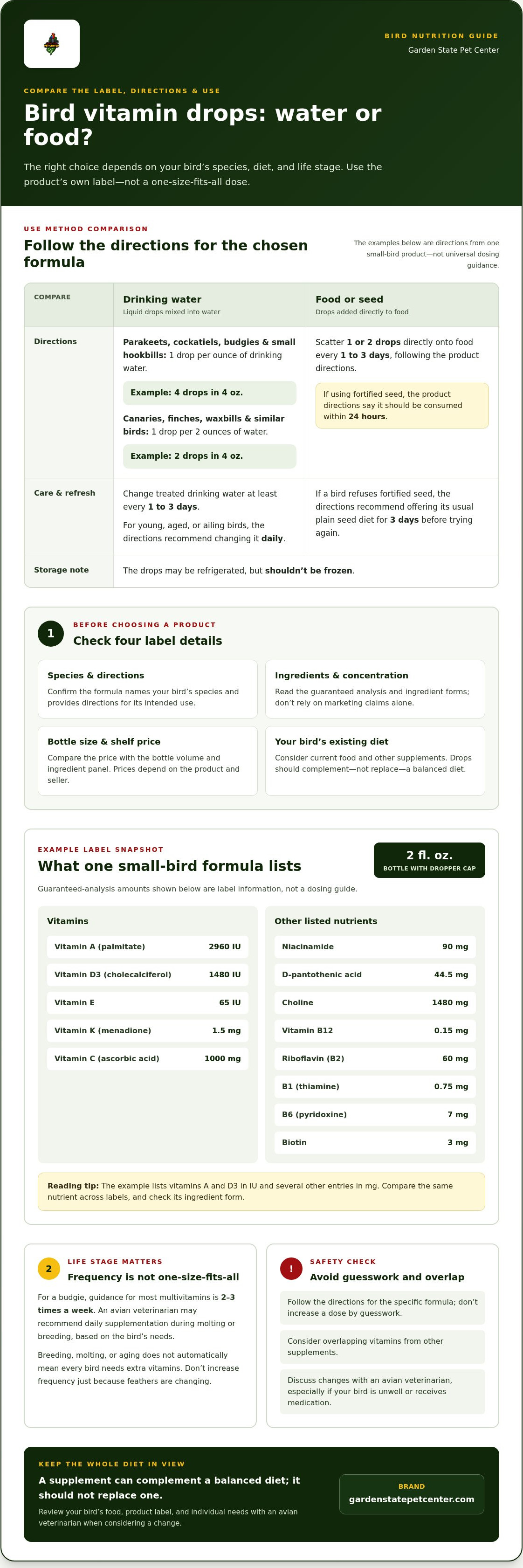
Prices depend on the product and seller, so compare the shelf price with the bottle volume and ingredient panel. One small-bird formula comes in a 2 fl. oz. bottle with a dropper cap. Its guaranteed analysis lists vitamin A (palmitate) at 2960 IU, vitamin E at 65 IU, and vitamin K (menadione) at 1.5 mg. It also lists vitamin C (ascorbic acid) at 1000 mg, niacinamide at 90 mg, d-pantothenic acid at 44.5 mg, and choline at 1480 mg.
Liquid drops can be used by the bird species named in a product’s directions, but the dose varies. For parakeets, cockatiels, budgies, and small hookbill birds, one formula specifies 1 drop per ounce of drinking water. Its directions also specify 4 drops in 4 oz. For canaries, finches, waxbills, and similar birds, they specify 1 drop per 2 ounces, or 2 drops in 4 oz. Follow the label for the specific formula you choose.
Water-based dosing needs careful preparation. The directions advise changing treated drinking water at least every 1 to 3 days. For young, aged, or ailing birds, they recommend changing it daily. If using fortified seed, the directions say it should be consumed within 24 hours. For food, they recommend scattering 1 or 2 drops directly onto it every 1 to 3 days. They also say the drops may be refrigerated but shouldn’t be frozen.
Safety starts with following the product directions, not increasing a dose by guesswork. The practical risk is giving more than directed or combining supplements with overlapping vitamins. A bird’s balanced diet remains essential; drops shouldn’t replace it. If a bird refuses fortified seed, the directions recommend offering its usual plain seed diet for 3 days before trying again. For a weak bird unwilling to drink, the directions describe putting 1 to 2 drops directly into its beak, followed by 1 to 3 mL of water. Treat that as product-specific direction, not a substitute for advice about an unwell bird.
2. Supplements for breeding, molting, and senior birds
Breeding, molting, and aging can prompt owners to reconsider a bird’s nutrition. They don’t automatically mean every bird needs extra vitamins. Start by reviewing the bird’s regular diet, the supplement label, and the reason for considering a change. For a budgie, the guidance for most multivitamins is 2-3 times a week. An avian veterinarian may recommend daily supplementation during molting or breeding, based on the bird’s needs.
Keep the routine specific to the bird and product. Before making a change, write down your bird’s current food, supplements, and schedule. Compare the label directions with the bird’s species and life stage: a recommendation for a budgie doesn’t automatically apply to a canary or another bird. During a molt, note when supplementation starts and follow the directions consistently. Don’t increase the frequency just because feathers are changing.
Breeding birds need an individual plan, not the assumption that more vitamins improve results. A veterinarian may recommend daily supplementation during breeding, but that differs from giving a daily dose without veterinary guidance. Share details about the bird’s diet and breeding status with an avian veterinarian, then follow the specific product directions they consider appropriate. Make sure everyone who feeds or cares for the bird understands the plan.
For young, aged, or ailing birds, one product’s directions recommend 1 1/2 to 2 times the regular dose. Treat that as product-specific guidance, not a universal dose for every formula. Check that the label applies to the bird and the intended use before adjusting anything. For a senior bird, record the usual diet and any current supplements. Those details help an avian veterinarian assess the total plan, rather than considering drops in isolation.
Can multivitamin drops affect medications or veterinary treatments? They may affect the overall treatment plan, particularly if the supplement contains ingredients the bird already receives. Before starting, stopping, or changing a supplement, give the avian veterinarian its full label and details of the bird’s medications. Don’t use drops in place of prescribed treatment.
Use a simple routine: identify the life-stage concern, review the product directions, and discuss changes with an avian veterinarian. Keep notes on the formula and schedule, particularly if a veterinarian recommends daily use during molting or breeding. For a bird-focused supplement selection, browse bird vitamins and supplements and compare each label with your bird’s needs.
3. Vitamin A, D3, E, and B-complex
Read the guaranteed analysis as a list of named nutrients and amounts, not as a dosing guide. One small-bird formula lists vitamins A and D3 in IU, while several other entries use mg. These units describe different measurements, so compare each nutrient with the same nutrient on another label. Check the ingredient form, too. For example, vitamin A appears as palmitate, while vitamin D3 appears as cholecalciferol.
- Vitamin A: The formula lists vitamin A (palmitate) at 2960 IU.
- Vitamin D3: It lists vitamin D3 (cholecalciferol) at 1480 IU.
- Vitamin E: The guaranteed analysis lists vitamin E at 65 IU.
- B vitamins: It lists B12 at 0.15 mg, riboflavin (B2) at 60 mg, B1 (thiamine) at 0.75 mg, B6 (pyridoxine) at 7 mg, and biotin at 3 mg.
Vitamin D3 has a specific role described for budgies: it helps them use calcium and supports bone health, particularly indoors without sunlight. That context helps explain why D3 appears on a bird supplement label. It doesn’t tell you whether a particular bird needs extra D3. Consider the bird’s overall diet and living conditions, rather than treating a listed ingredient as an automatic reason to supplement.
Use the label in a consistent order. First, identify the nutrient name. Next, note its form, such as cholecalciferol for D3 or thiamine for B1. Then record the listed amount and unit. Finally, read the product directions separately. A guaranteed analysis gives ingredient information; directions explain how the product is intended to be used. Don’t infer an individual bird’s dose from the analysis alone.
The B-complex entries deserve a careful read because “B-complex” can cover several named nutrients. This formula specifies riboflavin, thiamine, pyridoxine, B12, and biotin, with distinct amounts for each. Check the full list instead of assuming every product contains the same combination. Niacinamide and d-pantothenic acid are also listed on the formula, showing why ingredient-by-ingredient comparison is more useful than relying on a broad “complete” claim.
Include vitamin E and vitamin A in your comparison notes. Record the amount and form exactly as printed, then compare like with like across labels. Don’t add products just to increase a number on the panel. For a budgie or another pet bird, the label is only one part of the decision: diet, species, and individual circumstances also matter.
4. Why budgies may need vitamin supplementation
A budgie’s need for extra vitamins depends on its diet and circumstances. Breeding or molting may prompt a nutrition review, but these life stages don’t automatically call for the same supplement plan. Write down the bird’s regular food and any supplements it already receives. This gives an avian veterinarian a clearer picture than choosing drops based on life stage alone.
Indoor living is one specific factor to discuss. Vitamin D3 helps budgies use calcium and supports bone health, particularly when they’re kept indoors without sunlight. That explains why D3 may matter in a nutrition discussion. It doesn’t establish that every indoor budgie needs extra D3. Consider the complete diet and the supplement label together, rather than adding a product based on one detail.
How often should you give a budgie vitamins? Guidance for most budgie multivitamins recommends 2-3 times a week. During molting or breeding, an avian veterinarian may recommend daily supplementation. Follow the directions for the specific formula and the veterinarian’s advice; don’t turn a seasonal change into an automatic dose increase.
Before starting, make a short nutrition checklist:
- Write down the budgie’s usual foods and current supplements.
- Note whether the bird is breeding, molting, or kept indoors without sunlight.
- Read the product’s directions and ingredient panel.
- Discuss the plan with an avian veterinarian before changing the routine.
When should a pet bird see an avian veterinarian before taking vitamin supplements? Consult an avian veterinarian before giving a budgie supplements, particularly if you’re considering daily use during breeding or molting. Bring the product label and a clear account of the bird’s diet so the recommendation fits its overall nutrition plan.
Keep the goal clear: supplements complement a balanced diet, not replace it. Even if your budgie eats its usual food, review its diet before adding drops. Compare the listed nutrients with what the bird already receives, then follow the product directions. Avoid combining products just because each label features a different vitamin. Overlapping ingredients can make the total plan harder to assess.
For a practical example, an indoor budgie in molt has two details worth discussing: limited sunlight and a changing life stage. Neither detail alone sets a dose. Share both with an avian veterinarian, then follow the resulting plan consistently. If the recommendation is 2-3 times a week, keep that schedule distinct from daily use recommended for a particular bird during molting or breeding.
Track the routine in a simple log, noting the product, feeding schedule, and any changes to the budgie’s diet. When the bird’s life stage changes, review the plan rather than automatically continuing an old schedule. This keeps decisions tailored to the individual bird, its diet, and the supplement’s intended use.
5. What vitamins do pet birds need, and when are multivitamin supplements recommended?
Pet birds need a balanced diet, and supplements shouldn’t replace it. Whether extra vitamins make sense depends on the bird’s regular food, species, and circumstances. Start with the diet, not the bottle: write down the bird’s usual foods and current supplements, then compare them with the product’s ingredient panel.
A label can list vitamin A, D3, E, and several B-complex nutrients. Those names help you identify what the formula contains, but they don’t establish that every bird needs every listed ingredient. Read each amount and form carefully. Check directions separately, since a guaranteed analysis describes ingredients, while product directions explain intended use.
Vitamin D3 has a particular relevance for budgies kept indoors without sunlight. It helps them use calcium and supports bone health. That makes indoor living a useful point to include in a nutrition discussion, not a reason to assume every indoor bird needs supplementation. Consider the whole diet and the bird’s circumstances before deciding whether drops fit.
Life stage can also prompt a review. Breeding or molting may lead you to ask whether your bird’s usual diet meets its needs. Age or illness are further reasons to avoid changing a supplement routine casually. These circumstances don’t call for one universal formula or schedule. Instead, review the bird’s existing food, current supplements, and product directions together.
Use this practical sequence before adding a multivitamin:
- Record the bird’s species and usual diet.
- List any supplements already given, including their ingredients.
- Read the proposed formula’s ingredient panel and directions.
- Consider relevant circumstances, such as indoor housing, breeding, or molting.
- Discuss budgie supplementation with an avian veterinarian.
That review matters because the same supplement may not suit every bird. Share the label and diet details during the discussion. For budgies, consult an avian veterinarian about vitamin supplementation. The veterinarian can consider the full feeding routine and why you’re considering drops, rather than assessing one ingredient in isolation.
Keep the purpose of supplementation clear. A multivitamin can complement a balanced diet, but it isn’t a substitute for one. Don’t use a vitamin label as a shortcut for assessing nutrition, or add multiple products simply to cover more ingredients. Match the formula to the bird’s needs, follow its directions, and revisit the decision when its diet or life stage changes.
Garden State Pet Center: Premium Pet Food
Garden State Pet Center helps pet owners consider food choices alongside their bird’s overall care needs. Its premium pet food selection gives you options to explore, while pet toys and accessories support everyday enrichment. The store also offers exotic birds and small animals for households with a range of companion animals.
Use the article’s label-reading steps when comparing food and supplements, and keep a balanced diet at the center of your bird’s routine. If you’re weighing nutrition choices or looking for supplies for your bird, contact Garden State Pet Center to continue the conversation.
Make your bird’s next nutrition choice with confidence
Choosing multivitamin drops for pet birds can be part of a broader care plan, not an isolated purchase. Connect nutrition decisions to your bird’s everyday environment and routine. As these change, review whether the food and supplements still work together, and keep product details handy for future care discussions.
Garden State Pet Center offers premium pet food, pet toys and accessories, and exotic birds. These offerings support a thoughtful approach to daily care, from feeding choices to enrichment. Explore the options that fit your bird’s routine and take the next step at your own pace.
Contact Garden State Pet Center to continue planning a nourishing, enriching routine for your bird.
Frequently Asked Questions
How do bird vitamin drops compare with powdered supplements and fortified pellets?
The main difference is how each product is measured and offered. Drops are measured as a liquid and used according to the label; powders require the preparation described on the packaging. Fortified pellets are a food format, not a separate supplement added at serving time. Compare the intended species, ingredients, and feeding directions. For example, consider whether your bird reliably eats its regular food when choosing a way to provide a supplement.
How should multivitamin drops be administered to pet birds, and what is the correct dosage?
Use the directions for the exact formula and bird group; there isn’t one dose for every bird. One small-bird product directs 1 drop per ounce of water for budgies, parakeets, cockatiels, and small hookbills, or 4 drops in 4 oz. For canaries, finches, waxbills, and similar birds, it specifies 1 drop per 2 ounces, or 2 drops in 4 oz. Don’t transfer one group’s directions to another.
Can bird vitamin drops be added to drinking water, and how often should the water be changed?
Yes, some bird vitamin drops are intended for drinking water, provided their directions specify that method. Follow the product’s species-specific measurement and water instructions. One formula advises changing treated water at least every 1 to 3 days, with daily changes for young, aged, or ailing birds. Prepare fresh water as directed, and don’t assume another product has the same schedule.
What are the prices and ingredients of popular bird multivitamin drops in the US?
One small-bird formula lists vitamin A, D3, E, C, K, B12, B2, B1, B6, niacinamide, d-pantothenic acid, biotin, and choline. Compare the ingredient panel and bottle volume; prices vary by product and seller.

Article by
Victor Santucci
Victor Santucci Jr. is the owner of Garden State Pet Center and a Certified Clinical Pet Nutritionist specializing in premium pet nutrition, raw and fresh feeding, holistic pet wellness, birds and exotic animals. Through years of hands-on retail and animal-care experience, Victor helps pet parents make informed decisions about nutrition, enrichment and species-appropriate care.
Share this post
- 0 comment
- Tags: avian health, bird care, bird nutrition, budgie care, cockatiels, multivitamin drops, multivitamin drops for pet birds, pet bird diet, pet bird supplements