

Reptile calcium powder without D3 for feeding captive animals


Strong UVB or natural sunlight changes which calcium supplement makes sense. For reptiles kept under those conditions, reptile calcium powder without D3 is recommended; the animal can produce vitamin D3 through exposure to UV light. Calcium still matters, and a calcium-to-phosphorus ratio of about 2:1 is described as appropriate for processing dietary phosphorus.
It’s easy to wonder whether choosing calcium without added D3 leaves a reptile short of what it needs. The key is understanding how UVB exposure, dietary calcium and vitamin D3 work together, rather than treating one powder as the right choice for every setup.
This guide explains when calcium without D3 may suit a captive reptile, how to dust feeder insects and other foods, and what to consider when UVB exposure is low. You’ll also learn how to assess supplement routines and support steady, species-conscious feeding for reptiles and amphibians.
Key Takeaways
- Match calcium supplementation to the reptile’s species, diet, and lighting setup rather than relying on one routine for every animal.
- Dust feeder insects in a bag and shake them until coated; apply supplements shortly before feeding.
- Use feeding directions to guide how powder is added to insects, fruits, vegetables, or other suitable foods.
- Compare ingredient details and whether a supplement includes D3 before settling on a routine.
- Keep supplement powder and feeder foods dry and stored appropriately to support safe feeding.
Calcium supplement for captive reptiles and amphibians
Calcium supports bone growth, muscle function, and strength in captive reptiles and amphibians. Choose a supplement and feeding method with the animal’s diet and access to UVB lighting in mind.
Calcium Supplementation Recommendations
Start with the species and its diet. Calcium powder is commonly used for reptiles and amphibians that eat feeder insects, including bearded dragons, geckos, chameleons, iguanas, monitors, frogs, and snakes. Although some product directions describe daily use, follow the specific label and consider the animal’s overall diet.
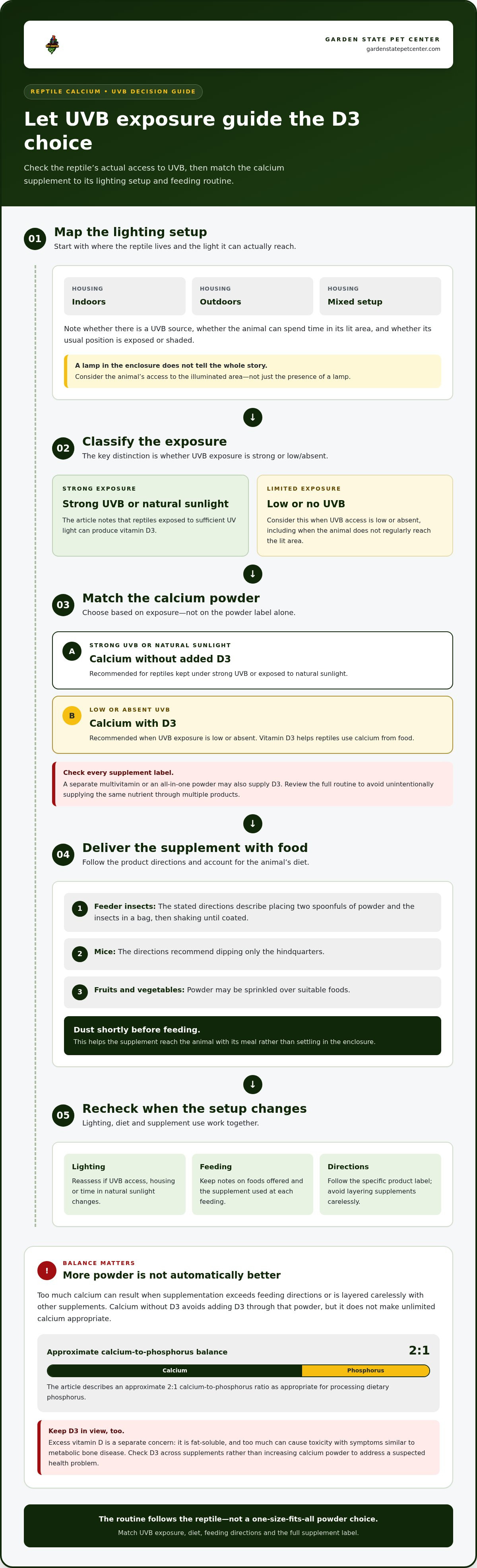
For insects, place them in a bag with two spoonfuls of powder, then shake until they’re coated. For mice, the directions recommend dipping only the hindquarters. Powder may also be sprinkled over fruits and vegetables. Dust food just before serving, so the supplement reaches the animal with the meal rather than settling in the enclosure.
Vitamin D3 Content and Supplementation
Vitamin D3 helps reptiles use calcium from food. Reptiles exposed to sufficient UV light can produce D3, so calcium without added D3 is recommended for animals kept under strong UVB or natural sunlight. The right choice depends on the enclosure’s lighting and the animal’s feeding routine, not simply on the powder’s label.
For reptiles with low or no UVB exposure, calcium with D3 may be recommended. Avoid combining supplements without considering their D3 content: a separate multivitamin can contribute vitamins alongside plain calcium, while an all-in-one powder is another routine. Review each label so the same nutrient isn’t unintentionally supplied through multiple products.
Excess Calcium and Potential Risks
Yes, reptiles can receive too much calcium if supplementation exceeds the feeding directions or is layered carelessly with other supplements. Calcium without D3 avoids adding D3 through that powder, but it doesn’t make unlimited calcium appropriate. Consider the full diet, the supplement schedule, and the calcium-to-phosphorus balance together.
An approximate calcium-to-phosphorus ratio of 2:1 is described as appropriate for reptiles to process dietary phosphorus. Excess vitamin D is a separate concern: because it’s fat-soluble, too much can cause toxicity with symptoms similar to metabolic bone disease. Check D3 content across supplements rather than increasing calcium powder to address a suspected health problem.
Liquid and spray supplements offer a different application method from dusting food. Follow their label directions and account for the same factors: species, diet, and D3 content. Spraying food or an enclosure doesn’t replace checking whether the reptile actually consumes the supplemented food. Keep the routine clear by recording which product is used at each feeding.
For practical feeding choices, the reptile care selection provides a relevant place to explore reptile supplies. Pair any supplement routine with appropriate lighting and suitable foods for the animal, whether it eats insects, mice, fruits, or vegetables.
Choosing supplements based on UVB lighting
Choose calcium with or without D3 by assessing the reptile’s UVB exposure first. Calcium without D3 is recommended for reptiles kept under strong UVB lighting or natural sunlight, while calcium with D3 is recommended when UVB exposure is low or absent.
UVB exposure matters because it helps reptiles produce vitamin D3, which supports their ability to use calcium from food. Wild reptiles synthesize D3 using sunlight. In captivity, the keeper must consider both the animal’s lighting and its supplement routine, rather than choosing powder by species name alone.
Assess the animal’s actual access to UVB. Check whether its enclosure has a UVB source, whether it can spend time in the lit area, and whether its usual position is exposed or shaded. A lamp in the enclosure does not tell the whole story if the animal rarely reaches the area it illuminates. Keep notes on the lighting arrangement alongside feeding and supplement details.
For an indoor reptile with low or no UVB exposure, calcium with D3 is the recommended option in the supplied guidance. For an animal under strong UVB, or one exposed to natural sunlight outdoors, calcium without D3 is preferable. These recommendations reflect how exposure changes the animal’s capacity to make D3; they aren’t interchangeable labels for the same routine.
Outdoor housing also calls for careful assessment. Natural sunlight provides UV exposure, so time outdoors is relevant when selecting a supplement. Consider the animal’s access to sunlight and shaded areas instead of assuming an outdoor enclosure provides the same exposure everywhere. Review the routine if housing or lighting changes.
Use this practical sequence when deciding:
- Identify whether the reptile lives indoors, outdoors, or in a setup that combines both.
- Assess whether it receives strong UVB or has low or no UVB exposure.
- Choose calcium without D3 for strong UVB or natural sunlight, and calcium with D3 for low or absent UVB.
- Revisit the choice whenever the animal’s lighting access changes.
UVB is one part of the care routine, not a reason to ignore diet. Track the food offered and the supplement used, especially when lighting or housing changes. For example, a bearded dragon moved outdoors may receive natural sunlight, which can affect which calcium option suits its setup. Review the whole routine so the choice reflects actual exposure, not assumptions based on the enclosure alone.
How well the powder coats feeder insects
For the stated feeding directions, place two spoonful's of calcium powder and feeder insects in a bag, then shake until the insects are well coated. Apply the dust shortly before feeding so it reaches the reptile with the meal.
Powder Coverage on Feeder Insects
Good coverage comes from powder contacting the insects rather than settling in the container. Use a bag with enough room for the insects to move as you shake it. Check the batch afterward: aim for a visible, even coating, not a pile of loose powder at the bottom. Serve the coated insects promptly.
Small or damp insects may handle differently from larger, dry feeders. Focus on coating the food lightly and evenly. If the powder clumps, separate the insects and shake them gently again before serving.
Dusting Feeders and Salads
Feeder insects aren’t the only food that can carry calcium powder. Repta Calcium without D3 may also be sprinkled over fruits and vegetables. Coat only the portion prepared for the reptile, then offer it fresh so the powder stays with the food the animal eats.
Dust feeders or salads immediately before serving. This helps reduce the chance that powder will fall off or remain uneaten after the food sits in the enclosure. For a salad, distribute the powder across the pieces instead of concentrating it in one spot.
Calcium Dusting Amounts
Some feeding directions specify a measured amount of powder in a bag with insects, shaken until they are coated. Treat that as the product’s preparation instruction, not a universal dose for every reptile, insect size, or feeding routine. Follow the specific supplement label and account for the animal’s other calcium sources.
Do not add more powder simply because some remains in the bag. Check the insects’ coating and serve the prepared portion. The animal’s species, diet, and supplement schedule all matter when establishing a consistent routine.
Gut-loading feeder insects is a separate preparation step. It means feeding insects before they become food for the reptile, so their recent diet contributes to the meal. Calcium dusting coats the outside, while gut-loading changes what the feeder has eaten. Keep the steps distinct and use suitable insect food rather than treating surface powder as a replacement for gut-loading.
For example, gut-load the insects first, then transfer the portion for the reptile into a clean bag. Add the supplement according to its directions, shake, inspect the coating, and serve. Keeping the sequence consistent makes it easier to assess coverage and avoid mistaking leftover dust for a measured serving.
Calcium powder ingredients and sourcing
Calcium powders can differ in their listed ingredients and mineral sources, so read the label rather than judging by the product name. Oolitic aragonite is one example of a calcium-bearing mineral material discussed in sourcing information, but do not assume it is present in every supplement.
Calcean summarizes oolitic aragonite replenishment at over 4 billion pounds per year. That figure describes replenishment of this mineral resource, not the amount in a particular container or the amount an animal should receive. Keep those details separate when comparing ingredient and sourcing claims.
Start with the ingredient list. Identify the calcium source and note whether the formula includes vitamin D3 or other added ingredients. A phosphorus-free calcium powder, for example, is labeled differently from a formula that includes D3. Those distinctions help you match the supplement to the animal’s lighting and feeding routine.
Use this label-reading sequence:
- Find the named calcium source in the ingredient list.
- Check whether vitamin D3 appears among the ingredients.
- Review any other listed nutrients before combining the powder with another supplement.
- Read feeding and storage directions on the same container.
Ingredient sourcing and nutritional suitability answer different questions. Sourcing identifies the material and where it comes from; the ingredient panel lists what the finished powder contains. Neither detail alone tells you how much to use. Follow the feeding directions and consider the reptile’s complete diet.
For example, if a label names a mineral source, compare that wording with the actual ingredient list instead of relying on broad phrases such as “natural calcium.” If the label lists D3, count that contribution alongside other supplements. A product without D3 can still be a poor fit if the animal’s routine requires a different approach or if its directions don’t suit the feeding method.
Store calcium powder in a cool, dry place, as directed. Close the container after use and keep moisture out, since damp powder can clump and become harder to distribute evenly. Store feeder foods separately in a dry, well-ventilated area protected from rodents and insects. Do not offer moldy or insect-infested feed, as it may cause illness or death.
Make sourcing claims useful by identifying the mineral source, checking the full ingredient list, and following the product directions. Then consider the animal’s species, diet, and lighting before setting a supplement routine. Reviewing labels can also help prevent overlap when a multivitamin or another calcium product is part of the feeding plan.
Calcium powder with or without D3
Choose between plain calcium and calcium with D3 by considering the reptile’s UVB exposure, diet, and other supplements. The label matters: two powders that both say “calcium” may contribute different nutrients to the feeding routine.
Calcium without D3 is recommended for reptiles kept under strong UVB lighting or natural sunlight. Reptiles can synthesize vitamin D3 using UV light, and D3 helps them use calcium obtained from food. For animals with low or no UVB exposure, calcium with D3 is recommended. These are different approaches, so match the powder to the animal’s actual lighting rather than relying on a general rule for all reptiles.
A practical comparison starts with the ingredient panel. Check whether vitamin D3 is included, then consider what else the reptile receives through food or supplements. A plain calcium powder paired with a separate multivitamin once a week is one described routine. An all-in-one powder used at every feeding is another. These examples show why the full schedule matters: the same nutrient may come from more than one product.
Before choosing a routine, review these details:
- Whether the enclosure provides strong UVB, low UVB, or no dedicated UVB source.
- Whether the reptile also receives natural sunlight.
- Whether its current calcium powder contains D3.
- Whether a multivitamin or all-in-one supplement adds more nutrients.
A phosphorus-free calcium powder without vitamin D3 is sold in a 4.1-ounce size. That product detail describes package size, not a feeding amount. Use the directions on the specific container to guide application, and don’t infer a dose from the package weight.
For a bearded dragon housed under strong UVB, calcium without D3 aligns with the stated recommendation. A reptile without a specific UV light source fits the guidance for calcium with D3. If an animal’s setup changes, review its supplement label and routine again. Moving a reptile outdoors, changing its UVB lighting, or switching to an all-in-one powder can alter the D3 it receives.
Keep the routine easy to audit. Record the calcium product, its D3 content, and which feedings include a multivitamin. This helps prevent accidental overlap and makes changes easier to track. Excess vitamin D, a fat-soluble vitamin, can cause toxicity with symptoms similar to metabolic bone disease. Avoid adding a second D3 source without considering what the existing powder or feeding plan already supplies.
Garden State Pet Center: Premium Pet Food
Garden State Pet Center offers premium pet food, including options for thoughtful feeding choices. When reviewing a reptile’s diet alongside its supplement plan, keep the animal’s specific needs in view and select foods suited to its species.
The store also carries Pet Toys and Accessories, Exotic Birds, and Small Animals, serving a community of owners with varied care needs. For questions about choosing food or exploring these offerings, contact Garden State Pet Center. Their team can help you consider the next step for your animal’s care.
Make Your Reptile’s Care Routine Work for the Long Term
The next step is to make your supplement choice part of a clear, consistent care routine. Keep your lighting setup, feeding habits, and supplement labels together so you can review them whenever your animal’s environment changes. That simple habit can make it easier to choose reptile calcium powder without D3 in a way that fits your animal’s day-to-day care.
Garden State Pet Center serves as a helpful online resource as you consider your pet’s needs. Its offerings include Premium Pet Food and Pet Toys and Accessories, alongside care for Exotic Birds. If you’re weighing your next step or want to explore the store’s pet offerings, contact Garden State Pet Center.
Build a consistent routine by making informed choices about diet, lighting, and supplements.
Frequently Asked Questions
How do reptiles fulfill their D3 needs?
Reptiles produce vitamin D3 through exposure to UV light, including sunlight. In captivity, the key is whether the animal has effective access to UVB, not just whether a lamp is present. For example, a reptile that stays in a shaded area may have different exposure from one that regularly basks beneath its UVB source. That distinction helps guide whether its calcium supplement should include D3.
How often should reptile calcium powder without D3 be used?
Frequency depends on the specific powder’s feeding directions and the reptile’s diet. Repta Calcium without D3 directions say daily use, but don’t apply that schedule automatically to every formula. Check the label, then consider how much supplemented food the animal actually eats. If feeders remain uneaten, the reptile may not receive the intended supplement, even when the food was dusted.
What are the best reptile calcium powders without D3?
The best choice is a powder whose ingredient panel clearly identifies its calcium source and confirms it contains no added D3. Match its directions to the reptile’s normal food, such as feeder insects or a plant-based meal. Also compare how easily it coats the foods you serve. A clear label and usable directions matter more than choosing a product based on a broad “reptile calcium” label alone.
How does calcium powder without D3 compare with calcium powder with D3?
The main difference is whether the powder adds vitamin D3 along with calcium. A plain formula can suit a reptile receiving strong UVB or natural sunlight, while a D3-containing option may suit one with low or no UVB. Before switching, read the supplement labels and account for any multivitamin or all-in-one product already in the feeding routine. That helps prevent unintentionally doubling up on D3.
Does calcium powder without D3 work with UVB lighting?
Yes. Calcium powder without D3 is recommended for reptiles kept under strong UVB lighting because UV exposure supports the animal’s own D3 production. Evaluate the setup from the reptile’s perspective: can it reach the lit basking area, or does it spend most of its time elsewhere? That practical observation helps you assess exposure more meaningfully than simply noting that the enclosure contains a UVB lamp.
What ingredients should I look for or avoid in reptile calcium powder?
Look for a clearly named calcium source and check the ingredient panel for added vitamin D3. Oolitic aragonite is one mineral source discussed in calcium sourcing, but don’t assume every powder contains it. Choose a formula that matches your reptile’s lighting and feeding routine. Review other supplements too, especially multivitamins, so you can account for nutrients supplied by more than one product.
How should reptile calcium powder be stored, and does it expire?
Store reptile calcium powder in a cool, dry place. Keep feeder food in a well-ventilated, dry area protected from rodents and insects.

Article by
Victor Santucci
Victor Santucci Jr. is the owner of Garden State Pet Center and a Certified Clinical Pet Nutritionist specializing in premium pet nutrition, raw and fresh feeding, holistic pet wellness, birds and exotic animals. Through years of hands-on retail and animal-care experience, Victor helps pet parents make informed decisions about nutrition, enrichment and species-appropriate care.
Share this post
- 0 comment
- Tags: amphibian care, calcium supplements, feeder insects, reptile calcium powder without d3, reptile care, reptile nutrition, UVB lighting, vitamin D3