

Interactive dog puzzle toys: Everything You Need to Know


Your dog isn't just acting out when they chew your favorite shoes; they're likely starving for a mental challenge that a standard tennis ball simply cannot provide. Mental enrichment is a biological necessity, not a luxury, for every canine. By introducing high-quality interactive dog puzzle toys into their daily routine, you can bridge the gap between physical exercise and total cognitive wellness. It's the difference between a dog that paces with anxiety and one that rests with satisfied focus.
We understand the guilt of leaving a bored pup at home while you work, or the frustration of spending money on toys that your dog ignores after five minutes. You want a solution that works for their specific personality and skill level without the guesswork. This guide will show you how to transform your dog’s mental health and behavior through the science-backed power of interactive puzzle toys. We'll explore how to choose the right difficulty level for your dog's IQ, ensuring they stay engaged while effectively reducing unwanted barking and destructive habits.
Key Takeaways
- Understand the biological phenomenon of "contrafreeloading" and why your dog is naturally wired to work for their meals.
- Discover the different categories of interactive dog puzzle toys, ranging from active treat-dispensers to stationary logic boards.
- Learn how to use a leveled difficulty framework to match a toy to your dog's specific IQ and prevent boredom or frustration.
- Gain a step-by-step method for safely introducing new puzzles to your pet using high-value rewards to ensure immediate success.
- Explore how combining mental stimulation with premium nutrition and professional socialization creates a calmer, more focused companion.
What Are Interactive Dog Puzzle Toys and Why Does Your Dog Need Them?
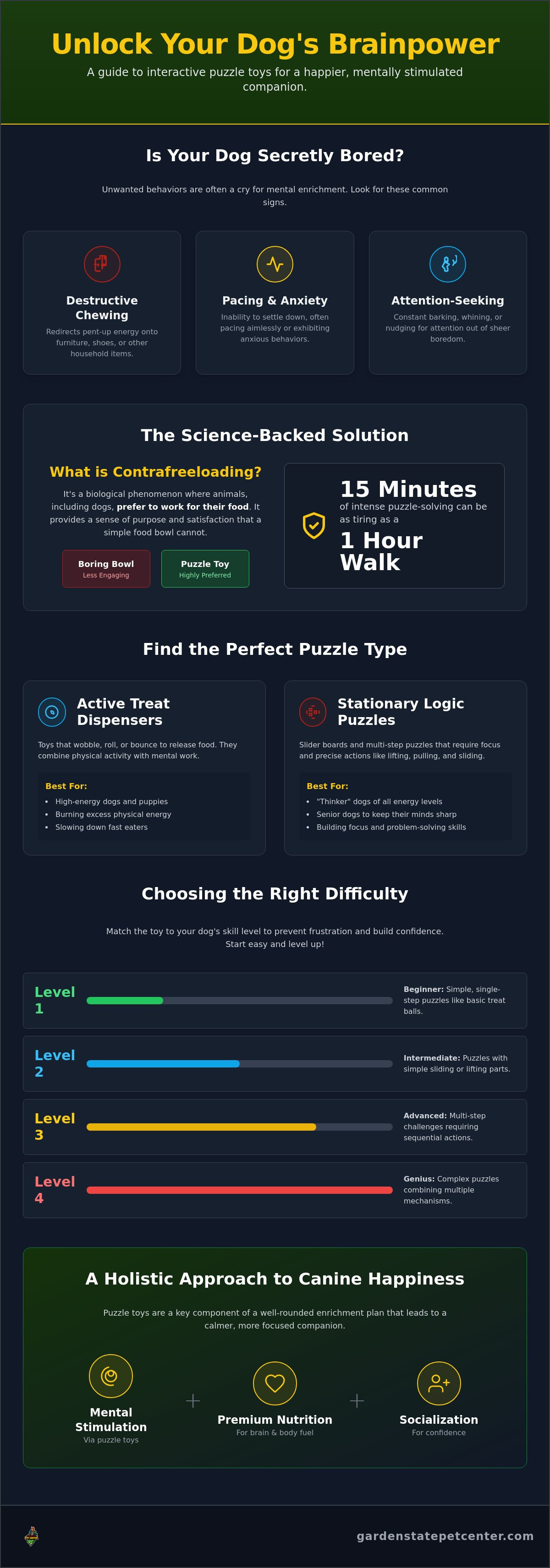
At their core, interactive dog puzzle toys are much more than simple distractions. They're sophisticated tools built to stimulate a dog’s problem-solving skills and tap into their primal instincts. Unlike a standard ball that relies on physical pursuit, a puzzle requires your dog to manipulate parts, use their nose, and think logically to earn a reward. This process honors the scientific concept of "contrafreeloading." This phenomenon suggests that many animals, including dogs, actually prefer to work for their food rather than having it handed to them in a bowl. It provides a sense of purpose that a static meal simply can't match.
To see how these tools work in practice and which ones might suit your pet, watch this helpful comparison:
Beyond the mental challenge, these toys serve as a vital practical tool for physical health. Many dogs suffer from "gulping," where they inhale their kibble in seconds. This behavior often leads to poor digestion and potentially dangerous bloating. By placing their meal inside a puzzle, you force them to eat slowly. This shift aids in weight management and ensures they feel full longer. It's a simple change that transforms mealtime into a productive, calming activity.
The Science of Canine Enrichment
When your dog engages in "nose work" or solves a complex logic board, their brain releases dopamine. This is the "feel-good" chemical that promotes relaxation and satisfaction. Many experts suggest that just 15 minutes of intense mental work can be as exhausting as a full hour of physical walking. This makes puzzles an essential component of Behavioral enrichment; it ensures your pet's mental and physical needs are met through a holistic approach. It's about providing a specialized level of care that goes beyond the basics of food and shelter.
Signs Your Dog is Craving Mental Stimulation
Your dog's behavior is often a direct reflection of their environment. If you notice pacing, destructive chewing on furniture, or constant attention-seeking, they're likely crying out for more enrichment. For senior dogs, these challenges are even more critical. Interactive dog puzzle toys can help mitigate the symptoms of Canine Dysfunction Syndrome by keeping the aging brain active and engaged. These tools are also incredible assets during crate training or for dogs struggling with separation anxiety. They provide a positive focus that keeps the mind busy while you're away. If you're looking for the right fit for your pup, explore our curated selection of dog toys to find a challenge they'll love.
Types of Interactive Puzzles: From Treat-Dispensers to Logic Boards
Not all interactive dog puzzle toys serve the same purpose. Choosing the right one depends heavily on your dog's play style, energy levels, and physical abilities. We generally categorize these tools into two main groups: active dispensers and stationary logic boards. Material choice is equally vital for both safety and durability. Heavy chewers should stick to resilient, food-grade rubber that withstands gnawing. Conversely, more delicate problem-solvers can safely enjoy the intricate components of hard plastic puzzles. Matching the material to your dog's mouth-strength prevents wasted money on toys that get destroyed in minutes.
Active Treat-Dispensing Toys
Select toys that wobble, roll, or bounce to dispense rewards during movement. These are the perfect solution for high-energy breeds that struggle to settle down or stay focused. By using premium dry food as the "fuel" for these toys, you turn a standard five-minute meal into a twenty-minute cognitive workout. It's an excellent way to burn physical energy while simultaneously engaging the brain. Since these toys move across the floor, they encourage your dog to use their entire body to solve the problem.
Stationary Logic Puzzles and Slider Boards
If your dog is more of a "thinker" than a "doer," stationary boards are ideal. These require specific actions like flipping a lid, sliding a disc, or lifting a peg to reveal a hidden treat. Use these puzzles for supervised play sessions to build patience in impulsive dogs and improve fine motor skills. Look for designs with non-slip bases. A sliding board can frustrate a dog and lead to them trying to flip the entire toy rather than solving the puzzle. These boards are fantastic for quiet evenings when you want your pet to stay in one place while remaining mentally occupied.
For dogs with a high prey drive, "Hide and Seek" plush puzzles offer a soft, tactile experience. These usually involve small squeaky toys hidden inside a larger plush base, mimicking the act of hunting. If you want a more relaxed, scent-focused session, consider snuffle mats. They mimic the experience of foraging through long grass, which is incredibly soothing for anxious dogs. If you're ready to find the perfect match for your pup's personality, browse our curated selection of specialized dog toys designed for every skill level.
Choosing the Right Difficulty: The Level 1 to Level 4 Framework
One common mistake pet owners make is buying the most complex toy available and expecting their dog to solve it instantly. This approach often leads to "puzzle frustration," where the dog gives up or becomes destructive because the goal feels unattainable. To prevent this, follow a structured progression using interactive dog puzzle toys based on a four-level difficulty framework. This system ensures your dog stays challenged without becoming overwhelmed, building their confidence as they master each stage.
- Level 1: Introductory. These toys focus on immediate gratification and simple cause-and-effect. Simple wobblers that spill kibble when nudged or basic snuffle mats are perfect for puppies or dogs new to enrichment.
- Level 2: Intermediate. These challenges introduce moving parts that require a specific action. Your dog must learn to slide a disc or uncover a hidden compartment to find their prize.
- Level 3: Advanced. This level demands sequential logic. Your dog might need to remove a top peg before a side slider can move, requiring them to think several steps ahead to reach the reward.
- Level 4: Expert. Reserved for the "Einsteins" of the dog world, these puzzles feature complex combinations of locks, drawers, and rotating levers that require intense focus and cognitive stamina.
Matching the Puzzle to Your Dog’s Breed and IQ
Working breeds like Border Collies, Shepherds, and Poodles often possess a natural aptitude for problem-solving and might skip Level 1 entirely. Assess your dog’s "puzzle personality" before investing in new gear. Identify if your dog is a "mover" who prefers physical manipulation and high-energy interaction, or a "thinker" who excels at precise, delicate movements. You can gauge your dog’s baseline intelligence by hiding a high-value treat under an opaque cup and seeing how quickly they use their paws or nose to flip it over.
Avoiding the "Frustration Gap"
Watch closely for the "frustration gap" during play sessions. If your dog starts biting the toy aggressively, barking at it, or simply walking away, the challenge is likely too high for their current skill level. Help them by partially opening compartments or using extra-smelly treats to lower the difficulty temporarily. Success is the greatest motivator for a dog. Ensure your dog "wins" frequently during the learning phase to build the persistence they need to tackle expert-level challenges later. If you're looking for the right starting point, explore our specialized dog toys to find a match for your pup’s current IQ.
How to Introduce Puzzle Toys to Your Dog Safely
Introducing interactive dog puzzle toys requires more than just dropping a new gadget on the floor and walking away. A poor first experience can lead to frustration or, worse, a dog that permanently ignores the toy. To ensure success, you must "shape" their behavior by guiding them through the initial learning process. This proactive approach builds a positive association with problem-solving and ensures your pet remains safe while they play.
- Step 1: Use High-Value Rewards. Start with premium dog treats that have a strong scent. The aroma acts as an immediate motivator, signaling to your dog that the effort is worth the reward.
- Step 2: Demonstrate the Goal. Let your dog watch you place the food inside the toy. If they see exactly where the "treasure" is hidden, they're much more likely to engage with the mechanism rather than getting confused.
- Step 3: Offer Active Assistance. During the first few attempts, help them out. Nudge a wobbler or partially slide a lid to show them how it moves. This prevents the "frustration gap" mentioned earlier.
- Step 4: Incrementally Increase Difficulty. Once they master the basic movement, use smaller treats or tighten the compartments. This keeps the challenge fresh without being overwhelming.
- Step 5: Maintain Novelty. Only leave the toy out for 15 to 20 minutes. Removing the toy after a successful session keeps it "special" and prevents them from chewing on it out of boredom once the food is gone.
Safety and Durability Considerations
No toy is truly indestructible. Even the most resilient rubber can develop cracks or lose small parts over time, creating significant choking hazards. Inspect every toy before each session for signs of wear or sharp edges. We strongly recommend choosing BPA-free and food-grade materials to protect your dog's long-term health. Always supervise your dog during play, especially with plastic logic boards that have removable pegs or sliders. If a toy becomes damaged, replace it immediately to maintain a safe environment. You can find a wide range of durable, high-quality dog toys and accessories in our curated collection.
Cleaning and Maintenance
Hygiene is a frequently overlooked aspect of canine enrichment. Saliva and food residue trapped in hidden compartments can quickly lead to bacterial growth, which may cause digestive upset. Check the manufacturer's instructions to see if your puzzles are dishwasher-safe or require hand-washing with pet-safe soap. For toys with deep crevices, use a small brush to ensure every corner is sanitized. Regular cleaning not only protects your dog’s health but also extends the life of the materials. Implement a rotation system where you swap toys every few days; this keeps the "new toy smell" and cognitive challenge alive for your pet.
Beyond the Toy: A Holistic Approach to Canine Happiness
While interactive dog puzzle toys are transformative tools for mental health, they're only one piece of the wellness puzzle. A truly happy, well-adjusted dog requires a holistic approach that combines cognitive challenges with specialized care, premium accessories, and superior nutrition. Utilizing resources like PrimeNest Market for high-quality pet supplies can help create the supportive environment your dog needs to thrive. Think of your dog's well-being as a structured system where physical exercise, mental enrichment, and internal health all support one another. When these elements are in balance, you'll notice a significant shift in your pet's ability to focus, learn, and remain calm in stressful situations.
High-quality food provides the essential fatty acids and antioxidants that fuel a smarter, more engaged brain. If a dog's diet is lacking in key nutrients, they may struggle with the cognitive stamina required to solve complex puzzles. We invite you to read our Premium Pet Food guide to understand how specialized nutrition directly impacts your pet's problem-solving abilities and overall vitality. By feeding your dog for brain health, you're giving them the best possible chance to succeed with their enrichment routine.
Beyond the home environment, professional socialization plays a massive role in maintaining a balanced temperament. Our expert pet boarding services offer a structured environment where dogs can engage with new sights and sounds under professional supervision. This synergy between professional boarding and consistent mental stimulation prevents the behavioral stagnation that often leads to anxiety or destructive habits. Garden State Pet Center is proud to be your reliable partner in every stage of this journey, providing the expertise you need to help your pet thrive.
The Role of High-Quality Treats in Training
Using raw or freeze-dried treats provides a much stronger "scent-trail" for puzzle work than standard processed biscuits. These potent aromas keep your dog locked into the task at hand, making the challenge of interactive dog puzzle toys even more rewarding. It's vital to balance their caloric intake; if your dog spends a long session working through a difficult puzzle, remember to adjust their next meal size accordingly to maintain a healthy weight. You can browse our full selection of high-end dog toys and accessories to find the perfect match for these high-value rewards.
Consulting the Experts
Sometimes, persistent behavioral issues like extreme separation anxiety require more than just a new toy. If increasing enrichment doesn't seem to lower your dog's stress levels, it might be time to consult a professional behaviorist to rule out deeper issues. Our knowledgeable staff can help you distinguish between a dog that is simply bored and one that requires a more specialized intervention plan. We also offer nutritional consultations to help you choose the best "puzzle fuel" based on your dog's unique health requirements. We're here to ensure you have the tools, the food, and the professional support to build a lifelong bond with your companion.
Empower Your Dog Through Mental Enrichment
Investing in your dog's cognitive health is one of the most rewarding decisions you can make as a pet owner. By matching the right interactive dog puzzle toys to your pup's unique IQ level and introducing them through positive reinforcement, you're doing more than just preventing boredom. You're actively reducing anxiety and fostering a calmer, more focused companion. Remember that mental enrichment works best when it's part of a holistic plan that includes premium nutrition and specialized care.
At Garden State Pet Center, we've shared our family-owned expertise since 1990 to help pets and their owners thrive together. Whether you need a simple introductory wobbler or a complex logic board, our on-site Certified Pet Nutritionist is ready to help you select the perfect rewards to keep your dog motivated. We offer nationwide shipping on all premium pet supplies, so high-quality enrichment is always within reach.
Shop our curated collection of interactive dog toys and premium treats to begin your journey toward a happier, more engaged pet. Your dog's sharper, calmer future starts with a single challenge.
Frequently Asked Questions
Are interactive puzzle toys safe for aggressive chewers?
Yes, provided you choose toys made from durable, food-grade rubber designed specifically for power chewers. Most plastic logic boards aren't suitable for aggressive chewers because they can shatter or create sharp edges. Always inspect the toy for wear before each session to ensure total safety. If your dog tries to gnaw on the puzzle rather than solve it, remove the toy and try a more resilient material.
How long should I let my dog play with a puzzle toy each day?
Aim for 15 to 30 minutes of active play per session. Mental stimulation is intense; 15 minutes of puzzle work can be as exhausting as a long walk for many breeds. It's best to remove the toy once the treats are gone to prevent your dog from chewing it out of boredom. Short, successful sessions are better than long ones that end in frustration or destructive behavior.
Can I use regular kibble in a puzzle toy or do I need special treats?
You can absolutely use regular kibble, which is a great way to turn mealtime into a cognitive workout. Using their daily food helps with weight management and prevents overfeeding. However, if you're introducing interactive dog puzzle toys for the first time or tackling a harder difficulty level, mixing in a few high-value, smelly treats can provide the extra motivation your dog needs to succeed.
What is the best puzzle toy for a puppy just starting out?
Start with a soft snuffle mat or a simple silicone wobbler that releases food with a gentle nudge. Puppies have shorter attention spans and can get discouraged easily, so "easy wins" are vital for building their confidence. These introductory challenges focus on scent and basic movement rather than complex logic. This sets a positive foundation for more advanced problem-solving as they grow and mature.
Will a puzzle toy help with my dog’s separation anxiety?
Yes, these toys are excellent tools for managing mild separation anxiety by providing a high-value distraction during your departure. Giving your dog a puzzle five minutes before you leave creates a positive association with your exit. The mental focus required to solve the puzzle helps lower their overall stress levels. For severe cases, you should use enrichment alongside professional behavioral training for the most reliable results.
How do I know if my dog is too smart for a specific toy?
If your dog solves the puzzle in under a minute with zero hesitation, they've likely outgrown that specific challenge. Watch for signs of "mechanical" solving, where they move parts automatically without thinking. When a toy no longer requires focused effort, it's time to move up the difficulty framework. Interactive dog puzzle toys should provide a moderate challenge that keeps them occupied for at least ten to fifteen minutes.
Are there puzzle toys for dogs that don’t care about food?
Yes, "Hide and Seek" plush puzzles are perfect for dogs motivated by prey drive rather than food. These toys involve hiding smaller squeaky characters inside a larger base, encouraging your dog to nuzzle and pull them out. This provides tactile and auditory stimulation that doesn't rely on treats. It's a fantastic alternative for pets on strict diets or those who simply prefer a game of "find the squeaker."
How often should I rotate my dog’s interactive toys?
Rotate your dog's toys every three to five days to maintain a sense of novelty and excitement. If a dog has access to the same puzzle every day, it becomes a routine task rather than a stimulating challenge. Keeping only two or three toys in the active rotation ensures your dog stays curious and engaged. This schedule also gives you time to thoroughly clean and sanitize each toy between uses.

Article by
Victor Santucci
Victor Santucci is the owner of Garden State Pet Center in Audubon, NJ, where he specializes in premium pet nutrition, exotic animals, and expert-level care. With years of hands-on experience and a passion for helping pets thrive, Victor is dedicated to educating pet owners on proper nutrition, enrichment, and species-specific care. His mission is simple: provide every pet with the highest quality products and every customer with honest, knowledgeable guidance.
Share this post
- 0 comment
- Tags: canine enrichment, dog behavior, dog boredom, dog puzzle toys, dog training tips, interactive dog puzzle toys, mental stimulation, pet care