

Best Human-Grade Dog Food Brands 2026: A Guide to Premium Canine Nutrition


What if the "all-natural" label on your dog's kibble doesn't actually mean the ingredients are safe for a human to eat? Many pet owners feel a deep sense of worry when trying to distinguish between marketing fluff and actual nutritional quality. You likely want a diet that transforms your dog's coat and energy levels, but the search for authentic human grade dog food brands often leads to more questions than answers.
It's understandable to feel overwhelmed by the complex labels found in specialized pet nutrition. We believe you deserve a reliable partner to help you make informed choices for your dog's welfare. This guide will show you exactly how to identify truly superior ingredients and navigate the legal requirements that separate genuine human-grade products from "fake" premium options.
You'll learn about the latest AAFCO labeling updates for 2026, the critical difference between human-grade ingredients and human-grade facilities, and which brands are leading the way in specialized canine care. We've simplified the science so you can focus on the long-term health and vitality of your companion.
Key Takeaways
- Identify the legal difference between "made with human-grade ingredients" and a product that meets the full 2026 federal manufacturing standards.
- Discover how the high bioavailability of premium proteins supports better skin health and more consistent energy levels for your pet.
- Compare top-rated human grade dog food brands that offer batch-level tracking and limited-ingredient recipes for sensitive dogs.
- Learn to adjust serving sizes based on life stage and activity level to ensure your dog receives optimal nutrition without excess calories.
- Master the 10-day transition rule to safely introduce new foods while monitoring your dog's coat shine and digestive health.
What is Human-Grade Dog Food? Defining the 2026 Gold Standard
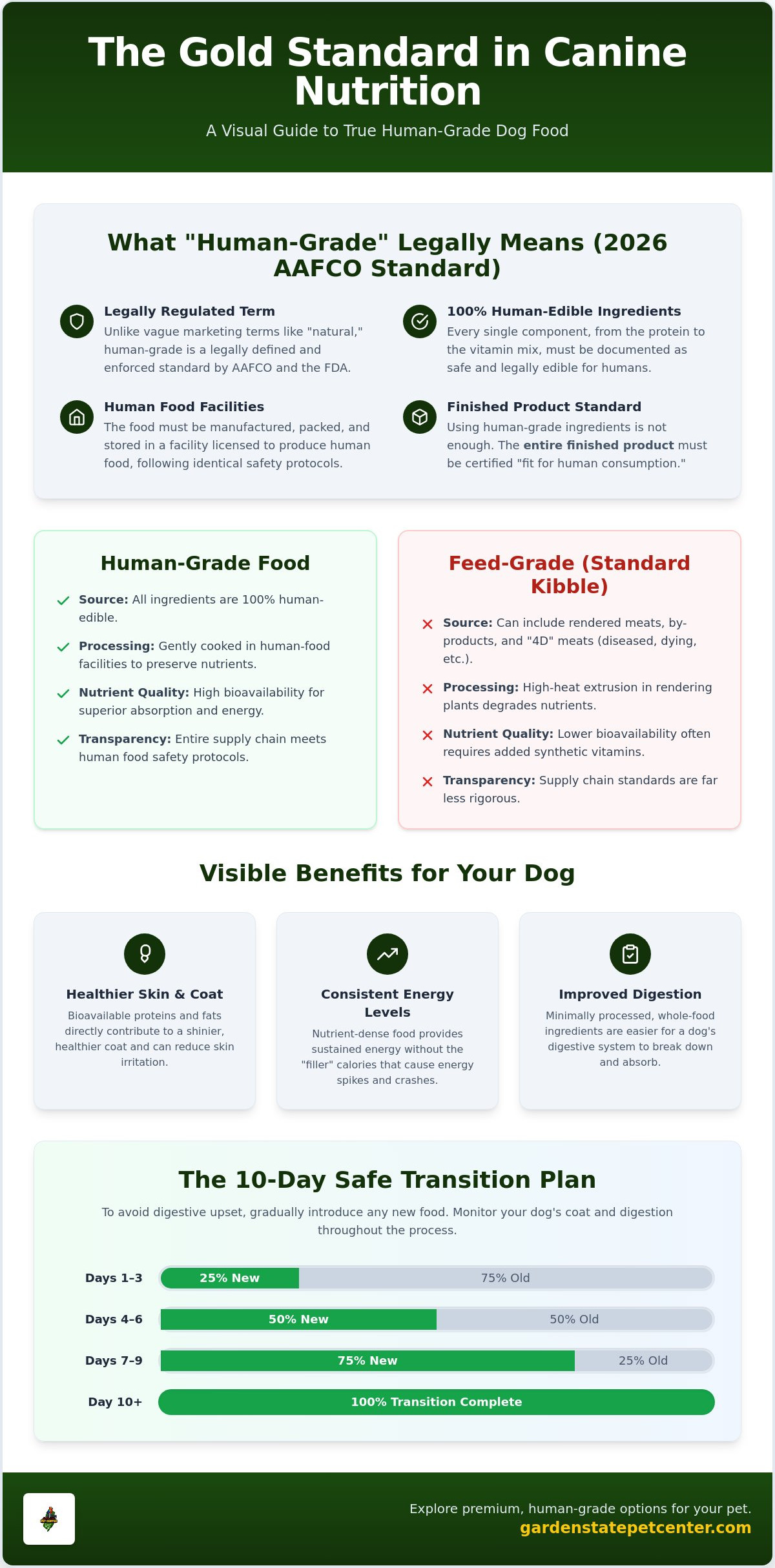
In 2026, the term "human-grade" has moved beyond marketing jargon to become a strictly regulated legal standard. Unlike "natural" or "holistic," which lack a formal definition from the Association of American Feed Control Officials (AAFCO), human-grade status requires every single ingredient to be edible for humans. It also mandates that the final product be manufactured, packed, and stored in facilities licensed for human food production. This distinction is the gold standard for pet owners who prioritize safety and transparency.
To better understand this concept, watch this helpful video:
The role of AAFCO and the FDA is critical here. While AAFCO provides the model regulations, the FDA enforces the safety standards. If a brand claims to be among the top human grade dog food brands, it must prove that its entire supply chain adheres to these rigorous protocols. The 2024 Official Publication from AAFCO introduced new model regulations for labeling, which are currently being phased in through 2026. For a comprehensive overview of dog food and how these standards compare to traditional options, looking at the legal framework is essential. Producing food in a human-food facility is the non-negotiable factor that separates these brands from standard retailers.
Ingredients vs. Finished Product
There's a common misconception that using human-grade ingredients makes the food human-grade. This isn't true. For the label to be legal, the finished product must be "fit for human consumption." If a company sources premium beef but processes it in a pet-food-only rendering plant, it loses its status immediately. A single feed-grade ingredient, like a low-quality vitamin premix, disqualifies the entire batch. True transparency involves brands sharing their sourcing documentation and facility certifications with you directly.
The 'Feed Grade' Alternative
Most traditional kibble is classified as "feed grade." This allows for ingredients that aren't fit for human consumption, often including rendered meats and by-products. These items are processed at high temperatures in rendering plants, which can sometimes lead to lower bioavailability of nutrients. Many dogs experience improved digestion and skin health when moving to premium dog food options that avoid these heavily processed alternatives. The safety gap between a human-food facility and a rendering plant is significant. You'll often find that dogs thrive when their diet moves away from these "4D" meats (dead, dying, diseased, or disabled animals) that are permitted in feed-grade production.
Human-Grade vs. Standard Kibble: A Comparative Analysis
When you look at a bowl of standard kibble versus a fresh, human-grade meal, the visual difference is obvious. But the real shift happens at the cellular level. Proteins in standard kibble are often rendered, meaning they've been cooked twice at extremely high temperatures. This process often degrades the amino acid profile. In contrast, human grade dog food brands utilize minimally processed proteins that retain their natural structure. This high bioavailability ensures your dog's body can actually use the nutrients to build muscle and support a robust immune system.
Because these diets are so nutrient-dense, you'll often find yourself feeding smaller portions than you would with traditional dry food. It's a more efficient way to deliver energy without the "filler" calories found in many commercial feeds. Most dry kibble is made through high-heat extrusion. This process can destroy sensitive vitamins, requiring manufacturers to add synthetic vitamin packs back into the mix. Human-grade options often favor "gently cooked" methods. These lower temperatures preserve the integrity of whole-food vitamins and minerals, reducing the reliance on laboratory-made supplements.
To understand why these production standards are so high, it helps to review the official AAFCO definition of human-grade, which requires every ingredient and every step of the process to meet human-food safety protocols. While the daily cost of these premium options is higher, the cost-to-benefit ratio often balances out. Improved skin health, a shinier coat, and higher energy levels can lead to significant long-term savings on veterinary care and specialized treatments for diet-related issues.
Digestibility and Stool Quality
Digestibility in human-grade protein refers to the percentage of nutrients that are successfully absorbed into the bloodstream rather than passed as waste. When ingredients are high-quality, the digestive tract doesn't have to work as hard to break down complex fillers. This leads to smaller, firmer stools and less waste to clean up in the yard. Whole-food fibers from real vegetables support this process, acting as natural prebiotics to nourish a diverse gut microbiome. You can browse our premium dog food selection to find options that prioritize this level of digestive efficiency.
Palatability for Picky Eaters
Picky eaters often struggle with the dry, uniform texture and bland aroma of standard kibble. Fresh, human-grade food provides a rich, meaty aroma and varied texture that mimics a natural diet. These recipes eliminate the need for artificial flavor enhancers or generic "animal fat" sprays that are common in lower-tier products. There's also a psychological benefit for the owner; seeing your companion eagerly finish a "real food" meal provides peace of mind that they're getting the best possible care.
Top Human-Grade Dog Food Brands to Trust in 2026
Selecting the right nutrition for your companion involves looking past colorful packaging and checking the actual manufacturing standards. In 2026, the elite human grade dog food brands distinguish themselves through rigorous supply chain testing and total ingredient transparency. At Garden State Pet Center, we act as your knowledgeable partner to help you identify which of these professional-grade options best suits your dog's specific lifestyle and health requirements.
Best for Transparency and Sourcing
Open Farm remains a leader in the industry due to their unmatched commitment to ethical practices. They utilize batch-level ingredient tracking, which allows you to use QR codes on every bag to trace every component back to the original farm. Their "Humanely Raised" certifications ensure that the meats used meet strict animal welfare standards. For owners who prefer a more artisanal, small-scale approach, SmallBatch offers exceptional raw and gently cooked recipes that prioritize local sourcing. Explore these high-transparency choices in Garden State Pet Center's dog food collection to see how they fit your feeding routine.
SmallBatch focuses on small-scale production to maintain the highest quality control. Their recipes often bridge the gap between raw feeding and gently cooked convenience, making them a reliable choice for owners who want minimally processed meals. By focusing on smaller batches, they ensure that the integrity of the human-grade proteins is never compromised by the mass-production techniques common in standard pet food plants.
Best for Allergies and Sensitive Stomachs
If your dog struggles with itchy skin or chronic digestive upset, Raised Right provides a specialized solution. They lead the market in low-carb, limited-ingredient human-grade diets. By eliminating common fillers like potatoes, peas, and lentils, they significantly reduce the risk of inflammatory responses. Their single-protein recipes are ideal for elimination diets, allowing you to pinpoint specific sensitivities with precision. For high-energy working dogs, OC Raw offers high-protein formulations that provide the caloric density needed for an active life without sacrificing human-food safety standards.
Carna4 offers a unique alternative for those who need the convenience of a dry food format. It uses sprouted seeds and human-grade meats to provide whole-food nutrition that is remarkably shelf-stable. While these brands offer incredible health benefits, Tufts University veterinary nutrition experts emphasize that the "human-grade" label primarily reflects the safety of the production facility. This is why we encourage you to consult with a professional for tailored dietary plans that ensure long-term nutritional balance. We invite you to visit our store for a personal consultation to find the perfect match for your pet's sensitive stomach.
How to Choose the Best Human-Grade Brand for Your Dog
Choosing from the top human grade dog food brands requires more than just picking a name off a shelf. You've got to align the nutritional profile with your dog's unique biological needs. Puppies, for instance, require significantly more amino acids and a specific calcium-to-phosphorus ratio to support rapid skeletal growth. Seniors often benefit from the higher moisture content found in gently cooked meals, which supports kidney function and eases digestion as their metabolism slows down.
Consider your dog's daily energy expenditure. A high-protein, calorically dense air-dried option might be perfect for an active Labrador, but it could lead to unwanted weight gain in a less active senior Pug. Fresh-frozen recipes often provide the highest nutrient retention but require dedicated freezer space and prep time. If you value convenience, look for shelf-stable air-dried or sprouted options that offer human-food safety without the need for refrigeration or thawing.
Reading the Label Like a Pro
Look closely at the first five ingredients on the package. These make up the vast majority of the recipe's weight. If you see generic "meat meal" or "animal by-products" in these slots, it's not a human-grade product. Watch out for hidden synthetics like "natural flavors" or caramel color, which can sometimes mask lower-quality sourcing. To verify if a brand is truly human-grade, check for a specific statement confirming the product was manufactured and stored in a facility licensed for human food production.
Budgeting for Premium Nutrition
We understand that moving to a 100% human-grade diet can be a significant investment. Many of our clients successfully use a "Hybrid Approach" to manage costs while still providing superior nutrition. By mixing premium dry food with human-grade toppers, you significantly boost the bowl's nutrient density without exceeding your monthly budget. This method is particularly effective for multi-dog households or larger breeds where full fresh feeding might be challenging.
Calculate your daily "cost per bowl" instead of looking at the total price of a bag or box. This perspective helps you see the value in preventative nutrition. Investing in high-quality proteins today often reduces the likelihood of expensive veterinary visits for skin allergies or digestive issues later in life. We're here to help you crunch these numbers and find a sustainable feeding plan that works for your family.
Visit our store today or browse our comprehensive dog nutrition collection to build a meal plan that fits your budget and your dog's health goals.
Transitioning Your Dog to a Human-Grade Diet
Switching your pet's nutritional foundation requires patience and precision. While the benefits of human grade dog food brands are significant, a sudden change can overwhelm your dog's digestive system. Trust the process and allow for a gradual adjustment period. This slow introduction gives the gut microbiome time to adapt to new protein structures and fiber sources, ensuring a smooth move away from heavily processed feed.
Monitor "The Big Three" indicators of health during this period: energy levels, coat shine, and stool consistency. You'll likely notice a "detox" phase as your dog moves away from the high-carbohydrate fillers common in standard kibble. During the first week, some dogs may experience slight changes in energy as their metabolism stabilizes. Within 14 to 21 days, most owners report a noticeable increase in vitality and a glossier coat. Stools should become smaller and firmer, reflecting the high bioavailability of the ingredients you've introduced.
The Step-by-Step Transition Schedule
Follow this action-oriented schedule to minimize the risk of gastrointestinal upset. Use a measuring cup to ensure accuracy during every meal.
- Days 1-3: Mix 25% of the new human-grade food with 75% of the current diet. Observe your dog for any signs of pickiness or loose stools.
- Days 4-6: Move to a 50/50 split. This is the most critical phase where you'll see how well your dog's system handles the increased nutrient density.
- Days 7-10: Increase to 75% new food and 25% old food. By day ten, you can usually complete the switch to 100% human-grade nutrition.
Expert Support for Your Journey
Professional guidance ensures a balanced transition, especially for dogs with chronic health issues or sensitive stomachs. Our team understands that every breed has unique requirements. We specialize in tailoring dietary plans for both common and exotic breeds, ensuring they receive the clinical precision they deserve. Whether you're managing a specific allergy or simply want to optimize long-term welfare, consulting with a knowledgeable partner makes all the difference.
Don't navigate these choices alone. We provide proactive support to help you choose between the various human grade dog food brands available today. Our staff can help you calculate exact caloric needs based on your dog's activity level and life stage. Visit our full-line pet store for a personalized nutritional consultation and let us help you build a high-end feeding strategy that works for your companion's specific needs.
Elevate Your Dog's Health with Professional-Grade Nutrition
Investing in your dog's diet is one of the most effective ways to ensure their long-term vitality. You've learned that authentic human grade dog food brands represent a rigorous commitment to safety and manufacturing standards that go far beyond standard kibble. By prioritizing high bioavailability and gently cooked ingredients, you're supporting a glossier coat, smaller stools, and sustained energy levels for years to come.
Since 1990, our family-owned business has provided specialized care to help pet owners navigate these important decisions. Trust our expertise. Our on-site certified pet nutritionist is available to help you build a customized plan for your dog's sensitive needs. We also offer nationwide shipping to ensure you have access to premium nutrition no matter where you live.
Take the next step in your pet's wellness journey today. Shop our curated selection of Premium Human-Grade Dog Foods and discover the difference that professional-grade ingredients make. We're excited to partner with you in your dog's health and happiness.
Frequently Asked Questions
Is human-grade dog food worth the extra cost?
Yes, the higher price reflects the safety of human-food manufacturing facilities and the use of edible-grade proteins. These diets often lead to fewer vet visits for skin allergies and digestive issues. This provides long-term savings for many families. Since you often feed smaller portions of these nutrient-dense recipes, the daily cost difference is frequently smaller than you might expect.
Can I make my own human-grade dog food at home?
You can prepare human-grade meals at home, but it's difficult to achieve a complete and balanced nutritional profile without expert help. Most home-cooked diets lack critical trace minerals or have improper calcium-to-phosphorus ratios. If you choose this path, consult a certified pet nutritionist. They'll ensure your recipes meet AAFCO standards for your dog's specific life stage and health requirements.
What is the difference between human-grade and holistic dog food?
Human-grade is a legal manufacturing standard, while "holistic" is an unregulated marketing term. A holistic food might use high-quality ingredients, but if it's processed in a pet-feed facility, it isn't human-grade. Top-tier human grade dog food brands must prove that every ingredient and the production facility itself meet FDA standards for human consumption. This legal distinction ensures a much higher level of safety and transparency.
Does human-grade dog food cause heart disease (DCM)?
There's no evidence that human-grade processing causes Dilated Cardiomyopathy (DCM). The FDA's investigation into DCM focused on grain-free diets containing high proportions of peas, lentils, and chickpeas, rather than the "human-grade" status itself. Many premium brands now offer grain-inclusive human-grade options. These provide a balanced nutritional profile that supports heart health while maintaining the high safety standards of a human-food facility.
How do I know if a brand is actually human-grade or just marketing?
Check the packaging for a specific statement confirming the product was manufactured in a facility licensed for human food production. Terms like "made with human-grade ingredients" are often used as marketing fluff if the final product is processed in a rendering plant. Reliable human grade dog food brands are transparent about their third-party certifications and facility inspections. Don't be afraid to ask a brand for their sourcing documentation.
Is human-grade dog food safe for puppies?
Yes, human-grade food is safe for puppies if the recipe is labeled as "complete and balanced" for growth or all life stages. Puppies have specific requirements for protein and minerals to support developing bones and muscles. Always verify the AAFCO statement on the label to ensure the nutrient density meets these rigorous developmental needs. We recommend a consultation to find the right caloric balance for your puppy's breed.
What happens if my dog has a sensitive stomach during the transition?
Slow down the transition and revert to the previous day's ratio if you notice loose stools or gas. A sensitive stomach often just needs more time to adjust to rich, minimally processed proteins. Adding a dollop of plain pumpkin or a pet-specific probiotic can help stabilize the gut microbiome during the 10-day switch. If symptoms persist for more than 48 hours, contact a professional for guidance.
Can I feed human-grade food to senior dogs with kidney issues?
Human-grade food can be excellent for seniors, but you must monitor protein and phosphorus levels if kidney disease is present. The high moisture content in fresh human-grade meals supports hydration. This is vital for renal health. Consult with your veterinarian to select a specific recipe that balances high-quality protein with the restricted mineral levels required for kidney management. We can help you identify lower-phosphorus options in our collection.

Article by
Victor Santucci
Victor Santucci is the owner of Garden State Pet Center in Audubon, NJ, where he specializes in premium pet nutrition, exotic animals, and expert-level care. With years of hands-on experience and a passion for helping pets thrive, Victor is dedicated to educating pet owners on proper nutrition, enrichment, and species-specific care. His mission is simple: provide every pet with the highest quality products and every customer with honest, knowledgeable guidance.
Share this post
- 0 comment
- Tags: AAFCO Labels, Canine Health, Dog Food, Dog Food Reviews, human grade dog food brands, Human-Grade Dog Food, Limited Ingredient Dog Food, Pet Nutrition, Premium Dog Food