

Pet Rat Food Lab Blocks: How to Choose the Right Diet


The food that looks most varied may not be the most reliable staple. With a seed mix, a rat can pick favorite pieces and leave others behind. Pet rat food lab blocks are formed pieces designed to provide a more consistent portion of a formulated diet. That doesn’t make every block the right choice, or mean variety has no place in a rat’s diet.
If you’re comparing blocks with mixes, look beyond appearance. Check the intended species and life stage, feeding directions, nutritional information, and how well your rat eats the food. A change can also raise practical concerns about picky eating and uneaten food, so plan how you’ll monitor your rat during a transition.
This guide explains what lab blocks are designed to do, how they compare with other common rat foods, and which label details to check. It also covers what an AAFCO statement does and doesn’t tell you about rat nutrition, how to compare products, and when to ask a veterinarian for advice tailored to your rat.
Key Takeaways
- Use the intended species and life stage on the label to narrow down suitable pet rat food lab blocks.
- Check feeding directions, ingredient information, and manufacturer contact details. Don’t rely on ingredient order alone to judge nutritional suitability.
- Compare blocks and loose mixes based on portion consistency and your rat’s feeding behavior, rather than assuming one format is always best.
- Introduce a new food gradually, watch how much your rat eats, and seek veterinary guidance about transition timing if your rat is vulnerable or unwell.
- Garden State Pet Center offers small animal food and access to an on-site certified pet nutritionist. Confirm product availability and consult a veterinarian for medical diet decisions.
What Are Pet Rat Food Lab Blocks, and What Role Do They Serve?
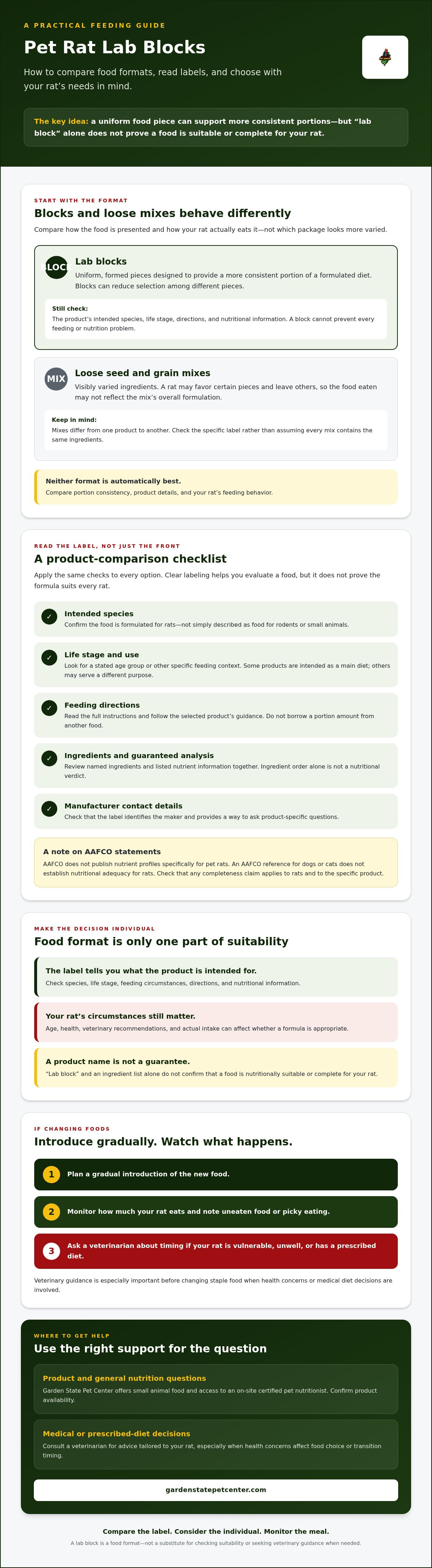
A lab block is a uniform, formed piece of food made to provide a consistent portion of a formulated diet. Pet rat food lab blocks can make servings more uniform than a loose mix, but the product name alone doesn’t confirm that a food is nutritionally suitable or complete for your rat.
Pet rats are domesticated brown rats, but their needs can still differ by age and health. Treat a block as a food format, not a guarantee. Check the label and consider your individual rat’s circumstances before choosing a staple.
For a general overview of feeding pet rats, watch this video:
How Lab Blocks Differ from Seed and Grain Mixes
Blocks come as similarly shaped pieces, while loose mixes contain visibly varied ingredients. Ingredients differ from one mix to another, so check the specific label rather than assuming every mix contains the same seeds or grains. A rat may favor certain pieces and leave others, which means the food eaten may not reflect the mix’s overall formulation. Blocks can reduce this kind of selection among pieces, but they can’t prevent every feeding or nutrition problem. Product suitability and your rat’s actual intake still matter.
Are Lab Blocks a Complete Everyday Food?
Some products are intended as a main diet, while others may have a different purpose. Don’t infer completeness from the words “lab block” or from an ingredient list alone. Check the label for the intended species and life stage, feeding directions, and any nutritional adequacy statement. Confirm that a completeness claim applies to rats and to the specific product. A statement for another species does not establish that the food is suitable for rats. AAFCO doesn’t publish nutrient profiles specifically for pet rats, so an AAFCO reference for dogs or cats doesn’t establish adequacy for rats.
Age, health, and veterinary recommendations can affect whether a formula is appropriate. If your rat has a health concern or a prescribed diet, ask a veterinarian before changing its staple food. For general category browsing, Garden State Pet Center lists dry dog food. That page is for dogs, not a recommendation for feeding rats.
How to Compare Pet Rat Food Lab Blocks by Label and Formulation
Start with the label, not the bag design or front-of-package claims. For each option, check whether it is intended for rats, note any stated life stage or feeding circumstance, and see whether the directions and manufacturer details are clear. Applying the same checks to every product makes the comparison more useful.
- Intended species: Confirm the food is formulated for rats, not simply described for rodents or small animals without further detail.
- Life stage and use: Look for an age group or other specific feeding context.
- Feeding directions: Read the full instructions and follow the selected product’s guidance rather than borrowing a portion amount from another food.
- Ingredients and guaranteed analysis: Review the named ingredients and listed nutrient information together.
- Manufacturer contact details: Check that the label identifies the maker and provides a way to ask product-specific questions.
Clear labeling helps you evaluate a food, but it doesn’t prove that the formula suits every rat. Transparency makes products easier to compare. Suitability still depends on the specific food and the individual animal.
Which Ingredients and Nutrition Details Should Owners Check?
Ingredient names provide context about what a formula contains, and their order reflects how they’re listed on the label. But ingredient order alone isn’t a nutritional verdict. Consider the full formulation rather than praising or dismissing one ingredient in isolation. The guaranteed analysis reports selected nutrient levels and can help you compare similar information across products. Don’t treat a few figures as proof that one food is best. Ask an exotic-animal veterinarian about an ingredient that’s unclear or may matter to your rat’s health.
How to Read Feeding Directions and Life-Stage Information
Check whether the directions address your rat’s age or another relevant circumstance, then follow the instructions for that specific food. Avoid applying a universal quantity across different formulations. If the label discusses growing, older, pregnant, or unwell rats, use that as a reason to verify suitability with a qualified veterinary professional, especially if your rat has a health concern or is on a prescribed diet.
Use this checklist to compare pet rat food lab blocks without letting appealing packaging or a single prominent claim make the decision for you. To browse general options, Garden State Pet Center’s small animal food category is a relevant place to start. Confirm whether a particular food is suitable for rats and currently available.
Lab Blocks vs. Rat Food Mixes: Which Choice Fits Your Rat?
Neither format is automatically the better choice. The food’s formulation matters, as does how your rat eats it and whether you can monitor intake. Use this comparison to identify practical trade-offs, then check the specific product label and your rat’s feeding behavior.
| Consideration | Lab blocks | Loose mixes |
|---|---|---|
| Format | Uniform, formed pieces. | A blend of visible ingredients that varies by product. |
| Portion consistency | Similar pieces can make portions easier to measure, though rats may still leave food uneaten. | Portions contain different ingredients, and the mix may not be eaten in the same proportions it was packaged. |
| Selective eating | There are fewer distinct ingredients to pick through, but this doesn’t guarantee a rat will eat the full ration. | A rat may prefer certain pieces and leave others, but selective eating isn’t inevitable. |
| Label checks | Check the intended species, life stage, feeding directions, and nutritional information. | Check those same details, along with what ingredients the mix contains and whether its directions describe a complete diet or another use. |
When a Uniform Block Format May Be Practical
A uniform format may simplify portioning and make leftovers easier to spot. Start with the amount directed on the label, then observe what your rat actually eats. In a group, the bowl alone won’t show which individual has eaten, so watch feeding when practical and note changes in appetite or body condition. Blocks aren’t a guaranteed health benefit, and an uneaten ration still needs attention. Ask a veterinarian if appetite, weight, or health changes.
When Owners Consider Mixes or Dietary Variety
Some owners prefer the visible variety of a mix. If you choose one, monitor whether your rat eats a range of ingredients or consistently leaves particular pieces behind. Enrichment and treats can add interest, but extras shouldn’t displace a nutritionally appropriate staple or make the overall diet unbalanced. Choose additions with care, and ask an exotic-animal veterinarian whether a particular food is suitable, especially if your rat has health concerns.
For either format, assess the formulation and feeding pattern rather than relying on appearance alone. Garden State Pet Center’s small animal food collection is a general category to browse. Check product details and availability before assuming a rat-specific option is offered.
How to Choose, Introduce, and Monitor Rat Lab Blocks
Make the decision in stages: assess your rat, check the product, choose a suitable food, and observe how your pet responds. A consistent routine can help you notice changes, but it can’t identify their cause. Follow a veterinarian’s guidance for individual health or nutrition concerns.
A Practical Checklist Before Buying
Before selecting pet rat food lab blocks, work through these checks:
- Assess the rat: Consider age, current health, and any diet recommendations from your veterinarian.
- Confirm intended use: Check that the food is intended for rats and appropriate for your animal’s life stage.
- Inspect the package: Look for intact packaging, clear storage instructions, and legible expiry information.
- Read feeding directions: Use the directions for that specific food rather than applying a quantity from another product.
- Resolve questions: Contact the manufacturer or a qualified professional if formulation or label details are unclear.
A label can guide your comparison, but it can’t account for every rat’s needs. If your pet is unwell, has a known health issue, or follows a prescribed diet, consult a veterinarian before choosing or changing food.
Changing Food and Watching for Problems
Avoid switching foods abruptly unless a veterinarian advises otherwise. A gradual change may help a rat accept a new food, but follow veterinary guidance on timing and method, especially for young, older, unwell, or otherwise vulnerable rats. If your rat refuses the new food or eats noticeably less, don’t assume it’s simply being fussy.
During the change, observe appetite, body condition, and droppings. These notes can help you describe what you’ve seen, but they aren’t a diagnosis. In a multi-rat home, watch each rat separately when practical because shared bowls make individual intake difficult to judge. Note who is eating and any changes, rather than relying only on how much food remains.
Seek veterinary advice promptly for appetite changes, weight loss, or signs of illness. Contact a veterinarian if you’re concerned. Don’t wait for monitoring notes to explain the problem.
For general browsing, explore Garden State Pet Center’s small animal food category. Check product details and current availability directly, as rat-specific lab blocks aren’t confirmed. For medical diet decisions, rely on a qualified veterinarian.
Where to Get Help Choosing Pet Rat Food Lab Blocks
A thoughtful choice depends on four things: whether the food suits your rat, how clearly the label explains its use, how your rat actually eats it, and whether a professional should weigh in. No single package claim can answer all four. Check current product details and availability rather than assuming a retailer carries a particular rat food.
Garden State Pet Center offers a small animal food category and has an on-site certified pet nutritionist. You can ask product questions and get help considering food options. The nutritionist is not a veterinarian, and retail nutrition guidance can’t diagnose or treat a medical condition.
When to Ask a Veterinarian or Nutrition Professional
Contact an exotic-animal veterinarian about a rat with a medical condition, unexplained weight changes, persistent appetite concerns, or other signs of illness. Bring the food label and a simple record of what your rat eats, any recent diet changes, and observations about appetite and weight. These details can inform a veterinary discussion, but they don’t replace an examination or professional diagnosis.
A nutrition professional may help you understand product information and compare options. Keep medical decisions with a qualified veterinarian, especially if your rat needs a therapeutic diet or has become unwell.
A Reliable Final Check Before You Choose
Before buying pet rat food lab blocks, review the package and your notes one more time:
- Does the label identify rats as the intended species and clarify the relevant life stage or feeding circumstances?
- Are the complete feeding directions and storage details clear?
- Does the food’s stated purpose fit the advice you’ve received for your individual rat?
- Have you confirmed current availability and any product details that remain unclear?
For broader food-selection context, read Garden State Pet Center’s complete premium pet food guide. It offers general guidance, not rat-specific veterinary advice, so use your veterinarian’s recommendations for decisions about your rat’s health.
Browse the small animal food options and ask about product details that matter to your selection. Confirm whether a specific rat food is currently available, then make your choice based on the label, your rat’s feeding behavior, and qualified professional guidance where needed.
Choose a Rat Diet With Confidence
The right choice isn’t determined by whether food comes as blocks or a mix. Match the product’s intended species and life stage to your rat, read the full label and feeding directions, and consider how your pet actually eats. Introduce any change thoughtfully, monitor appetite and body condition, and contact a veterinarian about health concerns or unexplained changes.
For questions about food options, Garden State Pet Center offers small animal food and has an on-site certified pet nutritionist available at the store. The team can help with product questions, while a veterinarian should guide medical diet decisions. Specific pet rat food lab blocks aren’t confirmed as currently available, so check product details before choosing. Pet supplies are available for nationwide shipping.
Browse small animal food and contact our team with product questions. Check the label and confirm that a food fits your rat’s needs before making a change.
Frequently Asked Questions
Are lab blocks a good everyday food for pet rats?
They can be an everyday staple if the specific food is formulated for rats and its label supports that use. Check the intended life stage, feeding directions, and any nutritional adequacy statement instead of relying on “lab block” as proof of completeness. AAFCO doesn’t publish nutrient profiles specifically for pet rats, so a dog or cat AAFCO statement doesn’t confirm a food is nutritionally adequate for rats. Ask your veterinarian about your rat’s individual needs.
What is the difference between rat lab blocks and a seed mix?
Lab blocks are uniform, formed pieces, while a seed mix contains varied ingredients that differ by product. A rat can choose among the visible pieces in a mix, and some rats may favor certain ingredients and leave others. Blocks offer a more uniform format, but don’t guarantee that a rat will eat its full ration or that the food is suitable. Assess the specific formulation and your rat’s eating behavior, not just the format.
Can rats eat only lab blocks?
That depends on the product’s formulation and feeding directions. Some foods may be intended as a complete staple, while others may call for additional foods or have a different purpose. Don’t assume every block is suitable as the sole diet. Check the label and ask an exotic-animal veterinarian if your rat has health concerns, is on a prescribed diet, or needs a tailored feeding plan. Keep fresh water available.
How do I choose lab blocks for a young or older rat?
Choose a food whose label identifies it as appropriate for your rat’s life stage, then compare its feeding directions and stated purpose. Don’t select a formula based only on a general claim about age or a nutrient number in isolation. Growing rats and older rats may have different needs, and health can affect suitability. Ask an exotic-animal veterinarian for guidance if your rat’s age or condition raises questions.
How should I switch my rat to a new lab block food?
Avoid changing foods abruptly unless your veterinarian advises it. A gradual transition may help your rat accept the new food, but ask your veterinarian about timing, especially if your rat is young, older, unwell, or otherwise vulnerable. Follow the new food’s feeding directions and watch how much your rat eats. If appetite drops or your rat seems ill, contact a veterinarian rather than assuming the adjustment is routine.
What should I do if my rat refuses lab blocks?
First, check whether the food is fresh, stored as directed, and intended for your rat’s life stage. Note how much your rat eats and whether the refusal began after a diet change. Don’t let a rat go without food while trying to force acceptance. Persistent appetite changes, weight loss, or illness warrant prompt veterinary advice, since refusal may reflect more than food preference.
Are all rat lab block brands nutritionally the same?
No. Formulas can differ in ingredients, nutrient information, intended life stage, feeding directions, and stated purpose. Compare the full labels rather than relying on brand reputation, packaging, or one prominent claim. Ingredient order and guaranteed-analysis values offer context, but neither alone proves suitability. Check that claims apply to rats, ask the manufacturer about unclear details, and ask a veterinarian about medically relevant nutrition questions.

Article by
Victor Santucci
Victor Santucci is the owner of Garden State Pet Center in Audubon, NJ, where he specializes in premium pet nutrition, exotic animals, and expert-level care. With years of hands-on experience and a passion for helping pets thrive, Victor is dedicated to educating pet owners on proper nutrition, enrichment, and species-specific care. His mission is simple: provide every pet with the highest quality products and every customer with honest, knowledgeable guidance.
Share this post
- 0 comment
- Tags: feeding rats, pet rat food lab blocks, pet rats, rat care, rat food, rat nutrition, small pet care