

Raw vs. Freeze-Dried Cat Food: A Complete 2026 Comparison Guide
The freeze-dried bag on the shelf and the frozen raw patty in the freezer might look like completely different products, but here's the counterintuitive truth: when it comes to core nutrition, they're far more alike than they are different. The real debate in the raw vs freeze-dried cat food conversation isn't about which one is healthier. It's about which one fits your life, your kitchen, and your cat's preferences.
If you've stood in the pet food aisle feeling genuinely confused by words like "biologically appropriate," "whole prey," or "minimally processed," you're not alone. The marketing language around premium cat diets can make a straightforward decision feel overwhelming, and legitimate concerns about food safety or daily convenience only add to the noise.
This guide cuts through all of it. You'll walk away with a clear, honest breakdown of how both formats compare nutritionally, what the actual safety risks look like, and how to build a feeding plan that works for your household without compromise. Whether you're transitioning a finicky cat to a new diet or simply want to make a more informed choice, you're in the right place.
Key Takeaways
- The raw vs freeze-dried cat food debate is less about nutrition and more about lifestyle fit — both formats can deliver biologically appropriate diets, but each comes with distinct trade-offs in convenience, safety, and cost.
- Cats are obligate carnivores whose evolutionary biology makes high-moisture, protein-rich diets a genuine health necessity — not a premium upgrade — and understanding this changes how you evaluate every food label.
- Nutrient retention and palatability differ in ways that matter: learn which format better preserves key enzymes and amino acids, and why your cat's texture preference could be the deciding factor.
- A rushed diet transition is one of the most common mistakes cat owners make — a structured 14-day schedule can prevent digestive upset and dramatically improve your cat's chances of accepting a new diet long-term.
- Working with a certified pet nutritionist takes the guesswork out of the switch entirely, helping you match your cat's specific health profile to the right brand and format from day one.
The Rise of Biologically Appropriate Feline Diets
Your cat's ancestors didn't wait for a bowl to be filled. The African wildcat (Felis lybica), the direct ancestor of every domestic cat alive today, evolved over millions of years as a solitary desert hunter, surviving almost exclusively on small prey animals. That evolutionary heritage didn't disappear when cats moved indoors. It's encoded in their biology, and it's the foundation of every serious conversation about raw vs freeze dried cat food.
The term "biologically appropriate" gets used liberally in pet nutrition marketing, but it has a specific meaning worth understanding. In the context of 2026 feline nutrition standards, a biologically appropriate diet closely mirrors the macronutrient profile, moisture content, and ingredient quality of what a cat would consume in the wild: high animal protein, moderate fat, minimal carbohydrates, and significant moisture. It's not a trend. It's a return to what feline physiology actually requires.
What Is an Obligate Carnivore?
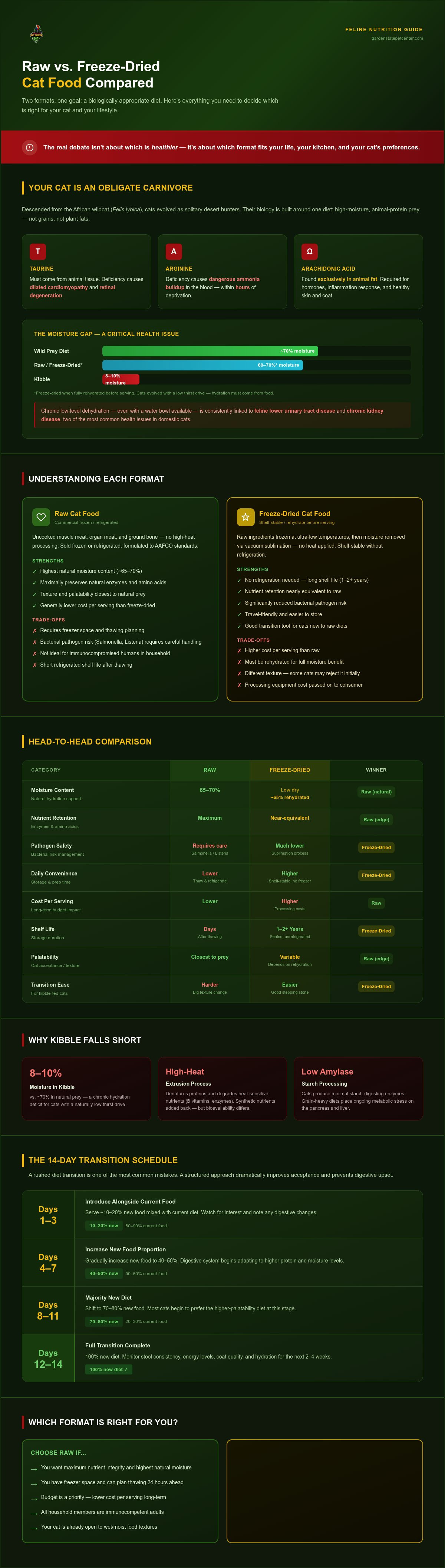
Obligate carnivore means a cat cannot thrive on plant-based nutrition. It's a metabolic reality, not a preference. Unlike omnivores, cats lack sufficient hepatic enzymes to synthesize certain amino acids from plant sources. Two of the most critical are taurine and arginine. Taurine deficiency leads to dilated cardiomyopathy and retinal degeneration. Arginine deficiency can cause dangerous ammonia buildup in the blood within hours. Both must come from animal tissue because cats simply cannot manufacture adequate amounts on their own.
Animal-based fats are equally non-negotiable. Cats rely on arachidonic acid, found exclusively in animal fat, for hormone production, inflammatory response regulation, and healthy skin and coat function. They also lack the enzyme delta-6-desaturase in meaningful quantities, which means they can't efficiently convert plant-based omega fatty acids into the forms their bodies actually use. Every cell in your cat's body is built around the assumption that animal protein and fat are the primary fuel sources.
Carbohydrate processing tells the same story. Cats produce low levels of salivary and pancreatic amylase, the enzymes responsible for breaking down starches. A diet heavy in grain-based fillers doesn't just fall short nutritionally; it places ongoing metabolic stress on the pancreas and liver over time.
The Problem with Traditional Processing
Kibble dominates pet food sales, but its production method works directly against feline nutritional needs. High-heat extrusion, the process that turns raw ingredients into shelf-stable pellets, can denature proteins and degrade heat-sensitive nutrients, including certain B vitamins and naturally occurring enzymes. Manufacturers typically compensate by adding synthetic nutrients after processing, but the bioavailability of synthetic versus naturally occurring nutrients in whole food sources isn't equivalent.
The moisture gap is arguably the more urgent concern. Kibble typically contains between eight and ten percent moisture. A wild cat's prey diet delivers roughly seventy percent moisture. Cats evolved with a low thirst drive because hydration came from food, not a separate water source. Chronic low-level dehydration, even when a water bowl is available, is consistently linked by veterinary researchers to feline lower urinary tract disease and chronic kidney disease, two of the most common health issues in domestic cats.
Shifting from a convenience-first mindset to a nutrition-first approach doesn't mean accepting inconvenience. It means understanding what your cat's body is actually asking for, and then finding the format, whether raw or freeze-dried, that delivers it within the reality of your daily life. That's exactly where this comparison begins.
Defining the Options: Raw vs. Freeze-Dried Explained
Strip away the packaging and the marketing language, and both formats share one defining characteristic: neither relies on high-heat cooking to achieve its final form. That single distinction separates them from kibble and most canned foods, and it's the reason the raw vs freeze dried cat food conversation tends to attract such passionate advocates on both sides. But the two formats aren't identical, and understanding what makes each one unique is the foundation for making a genuinely informed choice.
Raw cat food in its commercial form is exactly what it sounds like: fresh or frozen animal ingredients assembled in precise nutritional ratios. A quality commercial raw diet typically combines muscle meat, organ meat (usually no more than ten percent liver to avoid vitamin A toxicity), and either ground bone or a bone-replacement mineral source. The ingredients are portioned, often into patties, medallions, or nuggets, then frozen to preserve freshness and minimize pathogen risk during storage.
Freeze-dried cat food starts from the same raw foundation, but it goes through an additional processing step that transforms it into a shelf-stable product. The result is a lightweight, moisture-free food that rehydrates quickly and delivers a nutritional profile remarkably close to its frozen raw counterpart.
The Science of Freeze-Drying
Freeze-drying is a three-phase process called lyophilization, and it's fundamentally different from dehydration or air-drying. First, the raw food is frozen solid, locking its cellular structure in place. The frozen product is then placed in a vacuum chamber, where pressure is dramatically reduced. In this low-pressure environment, the ice crystals convert directly from solid to vapor through a process called sublimation, bypassing the liquid phase entirely. No heat is applied at any stage.
This matters enormously for nutrition. Heat-sensitive vitamins like B1 (thiamine) and B12, naturally occurring digestive enzymes, and delicate omega fatty acids remain structurally intact because they're never exposed to temperatures that would degrade them. The cellular architecture of the meat is preserved rather than collapsed, which is why freeze-dried food retains its original shape and rehydrates so effectively when water is added.
The Raw Food Standard
Within the raw feeding community, two philosophies dominate the conversation. The BARF model (Biologically Appropriate Raw Food) incorporates muscle meat, organ meat, raw meaty bones, and a small percentage of vegetables or supplements to replicate a broader dietary spectrum. Prey Model Raw (PMR) takes a stricter approach, eliminating plant matter entirely and targeting a whole-prey ratio of roughly eighty percent muscle meat, ten percent organ, and ten percent bone.
For most cat owners, the more practical question isn't which philosophy is correct; it's whether a commercial product carries the "complete and balanced" designation from AAFCO (the Association of American Feed Control Officials). That label means the food meets established minimum nutrient profiles for its intended life stage, removing the guesswork from home preparation. Explore our curated selection of raw cat food to see complete and balanced options from trusted brands like SmallBatch, OC Raw, and Vital Essentials, each formulated to meet those standards without requiring you to calculate ratios at home.
The "shelf-stable raw" concept is a large part of why freeze-dried formats have surged in popularity. Cat owners get the nutritional integrity of a raw diet without requiring freezer space, careful thawing schedules, or the handling precautions that come with raw meat. For multi-pet households, travelers, or anyone managing a tight daily routine, that convenience factor is genuinely significant.
Raw vs. Freeze-Dried: The Direct Nutritional and Lifestyle Comparison
Both formats start from the same raw ingredient base, but the path each takes to your cat's bowl creates real differences worth understanding. The raw vs freeze dried cat food debate sharpens considerably when you move past general claims and look at four specific areas: nutrient bioavailability, palatability, cost, and one critical feeding rule that most guides skip entirely.
Nutrient Retention: Closer Than You'd Think
Fresh raw food preserves naturally occurring enzymes and moisture in their most intact form. Freeze-dried food, because lyophilization uses no heat, retains those same enzymes and heat-sensitive vitamins with impressive fidelity. The practical difference emerges at rehydration: a properly rehydrated freeze-dried meal delivers a nutritional profile remarkably close to its fresh counterpart. The key word is properly. Dry freeze-dried food fed without added water is nutritionally dense but moisture-deficient, which directly undermines one of the primary reasons you're feeding a minimally processed diet in the first place.
The Rehydration Rule is non-negotiable. Always add warm water to freeze-dried food before serving. A rough starting point is equal parts food and water by volume, though individual brands publish their own recommended ratios. Skipping this step turns a premium diet into a hydration liability for a species already prone to chronic under-drinking.
Palatability: Your Cat Gets a Vote
Texture drives feline food acceptance more than most owners expect. Cats who've eaten fresh prey or raw food often respond enthusiastically to the moist, meaty texture of thawed raw patties. Others, particularly cats transitioning from kibble, find the familiar crunch of dry freeze-dried pieces far easier to accept. Neither preference is wrong. It's biological individuality, and it's a legitimate factor in choosing a format. If your cat refuses one, try the other before concluding they won't eat a minimally processed diet at all.
Cost: The Full Picture
Premium raw and freeze-dried diets from brands like Vital Essentials and OC Raw represent a meaningful investment compared to conventional kibble. Freeze-dried products typically carry a higher per-ounce price point than frozen raw, partly because the lyophilization process itself is energy-intensive. That said, freeze-dried food is calorie-dense, so serving sizes are smaller than they appear. Calculate cost per serving, not per bag, before drawing conclusions. For many households, the convenience premium of freeze-dried is worth it; for others, frozen raw delivers equivalent nutrition at a lower weekly cost.
Safety and Hygiene Protocols
Bacterial contamination is the most common concern raised about raw feeding, and it deserves a direct answer rather than dismissal. Many commercial raw brands now use High-Pressure Processing (HPP), a cold-water pressurization method that significantly reduces pathogen load without heat or chemical additives. Brands like SmallBatch use HPP specifically to address this concern while preserving nutritional integrity.
Regardless of HPP status, safe handling practices matter:
- Use stainless steel bowls exclusively; they're non-porous and far easier to sanitize than plastic or ceramic alternatives
- Apply a 20-minute feeding window; discard any uneaten raw food after that point to prevent bacterial growth
- Wash hands, surfaces, and utensils with hot soapy water after every meal preparation
- Thaw raw food in the refrigerator, never on the counter at room temperature
Freeze-dried food carries a meaningfully lower handling burden, which makes it the more practical choice for households with young children, elderly family members, or anyone who is immunocompromised. The reduced pathogen risk isn't just a convenience argument; for some households, it's a genuine health consideration.
Convenience and Storage
The logistics of each format couldn't be more different in daily practice. Frozen raw requires advance planning: patties typically need 24 hours to thaw safely in the refrigerator, and you'll need dedicated freezer space, often more than you'd expect for a multi-cat household. Freeze-dried food, by contrast, lives in a pantry bag and serves in under two minutes once you add water.
Travel is where freeze-dried earns its strongest case. It's the clear gold standard for cats on the move: no freezer access required, no thawing logistics, no TSA complications. A sealed bag travels as easily as any dry food while still delivering the nutritional profile of a raw diet.
Shelf life reflects that same divide. Unopened frozen raw must be used within the manufacturer's recommended freezer window, typically several months, and within a few days once thawed. Freeze-dried bags, when stored in a cool, dry place, commonly carry shelf lives of one to two years. For households managing tight freezer space or irregular feeding schedules, that pantry stability is a practical advantage that compounds over time. Browse our full selection of raw and freeze-dried cat food options to compare formats from trusted brands side by side.
Making the Transition: How to Choose the Right Path for Your Cat
Deciding between raw vs freeze dried cat food is only half the equation. The other half is execution. Even the highest-quality diet will fail if the transition is handled too quickly, and a rushed switch is the single most common reason cats reject new diets outright. Before you open a single bag or patty, two questions deserve honest answers: what's your cat's current health status, and how old are they?
Kittens and healthy adult cats generally adapt to dietary changes more readily than seniors. Older cats, particularly those managing kidney disease, hyperthyroidism, or inflammatory bowel disease, need veterinary clearance before any major dietary shift. A new diet that's nutritionally excellent for a healthy three-year-old cat may place undue metabolic strain on a fifteen-year-old with compromised organ function. Start with a vet check, then build your transition plan from there.
The 14-Day Transition Schedule
Slow and steady isn't just cautious advice; it's how feline digestive systems actually work. Cats have relatively short gastrointestinal tracts and a gut microbiome that needs time to adjust to new protein sources and fat ratios. A structured 14-day approach dramatically reduces the risk of loose stools, vomiting, or outright food refusal:
- Days 1 to 3: Serve roughly 90 percent current food, 10 percent new food. Keep portions consistent with what your cat already expects.
- Days 4 to 6: Shift to a 75/25 split. Watch for any changes in stool consistency or appetite.
- Days 7 to 10: Move to a 50/50 ratio. This is where most digestive feedback becomes visible.
- Days 11 to 13: Increase the new food to 75 percent. Energy levels and coat quality often begin improving noticeably at this stage.
- Day 14: Full transition to the new diet.
Reading your cat's "bio-feedback" throughout this process is essential. Firm, well-formed stools signal the digestive system is adapting well. Soft or mucous-coated stools suggest you're moving too fast; dial back a step and hold that ratio for an extra two to three days. Coat luster and energy levels are slower indicators, typically taking four to six weeks to reflect dietary improvements, but they're among the most reliable markers of long-term success.
Freeze-dried food works particularly well as a transitional "topper." Crumbled over your cat's existing canned food, it introduces new proteins and textures without triggering the digestive disruption of a full swap. Once acceptance is established, gradually increase the freeze-dried portion while reducing the base food. This same strategy works when layering freeze-dried over raw patties for cats who prefer a mixed-texture experience.
The Role of a Pet Nutritionist
DIY raw feeding carries real risk when ratios are guessed rather than calculated. Calcium-to-phosphorus imbalances, insufficient taurine from muscle-meat-only diets, and vitamin A toxicity from excess organ meat are all documented consequences of well-intentioned but unguided home preparation. A certified pet nutritionist removes that guesswork entirely.
For cats with specific health profiles, professional guidance isn't optional; it's the most efficient path to a diet that actually works. Senior cats often need adjusted protein levels and additional joint-supportive nutrients. Kittens require higher caloric density and precise calcium ratios to support skeletal development. Cats managing food allergies need a systematic protein elimination approach that's difficult to execute accurately without professional structure. Garden State Pet Center's on-site certified pet nutritionist offers exactly this kind of tailored consultation, matching your cat's individual health profile to the right brand and format from the very first conversation. For a deeper look at how specialized nutrition is approached for cats with complex needs, read our complete guide to specialized nutrition.
Troubleshooting Picky Eaters
Some cats genuinely don't recognize raw meat as food. This is the "imprinting" phenomenon: cats who've eaten only processed kibble for years have been conditioned to respond to specific aromas, textures, and flavors that bear little resemblance to fresh animal protein. It's not stubbornness. It's a learned response, and it can be unlearned with patience.
Two additions tend to break through imprinting resistance effectively. A small pour of unsalted bone broth over a new food introduces familiar, savory aromatic compounds that trigger appetite. Goat milk, which is naturally lower in lactose than cow's milk and tolerated by most cats, works similarly as a palatability bridge when mixed into rehydrated freeze-dried food. Start with just a teaspoon and adjust based on your cat's interest.
Temperature is the variable most guides overlook entirely. Cats are wired to respond to the scent profile of fresh prey, which is warm. Cold food straight from the refrigerator suppresses aroma and often gets rejected on that basis alone. Gently warming raw or rehydrated freeze-dried food to approximately body temperature, around 100 degrees Fahrenheit, can trigger a feeding response in cats who've refused the same food served cold. Don't microwave; use warm water in a bowl beneath the food dish instead. Browse our full selection of raw and freeze-dried cat food options to find the right starting point for your cat's transition.
Expert Feline Nutrition at Garden State Pet Center
Knowing the difference between raw vs freeze dried cat food is one thing. Finding a trusted source that stocks the right brands, answers your specific questions, and supports your cat's health beyond the initial purchase is another entirely. That's where Garden State Pet Center stands apart from every generic pet retail option.
Why Shop with Garden State Pet Center?
Garden State Pet Center isn't a big-box retailer stocking whatever moves fastest off shelves. It's a specialized pet store built around one principle: every animal deserves nutrition matched to its biology. That philosophy shapes every brand on the floor.
The curated feline selection includes some of the most trusted names in minimally processed nutrition:
- SmallBatch — frozen raw patties and freeze-dried options using HPP cold-water pressurization for pathogen reduction without heat
- OC Raw — complete and balanced raw formulas built around whole animal ingredients with clean, minimal ingredient lists
- Vital Essentials — freeze-dried raw minis and patties with a strong track record for palatability in cats transitioning from processed diets
- Instinct, Rawz, Farmina, Open Farm — additional options spanning freeze-dried, raw, and gently cooked formats to accommodate every health profile and budget
These aren't brands selected for margin. They're brands selected because they consistently meet the nutritional standards that obligate carnivore biology actually demands. Supporting a locally-owned business with nationwide reach means your purchase funds specialized expertise, not a corporate distribution algorithm. Shop our complete feline nutrition collection to explore the full range.
The on-site certified pet nutritionist is the resource that genuinely separates this store from every online-only competitor. When your senior cat needs adjusted protein levels, or your kitten requires precise calcium ratios for skeletal development, or your rescue won't touch anything that isn't kibble-shaped, a product page can't help you. A qualified professional who knows the brands, understands the science, and has worked through these exact scenarios can. Consultations translate directly into fewer wasted bags, faster acceptance, and measurable improvements in your cat's coat, energy, and long-term health.
Start Your Cat's Nutritional Journey Today
Getting started is straightforward. Reach out to the Garden State Pet Center team to book a nutritional consultation, bring your cat's current diet details, any known health conditions, and your daily routine, and walk away with a concrete plan rather than a shelf full of guesswork. Nationwide shipping means consistent access to your cat's chosen diet regardless of where you live, removing the frustrating cycle of substituting brands mid-transition when a local store runs out of stock.
The conversation doesn't stop after the first purchase, either. Garden State Pet Center's community of pet owners spans exotic bird keepers, reptile enthusiasts, and dedicated cat owners who share a common standard: their animals deserve better than average. Joining that community means ongoing access to practical guidance as your cat's needs evolve across life stages.
Your cat's health is built one meal at a time. Browse our premium cat food selection and transform your cat's health with brands and expertise you can rely on.
Your Cat's Best Diet Starts with One Good Decision
The raw vs freeze dried cat food debate doesn't have a universal winner, and that's actually good news. It means the right answer is the one that fits your cat's biology, your household's routine, and your commitment to consistency. Both formats deliver what an obligate carnivore genuinely needs: animal protein, healthy fat, and real moisture, without the compromises baked into conventional kibble.
Three things matter most as you move forward. Choose a complete and balanced formula from a trusted brand. Transition slowly using the 14-day schedule. And don't guess when your cat's health profile calls for professional input.
That's where Garden State Pet Center makes a real difference. Family-owned and operated since 1990, with an on-site certified pet nutritionist, a curated lineup of premium brands, and nationwide shipping to keep your cat's diet consistent wherever you are, this isn't a generic retailer. It's a knowledgeable partner invested in your cat's long-term health.
Shop our curated selection of premium raw and freeze-dried cat food and give your cat the nutrition their biology has always been asking for.
Frequently Asked Questions About Raw vs. Freeze-Dried Cat Food
Is freeze-dried cat food really raw?
Yes, freeze-dried cat food is genuinely raw. The lyophilization process removes moisture through sublimation in a vacuum chamber without applying heat at any stage, which means the original raw ingredients remain structurally and nutritionally intact. No cooking occurs. What you're buying is raw food with its water removed, not a processed product that merely resembles raw feeding.
Do I have to add water to freeze-dried cat food?
You should always rehydrate freeze-dried cat food before serving. Cats evolved to get most of their hydration from food, not a separate water source, so feeding freeze-dried food dry defeats one of the core benefits of choosing a minimally processed diet. Add warm water before every meal, following the brand's recommended ratio as a starting point. Most brands suggest roughly equal parts food and water by volume.
Can I mix raw and freeze-dried cat food together?
Mixing both formats is not only fine, it's a practical strategy many cat owners use successfully. Rehydrated freeze-dried food layered over a raw patty can improve palatability for cats who prefer varied textures, and it's a useful approach during transitions. Just ensure both products carry an AAFCO "complete and balanced" designation so you're not inadvertently creating nutritional gaps by combining two complementary-but-incomplete formulas.
Is raw cat food safer than kibble regarding bacteria?
The honest answer is that raw food does carry a higher inherent bacterial risk than heat-processed kibble, but that risk is manageable with proper handling and smart brand selection. Many reputable brands use High-Pressure Processing (HPP) to significantly reduce pathogen load without heat. Stainless steel bowls, a 20-minute feeding window, and refrigerator thawing rather than counter thawing address most practical risks. Households with immunocompromised members may find freeze-dried formats a more appropriate choice.
How much more expensive is freeze-dried cat food compared to raw?
Freeze-dried options typically carry a higher per-ounce price than frozen raw, partly because lyophilization is an energy-intensive manufacturing process. That said, freeze-dried food is calorie-dense, so actual serving sizes are smaller than they appear. Before comparing formats on price, calculate the cost per serving rather than per bag or per ounce. For some households, the convenience trade-off justifies the difference; for others, frozen raw delivers equivalent nutrition at a lower weekly cost.
Will a raw or freeze-dried diet help my cat lose weight?
Both formats can support healthy weight management because they're high in animal protein and low in the carbohydrates that contribute to fat storage in cats. Protein-rich diets support lean muscle retention during caloric restriction better than high-carbohydrate alternatives. That said, portion control still matters regardless of food quality. If your cat has a significant amount of weight to lose, a consultation with a certified pet nutritionist is the most reliable way to establish appropriate serving sizes for their specific body condition.
What should I look for on the label of a raw vs. freeze-dried cat food?
Start with the AAFCO statement confirming the food is "complete and balanced" for your cat's life stage. Next, check that a named animal protein appears as the first ingredient, not a by-product meal or plant-based filler. Look for a clear organ meat percentage to avoid vitamin A toxicity from excess liver. For raw formats, an HPP notation indicates the brand has addressed pathogen reduction. Brands like SmallBatch, OC Raw, and Vital Essentials are good benchmarks for what a clean, transparent label should look like.

Article by
Victor Santucci
Victor Santucci is the owner of Garden State Pet Center in Audubon, NJ, where he specializes in premium pet nutrition, exotic animals, and expert-level care. With years of hands-on experience and a passion for helping pets thrive, Victor is dedicated to educating pet owners on proper nutrition, enrichment, and species-specific care. His mission is simple: provide every pet with the highest quality products and every customer with honest, knowledgeable guidance.
Share this post
- 0 comment
- Tags: cat diet comparison, cat feeding guide, cat health, cat nutrition, freeze-dried cat food, obligate carnivore, premium cat food, raw cat food, raw feeding, raw vs freeze dried cat food