

Interactive Bird Toys: The 2026 Guide to Avian Enrichment and Mental Health


What if the most expensive toy in your bird's cage is actually the one doing the least for their mental health? Many dedicated owners find themselves in a frustrating cycle, watching their clever parrots dismantle costly items in minutes while still displaying signs of stress or boredom. It's a common struggle that often leads to guilt during the workday and genuine concern over destructive behaviors. Choosing the right interactive bird toys isn't just about finding something durable; it's about tapping into a bird's biological drive to forage and solve problems.
We believe that every bird owner should feel like a confident partner in their pet's care. You want to see your bird engaged rather than anxious, and you need to know that the materials in their enclosure won't cause harm. This 2026 guide introduces the "Foraging-First" framework to help you select tools that challenge your parrot's specific intelligence level. You'll learn how to navigate the latest EN 71-1:2026 safety standards and implement enrichment strategies that foster a calm, mentally stimulated environment for your feathered friend.
Key Takeaways
- Understand the biological drive for foraging and why mimicking natural behaviors is the key to reducing stress and boredom in parrots.
- Explore specialized categories of interactive bird toys, including mechanical puzzles and clear acrylic foraging devices designed to challenge high-level intelligence.
- Learn to identify and avoid toxic materials like lead and zinc while selecting avian-safe woods like balsa, pine, and manzanita for your pet.
- Master techniques for managing neophobia and safely introducing new enrichment tools using the "Success First" method to build your bird's confidence.
- Discover how to pair mental stimulation with premium nutrition to support a holistic lifestyle that promotes long-term physical and mental health.
The Science of Avian Enrichment: Why Birds Need Interactive Play
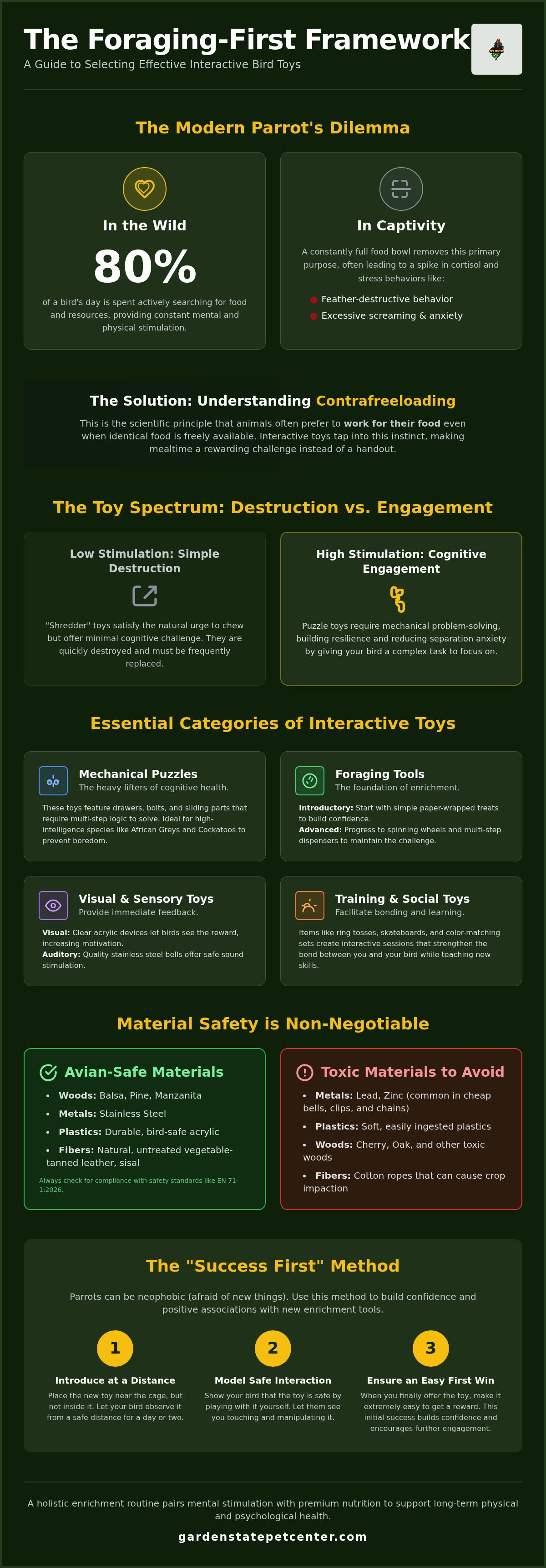
Parrots possess a cognitive capacity that rivals non-human primates and human toddlers. They can solve multi-step problems, recognize patterns, and even communicate complex needs. This high intelligence means they don't just want food; they need a purpose. In the wild, a bird spends up to 80% of its day searching for resources. When we provide a full bowl of seed without any effort required, we strip away their primary occupation. This lack of activity leads to a spike in cortisol levels, often resulting in stress-induced behaviors like feather-destructive behavior or excessive screaming.
To combat this, owners must integrate interactive bird toys into the daily routine. Unlike a static perch or a simple swing, an interactive toy requires a specific physical or mental action to produce a sensory or nutritional reward. It turns mealtime into a game and a workout. By providing these challenges, you're not just buying a toy; you're investing in your bird's psychological stability.
The Concept of 'Contrafreeloading' in Birds
Ethologists have long observed a phenomenon called "contrafreeloading." This is the tendency for animals to choose food that requires effort over identical food offered for free. For a parrot, the act of solving a puzzle to reach a nut is inherently more satisfying than finding that same nut in a dish. Avian enrichment is the provision of environmental stimuli that allow for natural behaviors. By using specialized gear, you satisfy the deep-seated foraging instinct that keeps their minds sharp. You can find a variety of these tools in our bird collection to start your bird on a healthier path.
Cognitive Stimulation vs. Simple Destruction
It's vital to distinguish between different types of play. While "shredder" toys satisfy the urge to chew, they are often disposable and offer little mental challenge. True behavioral enrichment involves puzzles that require mechanical problem-solving. High-intelligence species like African Greys or Cockatoos need escalating difficulty levels to prevent them from "solving" the environment too quickly. These mechanical toys help reduce separation anxiety by giving the bird a complex task to focus on while you're away. Instead of worrying about your absence, they're focused on the drawer, lock, or sliding compartment standing between them and their favorite treat. This mental fatigue leads to a calmer, quieter companion during the evening hours.
Essential Categories of Interactive Bird Toys
Providing a variety of interactive bird toys ensures your parrot doesn't just destroy their environment but learns to manipulate it. Mechanical puzzles are the "heavy lifters" of cognitive health. These toys feature drawers, locks, and sliding compartments that require logical steps to open. For example, a bird might need to unscrew a bolt before a drawer will slide out. This type of play builds resilience and mimics the complex problem-solving birds face in the wild. It's about moving beyond simple destruction toward genuine mental engagement.
Auditory and sensory toys provide immediate feedback, which is vital for maintaining focus. High-quality stainless steel bells offer a pleasant sound without the risk of lead or zinc poisoning found in cheaper alternatives. Motion-activated sound modules can also provide comfort and stimulation for birds left alone during the workday. These tools help create a dynamic environment where every movement can lead to a new discovery. For birds that enjoy visual stimulation, clear acrylic foraging devices are excellent because they let the bird see the reward, building motivation and reducing frustration during the learning phase.
Foraging Tools: The Foundation of Enrichment
Foraging is the cornerstone of avian mental health. Start with "introductory foraging" using simple cardboard boxes or paper-wrapped treats to build confidence. This allows your bird to succeed quickly and understand the concept of working for a reward. As your bird improves, transition to advanced tools like spinning wheels or multi-step dispensers. These sophisticated interactive bird toys link successful problem-solving directly to their Parrot Food, making high-value rewards the prize for their hard work. It's a natural way to keep them active and engaged throughout the day.
Social and Training-Based Interactive Toys
Interaction shouldn't stop at the cage bars. Training-based toys like skateboards, ring tosses, and color-matching sets facilitate bonding between you and your pet. Using target sticks and clickers allows you to build a shared language of trust and communication. Interactive gymnasiums also encourage physical movement, preventing the sedentary lifestyle that leads to health issues. These social toys transform your bird from a passive observer into an active participant in the household. You can browse our curated selection of bird toys and accessories to find safety-vetted options that match your bird's specific intelligence level.
Safety and Materials: Choosing Avian-Safe Interactive Gear
Safety isn't just a feature; it's the foundation of any enrichment program. While interactive bird toys are essential for mental health, the materials used in their construction can pose significant risks if not properly vetted. Many mass-produced items found on large retail sites prioritize low costs over avian welfare, often using "zinc-plated" hardware that can lead to heavy metal poisoning. We act as an expert filter to ensure that only the safest components enter your bird's environment.
Heavy metals like lead and zinc are the most common invisible threats in toy hardware. Birds explore their world with their beaks, meaning any metal component will be tasted, licked, and chewed. Zinc is frequently found in cheap clips, wires, and bells. To ensure total safety, prioritize items that utilize high-quality stainless steel components. This material is non-reactive, durable, and stands up to the powerful beak pressure of larger parrots.
Wood choice is another critical factor for safety. Balsa is excellent for smaller birds or those who enjoy soft textures, while pine and manzanita offer more resistance for power-chewers. Always avoid pressure-treated woods or those with unknown finishes, as these often contain arsenic or other toxic chemicals. Size-appropriateness also matters. A toy designed for a Cockatiel might have small parts that a Macaw could easily swallow, while a toy for a Macaw might feature gaps that could trap a smaller bird's head or feet.
The Avian-Safe Hardware Checklist
- Choose stainless steel for all chains, quick links, and fasteners.
- Avoid "jingle" bells with open slits, as these can trap beaks or contain lead clappers.
- Look for solid "tube" bells or those with welded clappers for safer auditory stimulation.
- Ensure all plastic components are made from high-impact, BPA-free acrylic.
'Non-toxic' labels on general pet toys are often insufficient for the sensitive respiratory systems of birds. Always look for products specifically designed for avian use.
Monitoring and Maintenance
Rope safety requires constant vigilance. Cotton is popular for its soft feel, but it easily frays into long, thin strands that can cause crop impaction or wrap around a bird's neck. Use natural fibers like sisal, abaca, or seagrass instead. These materials break down into shorter, safer fibers that are less likely to cause entanglement. Regular toy audits are mandatory, especially for aggressive chewers. Check for cracked acrylic in foraging puzzles and remove any toy that shows significant fraying or sharp edges. Clean your food-dispensing interactive bird toys using bird-safe sanitizers to prevent bacterial growth. You can find reliable, safety-vetted gear in our bird collection to keep your pet's environment secure.
Implementation: Introducing and Rotating Enrichment Tools
Even the highest quality interactive bird toys are ineffective if your bird is too intimidated to touch them. Neophobia, or the fear of new objects, is a common survival instinct in avian species. Because birds are prey animals, a strange shape or bright color in their territory can trigger a stress response. To overcome this, we recommend the "Success First" method. This involves starting with simple puzzles that offer an immediate, visible reward. When a bird learns that interacting with an object leads to a positive outcome, their confidence grows, making them more likely to tackle complex mechanical challenges later.
Observation is your best tool for long-term success. Every bird has a unique "play style." Some parrots are natural "shredders" who prefer to dismantle soft woods, while others are "problem solvers" who enjoy the mechanical logic of drawers and sliders. By watching how your pet approaches a new challenge, you can tailor your enrichment strategy to their specific preferences. This personalized approach reduces frustration and ensures that the toys you provide actually meet their cognitive needs.
The 3-Step Introduction Protocol
Introducing a new toy should be a gradual process that respects your bird's comfort zone. Follow these three steps to ensure a smooth transition:
- Step 1: Visual Acclimation. Place the toy on a table or stand near the cage, but not inside it. Let your bird observe the object from a safe distance for a day or two.
- Step 2: Guided Interaction. Bring the toy closer during out-of-cage time. Use high-value treats from our Bird Shop to lure the bird toward the toy, rewarding any curiosity or touch.
- Step 3: Supervised Placement. Once the bird is comfortable, hang the toy in the cage. Monitor their initial interactions to ensure they don't get a beak or toe caught in any moving parts.
Scheduling Your Rotation
Novelty is the fuel of mental stimulation. If a toy stays in the cage for months, it becomes part of the furniture and loses its enrichment value. We suggest a weekly or bi-weekly rotation to keep the environment fresh. You don't need to buy new items constantly; instead, maintain a "toy library" where you swap out three or four items at a time. Creating "toy themes," such as Foraging Monday or Puzzle Thursday, can also add a predictable but exciting rhythm to their week. Explore our full range of bird toys and accessories to build a diverse library that keeps your parrot engaged year-round.
Building a Complete Enrichment Routine for Your Parrot
A successful enrichment routine is much more than a collection of gadgets; it's a holistic lifestyle that supports every facet of your bird's health. While interactive bird toys provide the mental spark, they must be integrated into a day that includes flight time, social interaction, and proper hygiene. Foraging is a particularly effective tool for weight management and physical fitness. Instead of sitting stationary at a food bowl, a foraging bird must climb, hang, and use their core muscles to access their meal. This increased activity helps prevent obesity, a leading health concern for captive parrots.
Professional diagnostics also play a vital role in tailoring your bird's environment. For example, utilizing Avian DNA Sexing allows you to understand gender-specific behaviors that might influence play. Females may show increased nesting drives during certain seasons, requiring toys that satisfy the urge to shred without encouraging egg-laying. Males might benefit from high-energy training sessions that channel territorial instincts into positive problem-solving. By incorporating these diagnostics, you create a personalized care plan that respects your bird's unique biological needs.
Foraging as a Nutritional Strategy
Diet and mental stimulation are inseparable. Integrating a Premium Pet Food diet into your enrichment routine ensures your bird has the nutritional foundation required for high-level cognitive tasks. To convert a "bowl-fed" bird to a "foraging-fed" bird, start slowly. Place a portion of their daily pellets into easy-to-solve interactive bird toys right next to their traditional dish. As they gain confidence, mix in dried fruits or seeds to create complex dispensers that require minutes or hours of work. The psychological benefits of a "busy" mealtime are immense, as it significantly reduces the time available for stress-based behaviors like over-preening.
Where to Source Expert-Vetted Toys
Choosing where to buy your bird's gear is as important as the toys themselves. Specialized avian retailers offer a level of safety vetting that mass-market stores simply cannot match. We act as an expert filter, ensuring that every mechanical puzzle and foraging device meets strict standards for material safety and durability. Whether you're looking for high-impact acrylic or stainless steel components, we provide the reliable tools your bird needs to thrive. We offer nationwide shipping to help you maintain a fresh and challenging "toy library" regardless of your location. Shop our curated collection of bird toys to find your bird's next challenge and start building a more engaging routine today.
Building a Brighter Future for Your Feathered Companion
Mental stimulation is the cornerstone of a healthy life for your parrot. By shifting from passive play to a foraging-first framework, you satisfy the deep-seated instincts that keep your bird's mind sharp and body active. Remember that safety is non-negotiable; always prioritize stainless steel hardware and avian-safe materials to protect their sensitive systems. Implementing a structured rotation ensures that novelty never fades, keeping your pet engaged even when you're away from home.
Since 1990, we've provided specialized exotic bird expertise to help owners achieve the highest standards of care. We act as your trusted partner by offering only safety-vetted hardware and non-toxic materials, ensuring every selection supports long-term health. Whether you're across the country or just around the corner, our nationwide shipping brings premium interactive bird toys directly to your door. Explore our expert-vetted collection of interactive bird toys and enrichment supplies! Your bird's well-being is our passion, and we're here to help you create an environment where they can truly thrive.
Frequently Asked Questions
Are interactive toys safe for small birds like Budgies or Cockatiels?
Interactive toys are safe and highly beneficial for small birds like Budgies and Cockatiels as long as the components are scaled to their size. Small parrots are incredibly intelligent and require mental stimulation to prevent chronic stress. Look for lightweight mechanical puzzles with small drawers or paper-based foraging tasks that don't require excessive beak strength. Avoid heavy acrylics or large gaps where a small head could become trapped during play.
How do I know if an interactive toy is too difficult for my parrot?
You'll know a toy is too difficult if your bird ignores it entirely or displays signs of frustration, such as aggressive lunging or walking away. If they can't solve the first step of a multi-stage puzzle, they'll quickly lose motivation. To prevent this, use the "Success First" method by making the reward visible and easily accessible. Gradually increase the difficulty only after they've mastered simpler versions of interactive bird toys.
Can interactive toys help stop my bird from plucking its feathers?
Interactive toys can significantly reduce feather-destructive behavior by providing a constructive outlet for energy and focus. Plucking is often a result of boredom or high cortisol levels. By engaging a bird in complex foraging tasks, you redirect their attention away from their plumage and toward a rewarding problem-solving goal. While not a cure for underlying medical issues, mental enrichment is a standard recommendation for managing stress-based plucking.
What are the best materials for durable macaw toys?
The best materials for large parrots like Macaws include heavy-duty stainless steel and dense hardwoods like manzanita, java wood, or dragonwood. These birds possess immense beak pressure and can easily crush standard pine or thin acrylic. Look for toys that use welded links and thick, BPA-free plastic components. Durable interactive bird toys for Macaws should focus on mechanical complexity and structural integrity to withstand their powerful destructive instincts.
How often should I change the toys in my bird's cage?
You should rotate about 25% to 50% of the toys in your bird's enclosure every seven to fourteen days. This frequency keeps the environment novel without causing the stress associated with a total habitat overhaul. Keep a "toy library" in a separate bin and swap items out to ensure your bird always has a fresh challenge. Regular rotation prevents toys from becoming "furniture" that the bird eventually ignores or loses interest in.
Can I use regular bird seed in a foraging toy or do I need special treats?
You can certainly use regular bird seed or pellets in foraging toys, but high-value treats like almond slivers or dried papaya often provide better motivation for new puzzles. Mixing their daily food into a dispenser encourages them to spend more time "working" for their meals, which mimics natural wild behavior. For a balanced approach, use their standard diet for everyday foraging and save the special treats for complex mechanical tasks.
What should I do if my bird is terrified of a new interactive toy?
If your bird shows fear, immediately move the toy to a location where they can see it but don't feel threatened by it. This might be a table across the room or the top of their cage. Use treats to reward them for even looking at the object from a distance. Slowly move it closer over several days. This patient approach respects their natural neophobia and prevents a permanent negative association.
Are electronic bird toys worth the investment for smart parrots?
Electronic toys can be worth the investment for auditory stimulation, especially for species like African Greys that mimic sounds. However, you must ensure the electronics are encased in bird-safe, high-impact housing. Many electronic options aren't built for the destructive power of a parrot's beak. If you choose an electronic toy, use it primarily for supervised play or ensure it's a model specifically safety-vetted by experts for avian use.

Article by
Victor Santucci
Victor Santucci is the owner of Garden State Pet Center in Audubon, NJ, where he specializes in premium pet nutrition, exotic animals, and expert-level care. With years of hands-on experience and a passion for helping pets thrive, Victor is dedicated to educating pet owners on proper nutrition, enrichment, and species-specific care. His mission is simple: provide every pet with the highest quality products and every customer with honest, knowledgeable guidance.
Share this post
- 0 comment
- Tags: Avian Enrichment, Bird Mental Health, Bird Toys, Foraging, interactive bird toys, Parrot Behavior, Parrot Care, Pet Safety, Puzzle Toys